

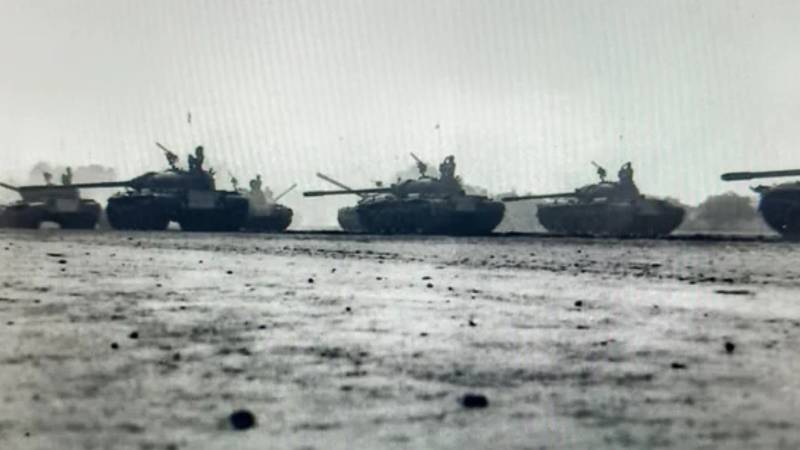
India and Pakistan, the two nuclear-armed neighbours of South Asia, have had a relationship based on mutual mistrust, hatred and animosity. Two major wars in 1965 and 1971 have been fought along with many bloody skirmishes like the Rann of Kutch, Siachen, Kargil and the latest conflict in May 2025. One of the scariest and most dangerous episodes in our history has been the Indian military exercise called Operation Brass Tacks. This crisis between the two hostile neighbours erupted between November 1986 and March 1987 after India announced the launch of the largest military exercise in this part of the world, named Operation Brass Tacks. This exercise was held in the desert areas of Rajasthan, very near the Pakistan border. This military exercise was conducted by nine infantry divisions, three armoured divisions and one air assault division, along with air support fighter aircraft.
With the launch of this exercise, alarm bells started ringing in the GHQ in Rawalpindi, and the military high command on our side saw Brass Tacks as a threatening and dangerous exhibition of conventional forces, and responded by moving its forces to the borders of Indian Punjab. International concerns spiked when Pakistani nuclear scientist Abdul Qadeer Khan was quoted as saying in March 1987 that Pakistan had a nuclear bomb. United States diplomats sought to defuse tensions between the two countries to prevent a nuclear war.
Operation Brass Tacks was spearheaded by a renowned Indian General, Krishnaswamy Sundarji, who had commanded an infantry division in the 1971 war with Pakistan. Along with the army units, the Indian Air Force and the Navy were also part of this exercise, beginning in 1986 and ending in 1987. While India claimed that these war games were merely to test and experiment with new concepts in warfare, about 600,000 troops had been amassed near the border, along with a large quantity of equipment and ammunition. These exercises were later described as “bigger than any NATO exercise and the biggest since World War II.”
In his memoirs, veteran Indian soldier Lt Gen P.N. Hoon, who fought against Pakistan in the 1965 war, described the war games as having a larger objective. “[Operation] Brass Tacks was no military exercise. It was a plan to build up the situation for a fourth war with Pakistan,” he wrote. In the backdrop of historical Pakistan-India ties, the Indian military exercise was deemed as alarming for Pakistan. Some considered these war games a threatening show of force at a very critical juncture in Pakistan-India relations. Independent observers viewed these war games as a psychological move to convey to Pakistan the superior strength of Indian nuclear capability. Some also considered it a plan to infiltrate densely populated areas inside Pakistani territory.
Operation Brass Tacks almost resulted in a full-scale war between India and Pakistan that could have resulted in a nuclear exchange. Still, the real reason behind this controversial exercise is yet to be disclosed
“General Sunderji’s strategy was to provoke Pakistan’s response, and this would provide India with an excuse to implement existing contingency plans to go on an offensive against Pakistan and take out its nuclear bomb projects in a preventive strike,” said Robert Art, an international observer, in 2009.
Military tensions between India and Pakistan are nothing new, but these tensions had accelerated rapidly in the 1970s, especially after the Indian testing of a nuclear device in Pokhran. India had begun special efforts to make its armed forces an indomitable force ever since the Pokhran nuclear tests in 1974. In response, Pakistan too had redoubled efforts to procure modern arms, ammunition and equipment in an attempt to retain strategic power balance in the region. As reports of the exercise kept pouring in, Pakistan responded with all its resources and capabilities, reiterating that the exercise was a threat to Pakistan’s integrity, and the armies of both countries were in an eyeball-to-eyeball situation.
At this stage, the Pakistani Foreign Office summoned the Indian Ambassador to Pakistan, S.K. Singh, at midnight to meet the Foreign Affairs Minister of State, Zain, and almost all strategic resources were mobilised. By mid-January 1987 both the armies were on high alert. Noorani, who had just returned from an emergency meeting with Gen Zia-ul-Haq, according to General Hoon in his book The Untold Truth, related the President’s message to Ambassador Singh that in the event of any violation of Pakistani sovereignty and territorial integrity, Pakistan was capable of inflicting great damage on India. When Singh asked Noorani whether this implied a nuclear attack on Bombay, Noorani replied in the affirmative.
By this time, India and Pakistan were once again on the brink of war. Fortunately, diplomacy intervened, and the love of cricket on both sides became a factor in defusing tensions. In February 1987, General Zia was cordially invited – or some say he invited himself – to watch a cricket match between the two countries in Jaipur, and consequently, he met the Indian Premier, Rajiv Gandhi, in Delhi. In this meeting, both leaders agreed to withdraw their armies from the border in a phased manner to ease the tension and avoid war. They also signed some other confidence-building measures to avoid any future escalation. In this way, the tension diminished by the end of March 1987.
On 31 December 1988, a Non-Nuclear Aggression Agreement was signed by Rajiv Gandhi on his visit to Pakistan. This ensured the prohibition of attacks against each other’s nuclear installations and facilities.
Operation Brass Tacks almost resulted in a full-scale war between India and Pakistan that could have resulted in a nuclear exchange. Still, the real reason behind this controversial exercise is yet to be disclosed. In 1999, former senior commander of the Indian Army, Lieutenant-General P.N. Hoon, remarked that the operation had mobilised the entire Indian Army to Pakistan's eastern border. He further noted that Operation Brass Tacks was a plan to build up a situation for a fourth war with Pakistan.