

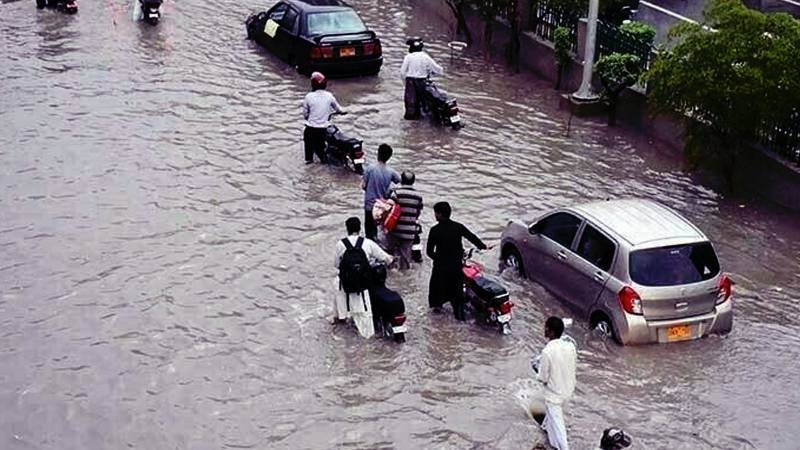
For decades, river Ravi had not experienced any flood, and it was falsely assumed that Ravi would not flow again downstream through Lahore, as India had the diversion system to redirect the water before it entered Pakistan. The water in Ravi flowing in Pakistani Punjab is largely the water of the Chenab River, which is drained into river Ravi through the Marala-Ravi link canal, irrigating 600,000 acres of land in Sialkot and Gujranwala districts.
As per the Indus Water Treaty, the eastern rivers Ravi and Sutlej came under the control of India, and their water is mostly used by India before entering Pakistan. However, this year, both rivers experienced high floods and, in their full glory, reclaimed their territory as they entered western Punjab.
The entire Himalayan region is showing the impacts of climate change, evident in extreme weather events. In India, there have been excessive rainfalls and several cloudburst events in Uttarakhand, Himachal Pradesh, Jammu, and Kashmir, which brought massive flooding across the entire Himalayan region.
Uttarakhand is known as the Land of Rivers, as the major rivers of India and dozens of minor rivers and nallahs originate there. This year, all the rivers experienced high floods after torrential rains, leaving many dead and injured. The Alaknanda and Saryu Rivers swelled after 369 percent excessive rains in 24 hours, causing major infrastructure damage. The Mandakini River flooded in the fourth week of August, with swift surges related to flash floods and cloudburst events, particularly in Rudraprayag and Chamoli regions. On 29th August, the Ganga River reached “severe flood” levels, exceeding danger marks. All its major tributaries were also in high floods, including the Song at Satyanarayan, Solani at Dosni, Ramganga, Gauri Ganga, and Dhauliganga, with rapidly rising levels crossing warning thresholds. The Dharhali and Saktoh Rivers in Rajouri were also in high flood near Rajouri.
Disaster management must be implemented at the grassroots level, with preparedness in all tehsils and union councils to manage rescue, evacuation, and relief in a timely and orderly manner
Similarly, by late August in Jammu and Kashmir, the Jhelum River was in high flood at Srinagar and Anantnag, with water rising above the danger mark.
From 19th to 27th August, the Tawi River in Jammu swelled rapidly and caused major infrastructure damage. Tawi is a major tributary of the Chenab River, which by 25th August also swelled to danger levels. Consequently, the gates of Salal Dam in Jammu were opened several times by India to release pressure. The Chenab and Tawi Rivers caused massive damage in Dhoda, Rajouri, and other areas in India before crossing into Pakistan at Marala in Sialkot district.
The surging waters of Tawi and Chenab merged and entered Sialkot, wreaking havoc beyond all expectation, with no government preparation able to match the ferocious waters. Along with the floodwaters of Chenab and Tawi, the three mountain nallahs—Eik, Dek, and Phalku—also flooded, inundating scores of villages and towns. The flood devastated the districts of Narowal, Shakargarh, Sialkot, Tehsil Daska, and Zafarwal, affecting millions of people.
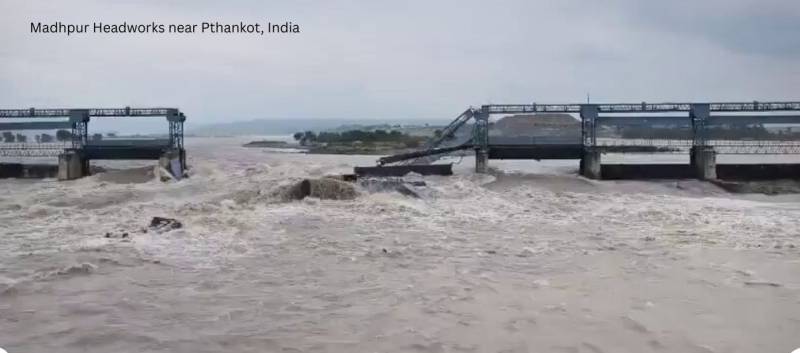
At exactly the same time, the Ravi also swelled due to sustained rains, causing flooding in Jammu, India, and infrastructure damage. Some gates of Madhpur Headworks near Pathankot city, first built in 1875 on the Ravi, broke down, allowing Ravi to surge downstream through Lahore in high flood. Ravi entered many outlying towns along Lahore, inundating scores of villages, and crops were completely destroyed.
As the Punjab government reeled under flood management pressure, the third eastern river, Sutlej, entered near Ganda Singh Wala in Kasur district in high flood, inundating more than eighty villages and destroying everything in its path.
The damage to infrastructure, including hundreds of kilometres of roads, bridges, culverts, spurs, and bunds, as well as residential and commercial property, is massive. It is still early to complete any damage assessment, but it is evident that the damage will run into billions of dollars. The flood has wiped out major infrastructure in many districts, including water works, electricity, road networks, and sewerage systems. Rebuilding would not only cost an astronomical amount but also take a very long time.
Even if, hypothetically, the Punjab government were able to rebuild all infrastructure devastated by the floods, the next flood could destroy it all again. Therefore, there is no alternative but to pursue sustainable flood management to ensure this does not happen again. Focusing solely on flood contingency planning will no longer suffice.
Decades of governmental neglect, coupled with human greed and disrespect for nature, have led to billions of dollars in damage and tragic loss of human lives
There are many important lessons from this year’s floods, and if there is any wisdom, it is high time to pay attention. The only way for sustainable development is to adapt and live ‘with’ the rivers.
The flood has demonstrated once again that if you try to cheat nature or rob rivers of their territory to build inside their beds, you will face severe consequences. The floods have shown that business as usual will not work, and governments must take immediate action to remove all encroachments and human settlements inside flood plains and river catchment areas without compromise.
But it is not just encroachments; ill-planned development on the rivers, including poorly designed roads, has also become a barrier to river flow and blocked natural paths.
Another important lesson is that disaster management must be implemented at the grassroots level, with preparedness in all tehsils and union councils to manage rescue, evacuation, and relief in a timely and orderly manner.
Sustainable flood management, in a nutshell, is ensuring that rivers can flow unhindered along their ancient routes, even in high floods, with no obstruction diverting water into human settlements outside natural flood plains. Better spurs must be built along rivers where large villages and towns exist.
The only way forward for sustainable development is to respect the rights of rivers and give them the right of passage. Other than temporary usage for seasonal cultivation, there cannot be permanent settlements inside or close to riverbeds.
Decades of governmental neglect, coupled with human greed and disrespect for nature, have led to billions of dollars in damage and tragic loss of human lives.
A government’s success in flood management is not measured by the number of people evacuated after a flood. Instead, it should be determined by how effectively rivers are allowed to flow safely through the plains and reach the sea without causing disaster.