

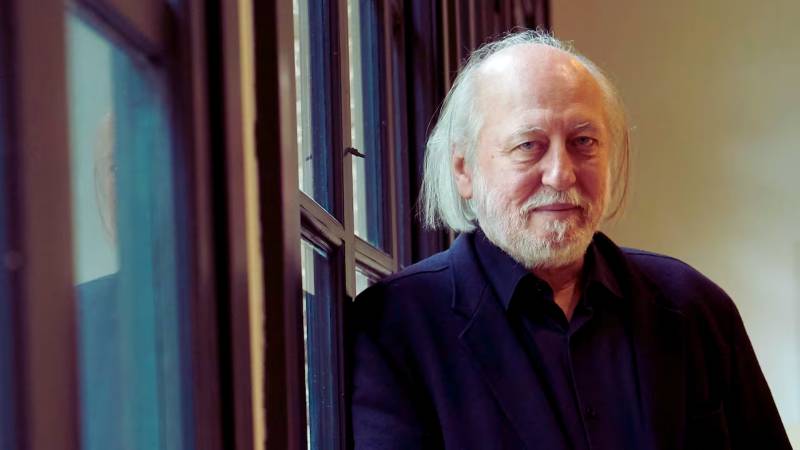
The year 2025 has added another golden line in the world's ledger of literature, as the Nobel Prize in Literature was awarded to the name that wandered unobtrusively earlier through the hallowed corridors of European letters — László Krasznahorkai of Hungary. The news came not like a thunderclap but like the deliberate swinging open of a massive cathedral door, spilling the scent of thought, sadness, and vision out into the surprised air. A novelist of profound depth but modest renown, Krasznahorkai is the victory of language over forgetfulness, of art over apathy, and of the persistent seeker over the clamorous horde of fashion. The Swedish Academy saw in him not only a writer but a prophet who, in his unyielding probing of hopelessness and loveliness, has reconfirmed the holy credo that writing may once again light the darkest recesses of the human heart.
Born in the little Hungarian town of Gyula in 1954, Krasznahorkai came to maturity under the aftershocks of a continent reeling from war and ideological strife. The dust of communism, the desire for faith, and the exhaustion of modernity settled deep within his imagination. Prior to abandoning himself to literature, he roamed the passages of law and the humanities, learning the bureaucratic tedium of systems and the unspoken rebellion of the human heart against them. He started writing not because he desired fame, but because silence was intolerable. Every sentence he wrote seemed a torch raised against the unrelenting darkness of existence.
Krasznahorkai’s works defy easy categorization. They are not merely novels but vast meditations stitched together by breathless sentences, sentences that seem to stretch beyond the horizon, gathering the dust of human thought as they move. His prose is like a swollen river after weeks of rain — rich, circuitous, unstoppable — bearing within it shreds of despair, shafts of transcendence, and the detritus of civilization. His syntax is famously prolonged, sinuous, and mesmerizing, a comma-and-clause symphony that wraps around the reader like mist. Punctuation is not for him a pause but a beat; each word exists in close conjunction with the one that follows. To read him is not to walk through a garden but to ascend a mountain of mind where the atmosphere thins out and blazes.
It is this manner — unyielding, monolithic, and lyrical — that makes him differ from the bulk of his peers. While most of the fiction of contemporary times moves to the beat of brevity and humor, Krasznahorkai lays emphasis on the weight of endurance. His writing is an exercise in meditation; it requires the reader to pause, breathe, and yield. It's a rebellion against speed, a protest against the constricting of human attention. With his boundless sentences, he creates a literary eternity in which time collapses and sense arises from the very act of endurance.
But beneath this stylistic grandeur is an incredible moral and philosophical vision. Krasznahorkai’s fictional world is peopled by dreamers, lunatics, prophets, and wanderers — men and women who live at the fragile edge between faith and madness. His landscapes are desolate Hungarian villages, crumbling cities, or mysterious Eastern temples; his characters move like pilgrims through ruins, seeking revelation amid decay. In those worlds, apocalypse is not a thing that happens but a state — a quiet wearing down of significance that erodes civilization from beneath. And yet, within that apocalypse, there remain sparks of compassion and art. Krasznahorkai is not only a reporter of despair; he is its anatomist, and in the end, its savior.
He writes as if the world itself was a single sentence broken only by breath and every human a dependent clause in quest of conjunction. His pages are filled with voices — muttering, toppling, coming back to life — that together constitute a crescendo of hope and exhaustion. The irony of his craft is that the vision is somber but the quest is radiant. Like an alchemist, he turns the lead of human suffering into the gold of spiritual reflection.
It is often said that Krasznahorkai’s writing is difficult. Indeed, it is not an easy river to swim. It resists the casual reader, it demands surrender, and it rewards patience. But difficulty, in his case, is not an ornament; it is the price of authenticity. The maze of his syntax is a maze of life itself. One does not comprehend his novels; one feels them, as one feels music or prayer. The reader becomes part of the whirlpool of his mind until meaning becomes something discovered rather than something felt.
What earned him the Nobel Prize, though, was not so much his distinctive prose as his unshakeable conviction in the potential of art to uncover truth in a disintegrating world. In an era marked by din, consumerism, and ephemeral gratification, he has persisted in his allegiance to the plodding and religious pursuit of thought. His novels remind us that literature is not entertainment but revelation — a mirror held up not to the fashions of society but to the immemorial face of the human soul. His work assails chaos with order, despair with rhythm, and nihilism with the obstinate endurance of beauty.
Although he is Hungarian by birth, his imagination is not tied to any geography. He is cosmopolitan in the most fundamental sense — not someone who circumnavigates the globe for ease, but someone who circumnavigates to find the meaning of exile. His travels to East Asia, his preoccupations with Buddhist art and philosophy, his reflections on European collapse — they all converge into a human voice that speaks to humanity's collective desolation and longing. He writes as if borders were not real and as if all human beings, regardless of being in Budapest or Kyoto, are trapped in the same storm of meaning.
Even though his recent worldwide recognition, Krasznahorkai has lived for long periods in relative obscurity. He was, for years, the writer's writer — a darling of fellow artists, a subject for philosophers to study, but never, in general, known by the populace. But this very obscurity might have been his protection and his talent. Without the encumbrance of fame, he wrote easily, shaping his own cathedral in words without worrying about applause. He had a slow-growing readership, like moss on stone, before the world eventually came round to see the architecture he had created. The Nobel Prize, therefore, is no coronation but rather a revelation — the revealing of a monument that had long lingered in the background.
The quirks that brought him this great accolade are in his moral richness and stylistic boldness. His books investigate how it is when faith falls apart, when structures crumble, and when human beings cling to the lip of their own abyss — but he never allows the abyss to be the last word. His characters drift through wasteland, but deep in their wanderings, somewhere, a spark of grace continues to burn. He catches that delicate instant when hope gives way to wisdom, when weariness yields vision. Such is his strange talent: he discovers the divine not in victory but in stamina.
In him, art is a slow resuscitation. He describes ruins, but his sentences reconstitute what they define. Every clause is a brick constructed against time. His is a voice that rings with the resonance of Kafka's discomfort, Beckett's muteness, and Dostoevsky's suffering, and yet it is uniquely his own — the blending of Eastern introspection and European passion. He speaks for the wordless, and by so doing, he dignifies their labor.
Translation has served as a sacred mission to deliver his art to the world. His works have been translated into English and numerous other languages by translators who have not only mastered the dictionary of words but the music of his mind. Through their fine work, the world has listened to his voice in varying tongues, but the rhythm cannot be mistaken — slow, solemn, and symphonic. It is no small miracle that the spirit of his Hungarian cadences, so delicate and complex, has weathered the crossing into other tongues. These translations have enabled his maze-like thinking to flourish on other continents, testifying to the power of art to overcome linguistic barriers.
His novels represent Krasznahorkai transforming common landscapes into allegorical philosophy. A decaying village is a parable of moral rot; a roving monk the symbol of human desire; a chaotic town the universe itself, hung between birth and destruction. Each landscape he paints takes on metaphysical life. Even silence is eloquent; even void thrums with meaning. Reading him is to experience a ruined cathedral in twilight — the air dense with memory, the stones still mumbling prayers.
In the very center of his work is a stark honesty. He neither flatters the reader with promise nor overwhelms them with despair. He shows the world as it is — hurt, tired, but radiant in its pain. His love is stern, his compassion is strict, and his belief, though tenuous, is unyielding. In each page, he grapples with the eternal questions: What is it to be? What is it to survive? What is left when all illusion is stripped away? His response, reiterated through the cadence of his sentences, is that consciousness itself is the ultimate miracle — that to behold the world as it really is, even in its barrenness, is to reach the divine.
The Nobel Prize has consistently reached out to authors who testify to human ethical crises, who remind us that art is not a hobby but a conscience. Krasznahorkai is part of this tradition. His novels are not comforting but jarring; they wake the reader up to the shake underneath being. In an age beset by distraction and digital din, his voice booms like a monastic chant, slow and stately, summoning us to the temple of language.
His Nobel laureate status is also a nod to the literary tradition of Hungary — a small country that has contributed great voices to the world, frequently under the burden of history. Out of this ground of silence and pain has emerged a writer whose words transcend the boundaries of nations to reach the universal. In paying tribute to him, the world is not only celebrating a man but a heritage of endurance — a reminder that great art does flourish in hard soil.
If fame measures how loudly one speaks, Krasznahorkai’s greatness lies in how deeply he listens. He listens to the whispers of history, to the sighs of forgotten people, to the silence between words. His literature does not shout; it murmurs with the gravity of revelation. Every sentence he writes seems to say: “The world is ending, but let us describe it beautifully.”
This beauty — harsh, tragic, and untainted — is what raises his work above politics or fashion. It is beauty created not out of ornamentation but out of understanding, the beauty that shows itself when truth and word converge without guile. It is the beauty of suffering — of a candle's burning in wind. That, perhaps, is why the Nobel Committee selected him: because in an era that glorifies speed, he makes us aware of slowness; in an era that is fascinated with surfaces, he insists on depth; in an era afraid of silence, he provides the dignity of stillness.
With his fiction, he has instigated a new rhythm for the contemporary soul. His sentences progress like weather fronts — expansive, slow, inexorable. They collect storm clouds of significance and then dissipate into light. His books are not so much read as lived through; they leave the reader changed, as if something in him has been stretched or defined. He doesn't narrate stories in the way that other people do; he writes meditations in the guise of a story. His plots are often simple — a stranger arrives, a village decays, a journey begins — yet within those skeletal frames he builds cathedrals of thought.
Krasznahorkai’s art stands as a monument to endurance. His career, long and quiet, reflects the very philosophy his writing espouses: that persistence itself is a form of faith. The Nobel Prize honors not an overnight triumph but a lifetime of disciplined isolation, a careful chiseling of words until they sparkle with metaphysical light. In recognizing him, the world acknowledges all writers who toil in the shadows, who are convinced that art's value is not in applause but in truth.
The strange elegance of his writing is that it combines despair and transcendence. He is aware of the pointlessness of human striving, but he writes as though forgiveness lay always on the other side of the next sentence. His books conclude not in resolution but in suspended progress — as if the narrative of being itself could never come to an end. Even when he writes of devastation, it is with such radiant accuracy that devastation takes on an aspect of rebirth. His is the literature of dusk, in which the light does not disappear but becomes silver and gentle.
The Nobel Prize has been accused more than once of rewarding fashion, but in giving it to Krasznahorkai, it has done something greater: it has rewarded integrity. His life and work are one straight line — a statement of faith that the writer has a responsibility not to amuse but to enlighten. He is one who stands alone on the mountain of language with a lamp that smokes but never goes out.
To read him now, in the radiant shadow of his Nobel win, is to see that he has not changed — the world did. His apocalyptic themes of exile and religious hunger, dismissed as too dark in their day, now speak directly to our anxious epoch. The madness he portrayed was prophetic; the silence he coveted is now a luxury. In this way, his Nobel is not an honor for something he has done in the past but an acknowledgement of how pertinent he has remained to the present.
His books have been translated into the world's great languages, and through these translations his philosophy has gone further than any passport would take him. His readers in far-off places have heard in his voice the echo of their own disquiet, their own longing. His sentences, stretching out like pilgrim roads, have guided so many minds to an increased consciousness of life. And even though his popularity has come late, it comes at the right time — when mankind most sorely needs to be reminded that art, as conscience, has to last despite a world forgetting what it signifies.
The poetry of his Nobel is in its symbolism. It is the victory of contemplation over din, of philosophy over style, of slowness over speed. It reminds emerging writers that literature is not a rung to fame but a beacon to illuminate the darkness. It reminds readers that the hardest books are often the best, that truth lies behind difficulty, and that language, when used with passion, can be a prayer.
László Krasznahorkai is now one of the immortals of letters, but he appears the least amazed. For him, the award is not an end, but a beginning — another twist in the endless sentence of art. His modesty is still intact; his eyes, still turned inward. He knows that no award can be greater than the satisfaction of a flawless sentence, that no ovation can compare to the inner delight of expression. His triumph is not his alone but belongs to the staying power of art itself — that gossamer but unbreakable bridge between isolation and community.
His will be the legacy of a seer who whispered, of a craftsman who constructed cathedrals using commas, of a pilgrim who transmuted despair into words. The world might forget the din of its celebrities someday, but it won't forget the weird, deliberate music of his writing. His work will be a refuge for everyone in search of meaning in the devastations of modernity, a lantern for those who walk through the maze of life.
So in celebrating László Krasznahorkai, the world celebrates the strength of silence, the holiness of thought, and the tenacity of beauty. The Nobel Prize, in his hands, is not a medal, but a metaphor — the golden full stop at the end of an unfinished sentence being penned by the human heart. And although the sentence will never end, it goes on, radiant and unbroken, in his words, in his vision, and in the still grandeur of a literature that is courageous enough to think that even in the devastation of the world, the soul can still sing.