

“One thing that I noticed is, having met some former Taliban that they, as children, grew up being indoctrinated. They grew up in violence. They grew up in war. They were taught to hate. They grew up in very ignorant cultures where they did not learn about the outside world.” Anon
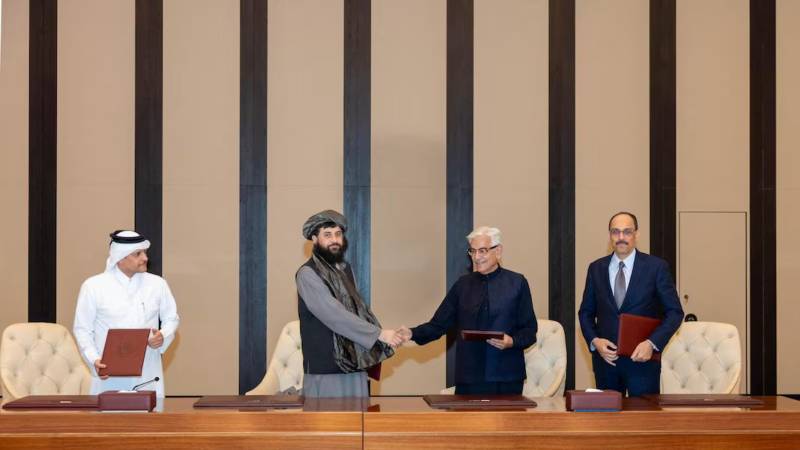
The Pak-Afghan peace talks in Istanbul have arrived at a deadlock – a failure has not so far been announced, leaving space for more talks, but so far, this does not appear likely. They were bound to fail. I had already written on many occasions why the average Pakistani’s joy at the US withdrawal and the Taliban takeover of Afghanistan was premature, since it was based on unrealistic expectations of an Afghan bonhomie, for alleged services rendered to the Taliban.
Furthermore, it had every sign of being short-lived because of the TTP's presence in Afghanistan after having run away from Pakistan in 2010/11. Also, releasing the TTP prisoners by the Taliban added to the TTP ranks. It was only a question of time before matters would come to a head. India, Pakistan’s existential enemy, waiting in the wings for an opportunity, was willing to sacrifice on every moral position they had committed to against the Taliban, as long as it worked against Pakistan.
This is just one of the many times that Pakistan has suffered the consequence of US abandonment. Frequently having to live with the ignominy of being abandoned and left to sulk in the wrong corner of the room after having been used. First, being dropped as an ally after the Cold War in favour of a strategic alignment with India, then, when the US walked away from Afghanistan after the Soviet withdrawal, being distracted in 1991 when the Berlin Wall came down, and then, Iraq’s invasion of Kuwait. True to form, the US cut and ran from Afghanistan in 2021, displaying indecent haste in their urgency, leaving chaos in their wake and Pakistan to face the consequences.
Pakistan, on its part, has never learnt its lesson and continues on the self-destructive path, searching for space in the US sphere, hoping to accrue some sort of benefit. Somehow, Kissinger’s famous quote does not appear to impress Pakistan: “It may be dangerous to be America’s enemy, but to be America’s friend is fatal”.
Pakistan’s policies towards Afghanistan have been confused at best, ambiguous at their worst. Usually, a firm position is scuttled by the moderate views of Afghan apologists, who think that their temperate approach makes them look reasonable and intellectual. Their arguments are neither grounded in logic nor history and are motivated more often than not by populism and politicisation of the Pak-Afghan inter-state relationship.
Apologists go to great lengths to justify why Afghanistan voted against Pakistan in 194,7, but whether that was withdrawn later or not, the fact that it happened is not mitigated
Whereas I am against any generalisation of people and communities, here are the facts: Afghanistan has borne ill-will against Pakistan right from its inception and has gradually manufactured a false narrative, re-inventing historical facts and rearranging events from the past. The reality is that there is no single government that has ever been friendly towards Pakistan, and Pakistan has bent over backwards trying to come to some understanding with the Afghans.
Apologists go to great lengths to justify why Afghanistan voted against Pakistan in 194,7, but whether that was withdrawn later or not, the fact that it happened is not mitigated. I say this even though no government position has ever been taken against Afghanistan on this matter. Then the bombing of the village Mughalgai in 1949 by the PAF is at times quoted as the main cause for rejecting the Durand Line on the pretext that since the Line was violated, it was now summarily rejected. They forget to mention that the line was violated on account of the hot pursuit of Afghan infiltrators, fighting for the Faqir of Ipi, who was trying to establish Pashtunistan.
Their long-standing support for the Red Shirt Movement and Pashtunistan is glossed over just as their incorrect claims to territories up to the Indus River, as they reject the international border. However, these are now ‘he said – she said’ stories and can never be concluded to anyone’s satisfaction; they must be avoided by sensible people in any kind of discussion. We must reconcile to live with these disagreements for times to co, me but accept them as disagreements only, not as a casus belli for war.
However, a conflict has now arisen between Afghanistan and Pakistan. The immediate cause is the TTP cross-border militancy, targeting government installations and people in Pakistan. This militancy is mindless and serves neither Pakistan nor Afghanistan. It is designed to destabilise the region and disrupt the CPEC progress. Evidence points towards India, which is apparently the only beneficiary of this militancy.
The demand made by the TTP to cease the violence is to first, revert FATA to its tribal administration under FCR; second, to withdraw the Army from FATA; third, that the TTP be allowed to bear arms and be allowed freedom of movement in FATA; and finally that the government of Pakistan would have to give an undertaking that it will not interfere in the internal matters of FATA. These were the conditions placed before the Grand Jirga set up in Tirah recently. The talks obviously broke down, and even the Jirga could never agree to these conditions. So much for a negotiated settlement.
Now we come to the matter of the Afghan Taliban, who were sent to the last negotiations in Turkey, 6 November 2025. They were under the explicit instructions not to commit anything to paper and to leave all commitments open-ended and by word of mouth alone. Also, not to agree to anything where there was any doubt in implementing what was being proposed.
The seven-member negotiating team then put in a complaint that Pakistan too had Daesh and IS on its soil; they were told to provide actionable intelligence, to which Pakistan was willing to allow them access and joint operations within Pakistan to clear these spaces. However, Pakistan expected as much from Afghanistan as well in the case of the TTP, but the Afghans refused any joint mechanism.
I, for one, have irrefutable evidence that the Daesh or the IS, who the Afghans are talking about, are TTP who simply change their labels whenever it is convenient to them and not any new phenomenon in these border areas. However, real Daesh and IS do exist within Afghanistan itself and do give the Taliban a run for their money.
The Taliban negotiators have now accused Pakistan of blaming Afghanistan and holding them responsible for the internal situation within Pakistan – this has not happened and is a blatant lie. Pakistan has only asked for action against TTP in Afghanistan, and those who attack Pakistan: either Afghanistan deal with them, if not, then allow Pakistan to deal with them, if not even this, then to conduct joint operations against them. Nothing was agreed to.
What should we expect now – the ceasefire holds, but for how long is anyone’s guess. Pakistan has been threatened by 1,500 suicide attacks, which can be taken with a pinch of salt, but the image of threatening a state with terrorism if the state does not allow them liberty of action and freedom of movement within its territory is alarming. This amounts to a ridiculous demand, and no one in their right mind can ever condone it.
Dismantling the TTP means upsetting the TTA foot-soldiers as well, who are the actual power base or centre of gravity of the Taliban regime
The Taliban lacks the capacity to deal with the TTP. It is because the TTA governance system is dependent on foot soldiers and not any popular representation. These amount to about 40,000 to 50,000 militants, uneducated, rustic and of an extreme bent of mind. These foot-soldiers have found a commonality with the TTP, and this then becomes the nexus of the TTP and TTA – both are identified by their utter immunity to reason and logic.
Any claims of the TTP being brothers in arms against the Coalition Forces in Afghanistan are false, and whereas individuals may have rendered their services, the TTP were mainly focused on attacking Pakistani forces. In fact, Mullah Omar had to give a fatwa against waging war against Pakistan and that the TTP should focus on the conflict in Afghanistan. They did not. Baitullah Mehsud, in January 200,8, declared war against Pakistan. Anyhow, the foot soldiers of TTA and TTP now supplement one another in a loose alliance.
Dismantling the TTP means upsetting the TTA foot-soldiers as well, who are the actual power base or centre of gravity of the Taliban regime. Furthermore, there is a power conflict between the Kandahari Taliban, who are more extreme than the others, and the Kabul-based Zadran group, commonly known as the Haqqanis. The latter were supported by Pakistan in the provision of logistics and administrative areas during the conflict with the US and were considered to be friends. They too have shown their intent with the recent aggressive warning to Pakistan, and one should not suffer any illusions of a soft corner from the Haqqanis.
If any of these groups, i.e. the Haqqanis or the Kandaharis, act against the TTP, the TTP will side with the other group, and this would weaken the side taking on the TTP. Finally, if a resolution to dismantle the TTP is taken universally by the Afghan regime, then the TTP have the option to join Daesh or IS already established in Afghanistan and work against the Taliban regime. These fissures and breaks within the regime reduce TTA’s resolve to manage the TTP, and it may even appear that Pakistan is being unreasonable in demanding this of them. That is simply not doable.
However, Pakistan has offered to do it for them if they themselves cannot do it. For one country to harbour terrorists against another simply because they lack the wherewithal to expel them is not a valid excuse and is not a matter that one can live with and simply ignore – it has consequences.
Thus, Pakistan and Afghanistan are arrayed for an imminent kinetic clash. The timing of the clash is likely to coincide with the Indian military presence on the eastern border. Specifically, in and around the creek areas near Karachi. India is likely to showcase its naval capability and hopes to avenge the humiliation of Sindoor 1 with Sindoor 2. I am sure Pakistan’s military is well prepared for such an adventure. Whether this becomes a two-front threat to Pakistan or remains a conflict limited to the Pak-Afghan western borders, time will tell, but it is likely to be settled within a week or two.
In the event of the western border, the Afghans have an exaggerated perception of their capability and capacity and are fed motivational propaganda from India, indicating to them that it is a cakewalk up to the Indus. The Afghan army cannot execute a conventional military manoeuvre, and their methods are limited to IEDs, assassinations, ambushes and terrorism. A tactic that may have served them well against the Coalition forces, but can never succeed against Pakistani forces, simply because the nature of war is totally different.
Pakistan does not intend to occupy Afghan territory, where such hit-and-run tactics may work. Now the Afghans have to put in a synergised, articulated, proper military effort against standing ground defences, which is way beyond their capability or intellect. However, they can still infiltrate where there are gaps and can pursue a low-intensity war in Pakistan’s towns, cities and highways. They would plan to engage in a war of attrition, which over a period of time would stretch Pakistan’s resources, cause battle fatigue, demoralise the people and cause political instability. It is from the ensuing chaos that is expected and created that the Taliban will try to find their opportunity and opening to secure spaces and disrupt governance.
Local jirgas, when demanding that operations must be ceased, must be given space and such operations can be put on hold until the requester, but then jirgas must be held responsible for the security and accountable for the stability of their own areas
Pakistan’s response must not allow the Afghans the luxury of time to unfold their plan of attrition. Pakistan must be decisive, certain and sure-footed. Pakistan must take advantage of their longer reach and apply a full-spectrum battle regime to overwhelm the Afghan Taliban. This would be engaging the depth with air strikes, precision attacks on camps, Afghan Taliban assets and movement. Then the mid-range, disrupting assembly of hostile militants, destruction of assets such as bridges, military installations, stores and ammunition dumps and finally the short-range immediate kinetic operations on ground against concentrated Afghan Taliban trying to attack across the border. Pakistan’s military operations must be designed to overwhelm the Afghans with the explicit objective of bringing them to a reasonable negotiated settlement with permanent guarantees.
However, Pakistan must understand that militancy within Pakistan must also be addressed at the same time. It ought to be remembered that terrorism is not a stand-alone phenomenon but simply a manoeuvre of war by another method. It is a tactical part of a larger scope. However, it is a manoeuvre that depends upon aggrieved people being recruited to a real or perceived political cause, with the intent to challenge the writ of the government through militancy. An exploitation of the misfortunes of a community by hostile agencies.
It is why it is unique, in that the front-line resistance to militancy comes from the people themselves. Military manoeuvres, if necessary, are only undertaken to establish an environment to allow for a political resolution to the grievance. Part of establishing the environment is to empower the people and strengthen the local leadership. The distrust between the local tribal people and the government forces must be addressed in both directions.
Politicisation of the situation must be avoided at all costs, and no one should be allowed to play with the emotions of the people. Local jirgas, when demanding that operations must be ceased, must be given space and such operations can be put on hold until the requester, but then jirgas must be held responsible for the security and accountable for the stability of their own areas. The military can provide them with the backup when they ask for it. However, in no way should a man's committees be resorted to.
These are recognised miscreants who have surrendered to the government, for which they have been rewarded. They are allowed to rule over their own people on behalf of the government. They are supplied with money, vehicles and arms, and they abuse their authority, generating revenue forcibly from the people through check-posts. They are seen as the representatives of the government and the agents of tyranny – one of the most prominent reasons why one should never trust the government is thus established.
The administration should arrange for open jirgas that determine their own mushers through the traditional process in keeping with local culture. The government must only deal with these mushers, who mus,t in tu,r n commit to securing their respective areas. It is the easiest method to establish trust and confidence between the people and the government.
I don’t know how this conflict will end or what will be the result, but I am sure that it will break out one way or another. It is unfortunate, but the Afghan intransigence can only be made flexible through a military application. Pakistan must endeavour to reach out to the Afghan people who are unnecessarily suffering from this conflict.
Any military action must avoid making regime change as its objective, which may very well happen by the initiative of the people themselves. We must never be in the business of felicitating any regime in Afghanistan and should have no preferences. Pakistan must allow opportunities to the Afghan youth and try and focus on development and opportunity building within Afghanistan after this conflict is resolved.
The ethnicity of the people, the contiguity of the geography and the common historical culture and tradition, all point towards inclusivity and not exclusivity – even possibly a confederation.