

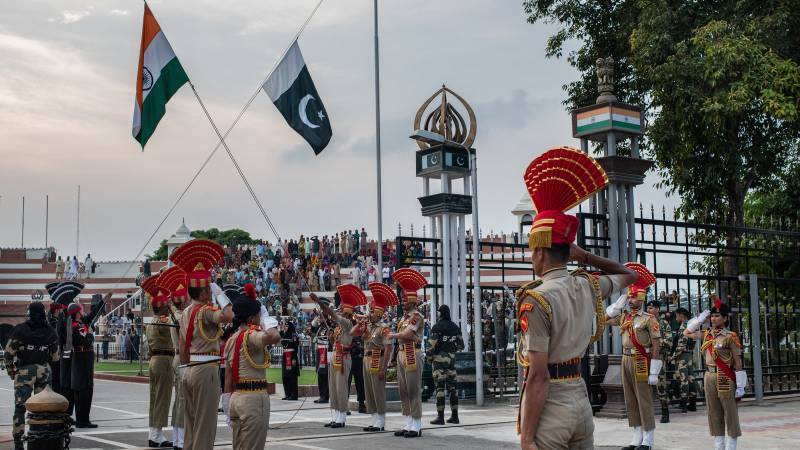
The conflict between India and Pakistan—two nuclear-armed neighbors with deep historical, territorial, and political animosities—remains one of the most enduring and volatile challenges in global politics. From the unresolved issue of Jammu and Kashmir to the cyclical nature of cross-border skirmishes and diplomatic breakdowns, the subcontinent continues to teeter between confrontation and cautious calm. At this fragile juncture, the wisdom of historical figures like Zhou Enlai offers an enduring lens through which to envision a different future.
Premier Zhou Enlai, China's first and longest-serving Premier, was a master strategist in diplomacy. His articulation of the Five Principles of Peaceful Coexistence—
- Mutual respect for sovereignty and territorial integrity,
- Mutual non-aggression,
- Non-interference in each other’s internal affairs,
- Equality and mutual benefit, and
- Peaceful coexistence
has shaped Chinese foreign policy for decades and influenced the peaceful diplomatic practices of many Non-Aligned nations, including Indonesia, Ghana, and Turkey
But more importantly, it provides a timeless framework for conflict resolution, especially in regions as fractious as South Asia.
Peace as a Conviction, Not a Tactic
Zhou believed that peace was not a strategic pause between wars but a principled commitment to non-violence and dialogue. Applied to the India–Pakistan conflict, this principle suggests that both states must move beyond reactive diplomacy and military posturing. The Pulwama-Balakot crisis of 2019 and the Pahalgam attack of 2025 serve as cautionary tales: provocation followed by retaliation only hardens public opinion and narrows diplomatic options.
Peace is not weakness; it is the highest strength of a mature people. No conflict is too deep—so long as the people still wish to live under the sun
To prevent similar escalation, India and Pakistan could institutionalize a bilateral crisis management mechanism operating at a sub-political level. This mechanism—possibly run through senior diplomats or military liaison officers—would ensure that communication lines remain open even during heightened tensions. Such a channel could act swiftly to clarify misunderstandings, de-escalate misperceptions, and reduce the likelihood of retaliatory missteps driven by misinformation or public pressure.
Quiet Diplomacy over Public Spectacle
Zhou was a practitioner of subtle diplomacy. During the 1955 Bandung Conference, he built trust across ideological divides—not through grandstanding, but through careful listening and consensus-building. In today’s context, where Indian and Pakistani leaders often speak past each other via televised diatribes and social media barbs, a similar reset is imperative.
Rather than relying on the faltering South Asian Association for Regional Cooperation (SAARC), a new South Asia Peace Dialogue (SAPD) process could be initiated. This informal forum—perhaps facilitated by ASEAN, the Organisation of Islamic Cooperation (OIC), or a neutral third-party state—could bring together retired diplomats, peacebuilders, and civil society leaders from both sides to create an atmosphere conducive to later official talks.
This form of people's diplomacy would follow Zhou’s own preference for shuttle mediation and discreet consensus-building, away from media glare and maximalist posturing.
Focus on People, Not Only Borders
Zhou often emphasized that diplomacy must ultimately serve the people. In the case of Kashmir, most proposals historically revolve around territorial sovereignty and strategic control, sidelining the voices of those who live there. This has only alienated communities and entrenched resentment.
What is urgently needed is a multi-tiered civilian contact framework that fosters human connection. Initiatives such as a Kashmir Youth Exchange Program, joint academic research platforms focused on climate and ecology in the Himalayan region, or even cross-border cultural festivals can humanize the “other side.” These grassroots peacebuilding measures would resonate with Zhou’s commitment to prioritizing people’s dignity over abstract territorial disputes.
Moreover, a transitional arrangement—such as a jointly observed civilian cooperation zone or limited-area governance project—could test new frontiers of trust, transparency, and co-existence without immediately challenging the sovereignty claims of either country.
Development as the Dividend of Peace
For Zhou, peace was not merely the absence of war. It was a generative condition—a prerequisite for economic cooperation, social justice, and human development. In this spirit, India and Pakistan could jointly explore a Kashmir Peace and Development Corridor. This would not only be a powerful symbolic gesture but also a practical investment in education, healthcare, water infrastructure, and renewable energy in the region.
Development initiatives like this would generate shared interests, reduce incentives for conflict, and help both countries reframe Kashmir, not as a battleground, but as a cooperative zone of peace and progress. It would also enable both governments to demonstrate to their respective public constituencies that dialogue can yield tangible benefits—jobs, stability, and hope.
The Courage for Peace
In the wake of military standoffs and a toxic information environment rife with nationalist rhetoric, disinformation, and psychological warfare, the greatest act of leadership is to choose peace—not as a concession, but as a conviction. Zhou Enlai's example teaches us that principled diplomacy, mutual respect, and people-centric solutions are not utopian ideals—they are pragmatic necessities in a world armed with nuclear weapons and disarmed of trust. His words still resonate:
“Peace is not weakness; it is the highest strength of a mature people. No conflict is too deep—so long as the people still wish to live under the sun.”
It is time to revisit Zhou’s vision—not just to honor the past, but to rescue the future.