

It has been a century or so since Gramsci introduced the term ‘subaltern’ during his time in prison. Around five decades later, Ranajit Guha founded Subaltern Studies as a collective intellectual project, and subsequently Gayatri Spivak wrote the famous essay Can the Subaltern Speak?. Since then, intellectuals from various parts of the world have contributed to developing a lens for analysing the conditions of institutional marginalisation faced by those subject to power.
Anyone familiar with the discourse of subaltern studies will understand that it was never about the subaltern speaking about their marginalisation; rather, it was about audibility. It concerned the ability of structures to hear the unheard voices of the marginalised and to process those voices into political slogans. Spivak’s post-structuralist addition to subaltern studies was a significant contribution, as Partha Chatterjee later admitted in his essay Subaltern Studies after Spivak.
Spivak addressed the question of women through Vertretung (representation – a form of political speaking on behalf of women) and Darstellung (re-presentation – a form of depicting women within the semiotics and syntax of culture). She explained the narrative of describing and depicting women. She not only criticised the outward direction of white men ‘saving brown women from brown men’, but also lambasted the inward direction: the depiction of women on behalf of women by men who deemed themselves fit to determine their cultural presence.
Nevertheless, the terrain of audibility has shifted. We can see women demanding the right to their own representation and re-presentation. Women in the public sphere can report, write, litigate, and fight for their own cases. It seems that women are audible to society, or rather, that the transition has made the system flexible enough to hear those voices. This is true, but only partially. Not all women are audible or bearable to the system. The grammar of audibility is limited, and the structure is soundproof to many marginalised voices, such as those of minority women, women affected by climate-induced displacement, and others.
Bonded labour is a generational phenomenon that affects the children of workers
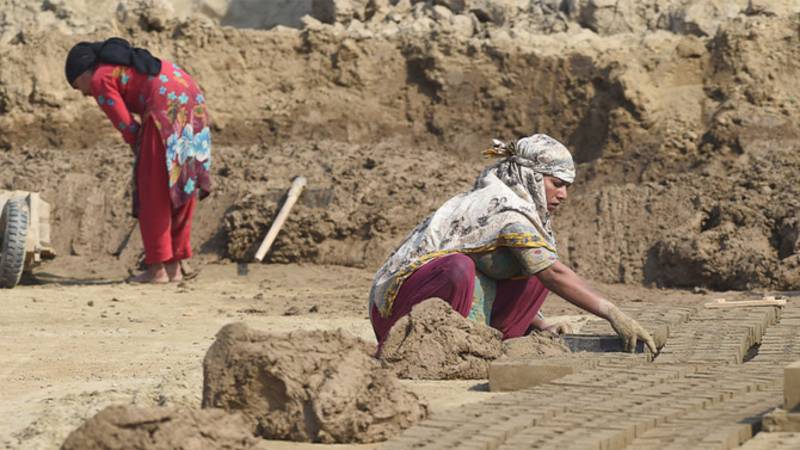
Among many cases, there is one that has been represented repeatedly yet has never been truly heard: the plight of women in bonded labour at brick kilns (bhatta).
The state outlawed bonded labour in 1992, and it was subsequently abolished; however, remnants of bonded labour persist in Sindh and Punjab. The Human Rights Commission of Pakistan (HRCP) released a study revealing the systemic exploitation of labourers working at different brick kilns. They interviewed 200 workers across Pakistan. The study found that 70% of workers were living under suppressed conditions, forced to reside in one-room quarters that were often overcrowded. It showed that the labourers were exposed to violence, had no legal contracts, and were frequently subjected to sexual violence. In addition, they were underpaid and compelled to work in horrific weather conditions.
The condition of labourers at these sites highlights an enigma: the authorities’ failure to comprehend the oppression of labourers, administrative negligence, and the gap between law enforcement agencies and the workers. Bonded labour is a generational phenomenon that affects workers’ children.
Within bonded labour, there are many reported cases of women being subjected to the male gaze and sexual harassment. Women endure the worst conditions without access to medical facilities. In some reported cases, women have been forced to work during pregnancy in extreme heat. Glory Magazine published the story of a 19-year-old girl named Maya, who has been working at a brick kiln for the past 14 years. She began working there when she was only five years old.
The intensive labour of working under harsh weather conditions, enduring multiple health problems, and raising children within these sites represents the voices of the subaltern – silent and marginalised. The audibility of these voices is minimal, and structures remain unwilling to acknowledge them. These women are subaltern. When Foucault discussed madness, he portrayed the voices of the mad as silent, as the liberal economy did not receive any contribution from them, and a series of structural forces blinded the majority from hearing their voices. The same applies here, with even greater intensity. Women working at these sites are real-life examples of the subaltern.