

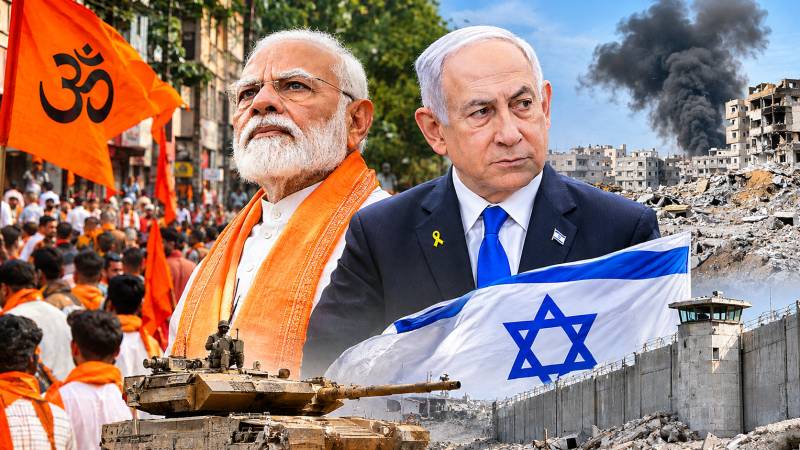
By autumn 2026, the international system is under more than just strain. Two ethno-nationalist projects are changing it from within, treating plural democracy as something temporary and international law as something negotiable. Hindutva in India and the harder forms of Zionism in Israel have gone beyond just majoritarian politics at home. Now, they serve as examples of how a nuclear-armed state can undermine equal citizenship, use historical grievances as tools, and spread this approach while claiming to follow democratic procedures and security needs. Together, they present the biggest challenge to the post-1945 order since the fascist movements between the world wars. This is not because they are the same as National Socialism, but because they are more flexible, more institutionally sophisticated, and harder to stop from the outside. The world notices this pattern but looks away.
Both cases use a similar approach: they create a mythic past that defines the true nation by excluding others. For Hindutva, this means imagining a pre-Islamic Hindu civilization marked by glory and unity, supposedly ruined by Muslim invaders and later weakened by secularists and colonialists. In reality, history is far more complex, competitive, and diverse, but accuracy doesn't matter here. What matters is how the myth works politically. It turns an 80-percent majority into a group that sees itself as wounded by history, so their current dominance is seen as unfinished liberation, not just power. Every sign of Muslim culture, every demand for equal rights, and every demographic trend is seen as proof of ongoing injury. Textbooks change, cities get new names, TV debates grow hostile, and neighborhoods are quietly separated. Violence against minorities is not random; it is the myth put into action. Cow vigilantes, provocative processions, selective use of bulldozers, and the gradual limiting of Muslim citizenship are not just mistakes. They are the expected results of a politics that sees co-existence as only a temporary use of Hindu space.
Zionism’s main story follows a similar path: it claims an exclusive ancient right, sees itself as a victim throughout history, and treats the Palestinian presence as an interruption that does not belong. This leads to settlement expansion, different legal systems for different groups, demographic changes, and turning Gaza into a controlled and disposable population. These are predictable results of seeing the land as only for Jews by right. Since the 1920s, Hindutva thinkers have admired the Zionist model of ethnic nationhood and military strength. Today, Indian and Israeli leaders highlight their shared civilizational ties while trading weapons, intelligence, and political support. At this point, the similarity is not just theoretical it is a real strategic partnership.
Both projects flip the usual idea that majorities have power and minorities are vulnerable. Instead, the dominant group is seen as a constant victim who needs special protection. In India, this means Muslim personal law is called unfair privilege, anti-conversion laws are seen as protection against a supposed demographic threat, and citizenship checks are described as purification. In Israel, it leads to a permanent security state and a readiness to accept many civilian deaths to keep demographic and territorial control. The emotional logic is the same: any sign of minority survival is felt as a new attack on the nation’s wounds.
This way of thinking spreads. As India and Israel build closer military and technological ties, they create a feedback loop. Methods and justifications used in one place are soon used in the other. They agree on what counts as “terrorism.” Surveillance and border technology are shared. Diplomatic support goes both ways. What is accepted as normal against Indian Muslims or Palestinians becomes language that other majoritarian movements can use. This partnership is not just about business; it is about shared beliefs. Both sides reject the idea that countries with many ethnic or religious groups can be built on equal citizenship instead of hierarchy.
The greatest danger is not the sudden arrival of dictatorship, but the gradual normalisation of a system in which some people belong by right while others exist only by permission.
From Pakistan’s point of view, the threat is real and built into the system. A Hindutva-led India that defines itself against Muslims sees Pakistan not as a neighbor with disputed borders and shared history, but as an outside part of its internal enemy. The suspension of the Indus Waters Treaty after the 2025 crisis, the ongoing militarization of the Line of Control, support for proxies, and refusal to engage in normal diplomacy all follow from this mindset. When India strengthens its ties with a project that has shown it can reshape an entire population’s living space through blockades, bombings, and settlements, the region’s balance changes. Nuclear deterrence still exists, but the risk of mistakes grows. The world’s ability to limit this kind of behavior weakens when two major powers treat some populations as permanent security threats instead of people with rights.
The wider situation makes things even more dangerous. Authoritarian and majoritarian trends are strengthening in many countries, even as some voters resist. Democratic institutions are under pressure. International law has been used selectively for so long that it has little authority left. In this setting, Hindutva and the harder forms of Zionism do more than survive; they provide a model for others. They show how to take over the state through elections, rewrite history, create grievances, target minorities, and call it national revival. Other groups are watching and learning. The result is not a new Axis like in the 1930s, but a more spread-out and tougher network of ethno-nationalist exceptionalism that eats away at the idea of rules-based coexistence.
These are not historically the same, and they do not work the same way. India still has competitive elections and a formal constitution, while Israel’s approach has lasted longer and is more direct. The main point is about structure and function. Both use connected methods of exclusionary myths, creating a sense of victimhood, and dehumanizing others, methods that have led to terrible outcomes in the past. Both have nuclear weapons and growing military power. Both see post-1945 rules, like sovereignty, non-aggression, minority rights, and bans on taking land by force, as obstacles to get around, not values to protect. Now, they also support each other.
The risk is not that either country will suddenly become a fascist dictatorship. Instead, both show that formal democracy can coexist with the gradual legal and social subordination of certain groups, and that this model can spread using the language of security and civilizational renewal. The post-1945 order was flawed and often hypocritical. Now, it is being replaced, bit by bit, by something older and more dangerous: the clear claim that some nations are truly legitimate and others are temporary, that some people belong by right and others only by permission, and that bringing back a mythic past justifies using any force needed today.
This is the threat. It appears in changed textbooks, new city names, separated neighborhoods, suspended treaties, and populations treated as demographic problems. The world notices but turns away because facing the issue is expensive, strategic partnerships are easier, and the alternative means admitting that those who never truly accepted the rules-based order are already changing it. For Pakistan, the stakes are existential. For any society that still values plural citizenship over civilizational purity, the stakes are just as high.