

“How could the world go back to the way it was when so much bad had happened?”
(Samwise Gamgee in the Lord of the Rings)
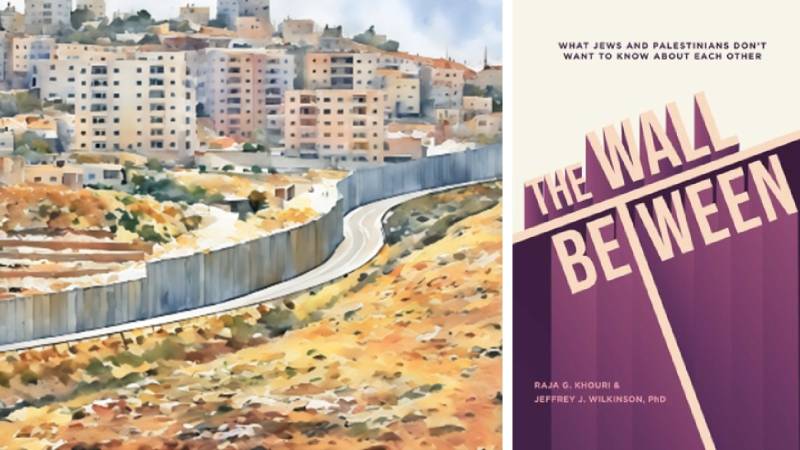
Sam’s speech in the Lord of the Rings ends with an uplifting message to fight for some good in the world. However, both Pankaj Mishra and Yuval Noah Harari write that the arc of the moral universe (or history) does not bend towards justice (The World After Gaza, pp 279; Nexus, pp 403). The genocide and ethnic cleansing in Gaza rationalised through weaponised victimhood is a testament of that. Is there any hope then for a Truth and Reconciliation type institution in this context? Raja Khouri, a Palestinian Christian, and Jeffrey Wilkinson, an American Jew try to push for a conversation through their book. Khouri emphasises a “one-person-one-vote democracy” solution in historic Palestine, whereas Wilkinson highlights that we must “redress the injustices that the creation of the State of Israel has created” (pp 140-143). A synoptic review of their book is as follows.
The authors argue that the power balance in North America is skewed heavily to the pro-Israeli position, which dismisses the suffering of the Palestinians (pp xvi). Given this power differential, they reject “both-sideism” or equivalence and instead emphasise the struggle of the oppressed against the oppressors (pp xx, xxi). They contrast between a “well-funded (and) muscular position” of the “pro-Israel lobby” and a “poorly led Palestinian resistance”, highlight the weaponisation of trauma and victimhood, and argue that the traumatic past does not justify present inequalities (pp xxii).
The authors highlight that Zionism yielded a “colonial” outcome, which helps us to understand why left-leaning academics emphasise “settler colonialism, apartheid, and the Occupation” (pp xviii, xxiv). They add that Palestinians view antisemitism as a weapon to “silence their resistance to oppression” and as a “boot that presses down one’s neck, choking speech (and) silencing thought” (pp xxiii, 26). Thus, they call for a shift from “identity, trauma and victimhood” to “freedom, respect, dignity, equality, and human rights” (pp xxiii).
Weaponised victimhood, Western complicity, and antisemitic Zionism
The authors state that Jewish identity as the victim remains even as victimisation has not, and quote that the victim stance is powerful for the victim is always right and forever entitled to sympathy (pp 15, 17). Thus, accusations of antisemitism are hurled even when Palestinians object to Israel’s use of snipers that target civilians (pp 31). Moreover, antisemitism is defined in a way that ensures the oppression of the Palestinians and equating the criticism of Israel to hatred for the Jews has the “singular purpose” of silencing criticism (pp 32, 58).
The authors note that antisemitism did not exist in the Middle East as it did in Europe (pp 22). They explain that “the river to the sea” slogan is not about Jews but rather about “equal rights and opportunities for all Palestinians” (pp 36). They add that Jews view Palestinian resistance as an “existential threat” despite the pacts and accords with Egypt, Jordan, Syria, Lebanon, UAE, Bahrain, Morocco, Oman, and Sudan (pp 68). Moreover, they state that “blaming Arabs for all the conflicts is classic scapegoating”, as “Zionist forces were responsible for many massacres” and committed “intentional ethnic cleansing of Palestinians” (pp 130-131).
The authors argue that while Israel is an “ethnocracy,” projecting it as a democracy deflects criticism of Israel and ingratiates it with western democracies
The authors state that the guilt of western complicity in the Holocaust has rationalised the occupation, settlements, and murder of the Palestinians (pp 28). They state that for Palestinians “antisemitism that happened elsewhere is resolved on their backs” (pp 41). They highlight antisemitic Zionism just as they emphasise that one can criticise Zionism and not be antisemitic (pp 39). The former is noted from the fact that right-wing Israeli governments under Netanyahu have forged close relations with nationalist Eastern European governments and Evangelical American Zionists, both of whom share a history of embedded antisemitism (pp 39).
The catastrophe and Liberal Zionism
The authors state that for the Palestinians, the Zionist argument that the Palestinians rejected the UN partition plan is tantamount to blaming the victim for not accepting their victimisation, as the land was not theirs to give (pp 49, 132). They highlight that the “impact of Zionism on Palestinians” is that of “settler colonialism: displacement of the indigenous population, confiscation of property, and a … systemically discriminatory (state)” (pp 52). They argue that the “Nakba is a fundamental part of … Zionist history for which Israelis will have to take responsibility” and question if “progressive Zionism (is) about protecting Israel while minimising guilt” (pp 54, 57). The authors write that “many Zionists have acted as if no one was displaced” and claim that promoting Palestinian refugees to return to their homes is antisemitic (pp 80, 87). However, they argue that the Jewish leadership knew that for “Zionism to succeed, Palestinian Arabs would have to be moved out of the land” (pp 133).
The authors argue that while Israel is an “ethnocracy,” projecting it as a democracy deflects criticism of Israel and ingratiates it with western democracies (pp 62, 63). They emphasise that “we don’t witness the daily violence of Palestinian lives” and forget their “ongoing oppression and humiliation”, even as “Zionism, literally, is killing them” (pp 72). They detail that Palestinians are “rarely given permits to build or expand their homes”, “children are often shot and killed without repercussions”, and Palestinian land is often confiscated under various pretexts (pp 70-71). Yet, the West sees Palestinians as they saw “red Indians” in Hollywood westerns, i.e., as “violent savages” attacking caravans of white folks for no apparent reason and reduces the “legitimate struggle for freedom and self-determination” to “acts of terrorism” (pp 71, 72).
From undermining to amplifying Palestinian discourse
The authors argue that rhetoric is used to justify war and genocide, whether it is the pretext of “weapons of mass destruction” or “terrorists” (pp 101). They write that the pro-Israel lobby like AIPAC in the US and CIJA in Canada far surpass Palestinians in “financial capacity and political influence” (pp 103). They add that such “organisations regularly poke the wound of antisemitism to prevent it from healing” and “dabble in anti-Palestinian tropes” (pp 104). Moreover, they argue that “fixation with antisemitism” drives the discourse and not “Palestinian human rights” (pp 93). Thus, instead of “Israeli abuses of Palestinian human rights”, the discourse ends up being about Palestinians defending against “accusations of antisemitism”, which is akin to presenting “the victims as villains and the oppressors as oppressed” (pp 105, 107).
The authors argue that “we must be able to call out injustice without being labeled antisemitic” and that trauma cannot excuse us from addressing the Occupation (pp 114, 116-117). They state that prioritising Jewish safety over Palestinian rights is akin to the response “all lives matter” to Black Lives Matter and reiterate that “while there are two narratives, there are not two equal sides” (pp 116, 117). They add that linking BDS with antisemitism “exaggerates the threat to Jewish students” but “many young Jews find pro-Israel arguments that are rooted in past trauma to be outdated and unhelpful” (pp 39, 121).
The authors argue that “morally, Palestinians have a much stronger claim to the land than do Jews” and question that just “because one has suffered, does that justify inflicting suffering on another?” (pp 132, 133). They add that “Israel has a right to security” argument “precludes the idea that there are Israeli violations that require resistance” (pp 134). They argue that “even the harshest critiques of Israel” calling it “an apartheid state or a settler-colonial enterprise” is not antisemitic, that we need to pay attention to the “root causes of Palestinian resistance”, and that “resistance to oppression is a Western value” (pp 136).
Overall, while the book focuses on sustained conversations, it becomes apparent that the bulk of the focus is on the stronger pro-Israelis to engage in a difficult self-reflection. While the authors do not adopt a strong position like Ilan Pappe or Pankaj Mishra, their narrative comes close. In essence, they are clear about the oppression that Zionism has wreaked on the Palestinians, the muzzling of Palestinians through weaponised victimhood, and the need to shift from undermining Palestinian resistance to amplifying its discourse.