

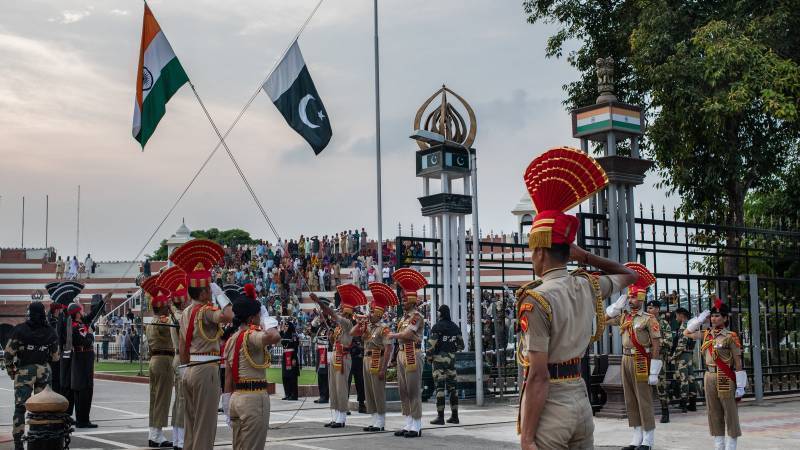
Undoubtedly, Pakistan has long contended with Indian hostility. There is no need to recount the communal slaughters of 1947, India’s reneging on commitments regarding Kashmir and its repression of Kashmiris, its role in helping East Pakistan break away, two major wars and many skirmishes that skirted near blow-ups, economic pressure, threats to Pakistan’s rivers, and its encouragement of insurrectionists within Pakistan. Conversely, India accuses Pakistan of plotting religious terrorism in Bombay, Delhi, and Kashmir, as well as assisting Khalistanis in Punjab, while also issuing nuclear threats.
Yet it remains a fact that Indians and Pakistanis, as individuals, find much in common and are quick to become friends—particularly those who share a common language and literary or musical traditions. There is a long history of living side by side as neighbours and friends, both in the subcontinent and abroad. However, this sentiment has not been nourished by either country since independence.
Is it not time to rethink the relationship between the two countries? Can Pakistan consider taking the initiative in redefining its relations with India? There are valid arguments for Pakistan to reconsider its long-standing stance toward India—without compromising national security or defence capabilities.
The purpose of this article is to offer the possibility of viewing the India–Pakistan situation from a different perspective—one that steps out of the age-old confrontational mode. This perspective assumes a strong commitment to dignified self-preservation when dealing with India.
We must begin by acknowledging and acting on the fact that Pakistan is a smaller, relatively less developed, and poorer country. India is 3.7 times greater in area than Pakistan. Its population is more than five times larger. India’s domestic GDP is USD 3.6 trillion (2023), while Pakistan’s GDP is USD 337.9 billion (2023), according to World Bank estimates. India’s economy is nearly ten times larger. Its per capita GDP is USD 2,480 compared to Pakistan’s USD 1,365—almost double. Life expectancy in India is 72 years; in Pakistan, it is 68. Even the extreme poverty rate (defined at USD 3 per person/day) is significantly lower in India (5.3%) compared to Pakistan (16.5%). India has foreign exchange reserves of USD 670.1 billion (2023), while Pakistan, with reserves hovering around USD 15 billion, remains under IMF protection to sustain its exchange viability.
The point is obvious: Pakistan lags behind on nearly all indices of economic and social power.
We in Pakistan must recognise that we are a middle-range power whose interests lie primarily in looking after internal affairs. Our goal should be to build a peaceful and prosperous country, potentially serving as a bridge between South Asia and the Middle East. Our focus should not be on competing with India or standing up to it on every issue.
In practical terms, this means beginning with lowering the rhetoric. On matters of national interest, our leaders and media should avoid boastful or confrontational language. Consider all the sloganeering about ‘death to Israel’ or ‘death to America’—such rhetoric has only ever served as an excuse for aggressors to inflict destruction, often leaving us in defeat.
In relation to India, we should present our point of view firmly but without threats or demands. We must show the confidence of a nuclear power capable of defending itself, but do so in measured, calculated language. Militaristic narratives should be avoided.
With trust-building on our part, we could then demand reciprocal measures from India including cessation of funding to Baloch or other separatists
The recent four-day skirmish with India—where the Pakistan Air Force performed well—should have been treated realistically. Instead, the media gloated, nationwide victory marches were staged, and a national leader, Bilawal Bhutto, boasted in New York: “We shot six Indian planes, we could have brought down twenty.”
Sitting here in Toronto and regularly tuning in to Geo News, I have cringed at its nightly ‘jaw-breaking’ victory narratives, repeated for weeks. As one Dawn columnist pointed out, the shooting down of six aircraft is not “payback” for the loss of half the country in 1971, despite what some commentators claimed. Such rhetoric has more potential to delude us than to frighten any adversary.
Undoubtedly, there are strident voices among Indian leaders and media. But we must show confidence by refusing to be provoked by Indian propagandists. The risk of overwrought rhetoric is that boastful claims become entrenched beliefs, distorting national perception.
Kashmir
Kashmir has remained a disputed territory between the two countries since independence. UN resolutions calling for a plebiscite have been ignored with impunity by India. The Indian state’s crackdown on Kashmiris continues, fostering violence and repression. Pakistan has tried almost every possible measure—from tribal lashkars and wars to fighter infiltration, appeals to world bodies, negotiations, and consistent moral support for Kashmiri rights—but most efforts have proven unfruitful.
Appeals to global powers to uphold UN commitments have produced no meaningful results. India has not been pressured even by Muslim-majority countries, many of which prioritise trade and political relations with it. Our speeches in the UN and resolutions in the OIC have become little more than ritualised gestures.
After nearly 80 years of armed and peaceful struggle, Pakistan is no further along than it was at the time of the initial armistice. We retain roughly a third of the former princely state as Azad Kashmir, and that is where the matter remains frozen. There is no realistic prospect of change on the ground.
India, meanwhile, has formally incorporated its part of Kashmir as a regular province, ended its special status, built a railway, and integrated the region into its economy.
Perhaps it is time we rethink our strategy and consider accepting this reality. This idea deserves serious consideration in the national interest. The Line of Control could be formalised as the international border between India and Azad Kashmir. President Musharraf once proposed such a solution—initiating even a bus service across the LoC—but the Kargil episode derailed the process. We can support Kashmiris in pursuing civil rights within the Indian constitution and work diplomatically to safeguard their peace and security.
Mutual Charges of Terrorism
The second major source of tension is the reciprocal accusations of terrorism and subversion. Both countries accuse each other of fostering unrest and deploying intelligence assets. There is virtually no mutual trust in this area.
Pakistan should take the moral high ground and initiate trust-building measures. Accepting the Line of Control as the de facto boundary in Kashmir would greatly enhance confidence in Pakistan’s intentions. This could be followed by a commitment to dismantle remnants of past militant outfits such as Lashkar-e-Taiba and its successor fronts. Plotting against neighbours should be made a criminal offence.
Bilawal Bhutto has proposed meetings between the intelligence chiefs of both countries, among other confidence-building steps. His suggestions merit serious, non-partisan consideration in the national interest.
With trust-building on our part, we could then demand reciprocal measures from India including cessation of funding to Baloch or other separatists. Public evidence suggests that actual hostile acts are far fewer than the exaggerated suspicions and conspiracy theories that plague both sides. This climate of distrust must be dismantled through firm, reassuring policies and actions.
Indus Water Treaty
The third emerging concern is India’s threat to walk away from the Indus Waters Treaty (IWT), signed in 1960 and guaranteed by the World Bank. Pakistan is entitled to waters from three western rivers—Indus, Jhelum, and Chenab—while India can build hydroelectric dams without affecting water flow. Now, in retaliation for recent military skirmishes, India is threatening to abandon the treaty.
This will not be easy, as the World Bank remains its guarantor.
Pakistan should pursue negotiations through the World Bank’s mediation, aiming to protect its water rights. Given the increasing impacts of climate change—melting glaciers, erratic rainfall, droughts—joint river management is in the interest of both countries. Pakistan, being dependent on these rivers for survival, has no choice but to ensure the treaty’s integrity.
The resolution of the Kashmir and terrorism issues would create a more conducive environment to resolve this new challenge. Calm, rational negotiations involving international bodies offer the best path forward. Any hint of nuclear retaliation only damages our credibility.
Conclusion
The crux of this proposal is simple: Pakistan should consider a new, realistic approach to its relationship with India. The historical confrontational stance has failed to resolve core disputes or foster neighbourly peace. By taking the initiative, Pakistan may, over time, thaw India’s rigid posture—building on centuries of shared culture and coexistence.
Reducing hostility with India is also critical for addressing Pakistan’s internal challenges. It would weaken religious militancy, open space for reconciling regional and ethnic grievances, and could stimulate economic recovery.
It is not traitorous to advocate realism. Nor is it a sign of weakness to extend a hand of neighbourly cooperation. With recent military and strategic confidence, Pakistan is well-positioned to shift gears and lead this process.