

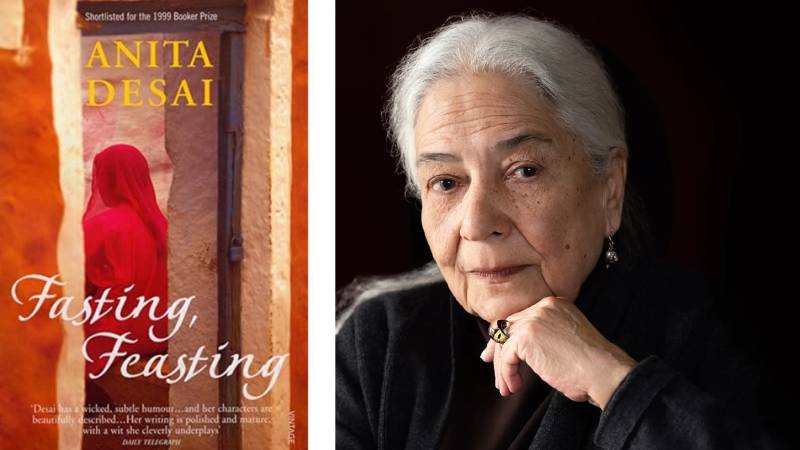
South Asian culture is kaleidoscopic and rich, and so are most of the novels set in its milieu. It feels fascinating that, as one sits in one’s study, one can, with the help of a book, take a round of other countries, households, places and events described or recorded decades ago. Anita Desai’s novel Fasting, Feasting is an epitome of the depiction of subtle yet profound differences that exist between cultures. Born in 1937, Desai is a world-acclaimed Indian author and Emerita John E Burchard Professor of Humanities at the Massachusetts Institute of Technology. Her other notable works include Cry, the Peacock, Fire on the Mountain, Clear Light of Day, and In Custody. While these novels explore the themes of obsession, solitude, memory and time, and cultural decay, Fasting, Feasting veers in and out of the theme of suffocating patriarchy and disturbing gender inequality.
Divided into two parts, the novel unfolds in the late 1970s in a town in India. It portrays the life of a middle-ranking government magistrate's household. The wife is at the beck and call of her husband. The first and major part revolves around the life of Uma, one of the two daughters of, as predominantly mentioned in the novel—or as Uma herself prefers to address—Mama and Papa. Reading between the lines, it can be safely assumed that Mama is always mentioned first whenever written as the combined MamaPapa, because she treats her elder daughter, Uma, with a little less rigidity than her husband. Through the character of Uma, Desai reveals how the unfairly treated siblings lag behind and suffer emotionally and psychologically over the course of their lives.
The narrative centres on Uma, the eldest daughter, whose academic struggles and health issues condemn her to a life of servitude within her own home
Being poor in studies, Uma is unable to get suitable grades and hence cannot keep herself going in the convent where she is enrolled. Moreover, she suffers a seizure, which makes it impossible for her to attend any institute and continue her education. Given this, she is sacrificed at the altar of household chores and handed over the responsibility of looking after her one and only younger brother, Arun. On the other hand, Aruna, who is younger than Uma, lives a fairly normal life. Now and then, she just helps with tending to Arun. Desai puts Uma’s feelings in the following words, “But ayah can do this ayah can do that - Uma tried to protest when the orders began to come thick and fast. This made Mama look stern again. 'You know we can't leave the baby to the servant,' she said severely. 'He needs proper attention.' When Uma pointed out that ayah had looked after her and Aruna as babies, Mama's expression made it clear it was quite a different matter now, and she repeated threaten-ingly: 'Proper attention.'”
Gender inequality is shown so embedded in the fabric of culture that when Anamika, cousin of Uma and Aruna, wins a scholarship to Oxford, it is merely used to lure suitable suitors for her. A girl like Anamika, with a bright future awaiting her, is married off to a man much older than her.
Apart from this, Uma bears the burden of two failed marriages, along with the temper tantrums of her father, who blames her for causing him enormous loss due to the unwanted dowry and the arrangements of the marriage functions. Conversely, the miserly father does not think twice before deciding to send his only son abroad for higher studies. Even the expenses of Aruna's wedding arrangements are borne with much displeasure. He gives in to Aruna’s demands, because, as Desai writes, “There were so many marriage proposals for Aruna that Uma's unmarried state was not only an embarrassment but an obstruction.”
The ordeal for Uma does not end here. Years pass by, and she continues to be burdened with more responsibilities. Aruna comes home to spend some days with her family and gives the charge of her newborns to Uma. Again, she is treated more like a house help than a sibling. But the last nail in the coffin proves to be the matter of Uma's career. Uma is offered a job, but on account of her parents’ choice, she cannot take up the role to begin her career—something she has given much thought to.
The first part of the title "Fasting" is symbolic of the meagre resources that are utilised while running the household. It can be gauged from the fact that if any guests come over and some sugar crystals fall on the shelf by mistake during the preparation of lemonade for them, the cook has to answer in case the sugar stock runs out before its due time.
The second part centres around Arun, who has gone to the United States to pursue his studies. Desai writes, “If one word could sum up Arun's childhood— or at least Uma's abiding impression of it—that word was 'education'.” His life is marked by the cultural differences that he observes during his stay, first at the university and then in the Pattons’ house, where he spends his summer holidays. Through Arun’s character, Desai puts forth the contrast between the reticent, frugal life he has lived back in India and the spendthrift, unruly life he experiences in the company of the Pattons. He keeps exploring his cultural identity and struggles to reconcile with the fact that things and familial relations are entirely different. If seen in the context of siblings, Arun is still the most privileged, though not much aware of it.
Fasting, Feasting makes for a perfect holiday-season read—slow-paced and sans any dramatic contours throughout the narrative. The language employed is symbolic and image-rich, replete with rhythmic words, contrasting registers and psychological insights. The novel simply shows how each character carries their hunger for freedom, even when the world around them refuses to change.