

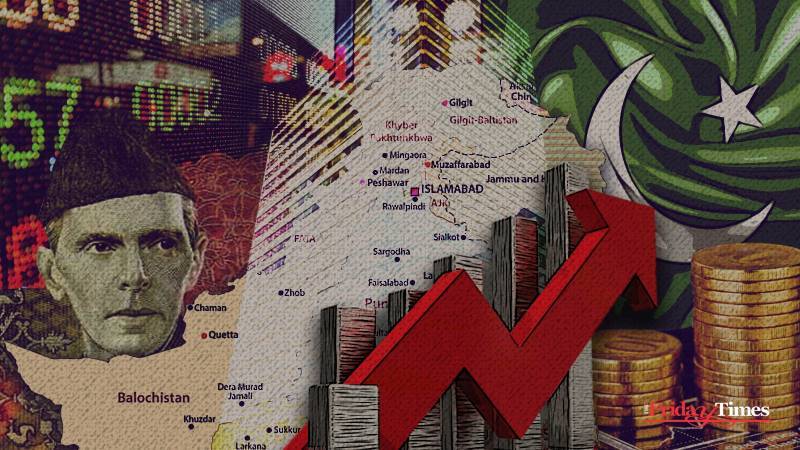
When political stability is absent, the wheels of an economy often move with difficulty. Pakistan's economic highs and lows have always been intricately linked to political turbulence. The dream of economic stability can only be realized when serious political harmony is fostered at the national level.
By March 2025, Pakistan has achieved some commendable economic indicators, but the question persists: Is this improvement temporary, or will it endure? In 2023, Pakistan faced a current account deficit of $1.1 billion, but the current fiscal year stands in stark contrast, with a surplus of $944 million. This is a promising sign. Furthermore, remittances crossed the $17.8 billion mark by March 2025, which serves as a reassuring economic indicator.
These statistics suggest that if the political system remains stable, the economy could indeed gain momentum. However, this optimistic outlook isn’t a product of sheer luck or chance. It comes on the back of several internal and external factors. The revival of negotiations with the IMF, strict control over imports, cautious export policies, and, perhaps most importantly, the trust of the Pakistani diaspora—are all integral pieces of the puzzle that point toward economic improvement.
Nevertheless, we must not forget that at one point, the price of electricity was raised from Rs 28 per unit to Rs 58, and now Prime Minister Shehbaz Sharif has managed to reduce it by Rs 7.48 per unit, bringing some relief to the public. However, this is not an extraordinary achievement. Oil prices on the global market have decreased, but domestic fuel prices have remained unchanged, as economic indicators and circular debt continue to restrain the government’s hand.
IMF delegations have visited Pakistan three times in recent months, not only to offer financial aid but to insist on implementing reforms and determining how governance should be carried out
As a political analyst, I’ve had the chance to witness these shifts not only in policy papers but also through firsthand political observation. Recently, along with fellow journalists I had a chance to have an informal conversation with Pakistan Peoples Party Chairman Bilawal Bhutto Zardari during an Iftar dinner at the Lahore Governor House. While his ambition to become Prime Minister was palpable, he also expressed a desire to maintain his individuality as a political leader. He expressed to keep his distance from the broader political parties and other establishments. Later after 3 days we were in making reconciliation tries with PTI which weren't fruitful at all.
It is noteworthy that, at the time, despite being part of the ruling coalition, Bilawal had refrained from taking any ministries. His decision to avoid high-profile government roles reflected his strategy to retain a unique identity while remaining an ally of the government. It’s interesting, though, considering his father, Asif Ali Zardari, holds the position of President of Pakistan, and yet Bilawal's reluctance to take on any ministries puzzled me. Bilawal, despite having been in Pakistani politics for over 15 years, still struggles with articulating issues like the economy and public welfare, especially when compared to seasoned leaders. Yet, only 9 days later, his tone shifted significantly. He spoke passionately about the need for national stability and cooperation with the government to move the country forward.
This shift in Bilawal’s rhetoric isn’t merely an isolated change of heart—it’s a reflection of a larger political mood. As Pakistan navigates its current challenges, the politics of reconciliation and patience are becoming increasingly vital. If leaders like Bilawal can embrace flexibility in their thinking and extend a hand for national stability, that could set the stage for much-needed harmony.
Amid all this, the critical question remains: Will Pakistan’s economy sustain its upward trajectory? Even with impressive remittances and a current account surplus, inflation remains high, and sectors like agriculture and manufacturing are yet to recover fully. Investment continues to be uncertain, and the overall environment for businesses and individuals is still shaky.
It’s a moment in time that requires politicians to rise above personal interests and chart a united course for the country. The impressive figures—$17.8 billion in remittances, and a $944 million surplus point to a direction of potential prosperity, but for these gains to endure, Pakistan needs a focused, unified approach. Otherwise, history may remember the present leaders as short-sighted.
Pakistan, at this juncture, cannot afford another round of turmoil. As Voltaire once said, “Optimism is the madness of insisting that all is well when we are miserable” — yet in the context of our emerging surplus, that same optimism can also be a call to action. These positive indicators are not a destination, but a nudge toward meaningful reform.
Pakistan’s foreign exchange reserves have shown some positive movement. While this is an encouraging trend, these reserves remain under pressure due to external debt repayments, which amount to over $22 billion in fiscal year 2025. Despite this, the government has managed to stabilise the currency somewhat. However, challenges loom on the horizon. The global economic landscape continues to shift, with fluctuations in oil prices and geopolitical tensions poised to affect the economy.
The bigger picture is clear Pakistan is not yet out of the woods. Its fiscal policy continues to face scrutiny, particularly in light of the ongoing agreements with international lenders such as the IMF. While the situation is far from disastrous, inflation persists, and agriculture and industry remain far from fully recovered. Achieving true recovery will require more than just short-term relief; it will demand long-term planning, clear strategies, and above all, political and national unity.
This is where the key challenge lies. How will the political leadership rise to the occasion? If the country's leaders can collectively focus on the greater good, understanding the gravity of the economic and political environment, they will be able to steer the ship through turbulent waters.
IMF delegations have visited Pakistan three times in recent months, not only to offer financial aid but to insist on implementing reforms and determining how governance should be carried out. They are expected to impose new targets on the Federal Board of Revenue (FBR) and the State Bank, signaling that Pakistan is still far from fully navigating its economic troubles. The continued presence of circular debt is a major roadblock, and without lasting policy reform, clear strategies, and national unity, economic stability will remain an uphill battle.
Economic revival is not a result of one signed agreement, one policy meeting, or one speech. It is a collective national effort, involving all sectors of society. The coming months and years will be a test of Pakistan’s resolve and unity. The question is: Will the nation rise to the challenge and move forward with a shared vision for prosperity?