

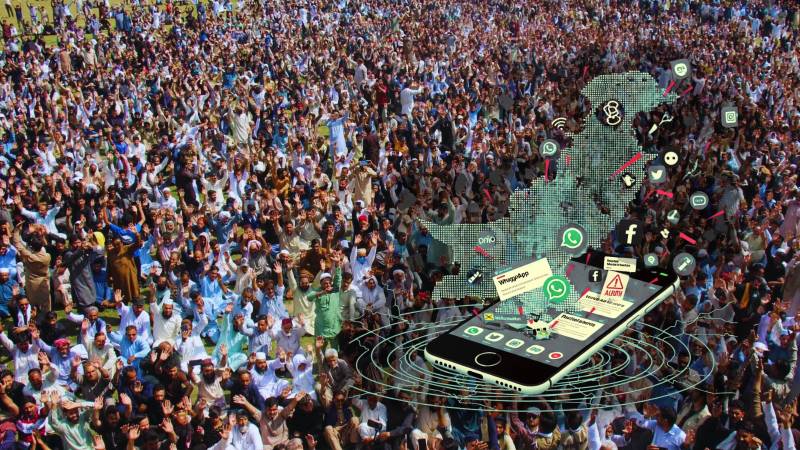
In recent weeks, Azad Kashmir has seen not just unrest, but a fight for credibility. The official media issued a totally disparate report when the Azad Kashmir Action Committee raised concern over the growing financial distress of the people and the lack of administrative interest. Official spokespersons held the organisers of the movement responsible for fuelling unrest, but news channels termed the action disruptive and politically motivated. The people of Kashmir, however, were not given a say of their own. Apart from distorting the script, their voices were stifled by the region-wide, nearly week-long shutdown of the internet and cellular services.
The ideal setting for misinformation propagation was provided by this information blackout. Accusations that the protests were violent and had a foreign dimension were promoted by social media accounts recycling official spin. On-the-ground reports, relayed through offline testimonies and virtual private networking, showed a largely non-violent movement driven by native autonomy, basic amenities, and economic relief. The government version had a monopoly on social media and television since journalists could not independently cross-verify claims due to a lack of connectivity. The end product was a meticulously woven fiction, with the government seeming to impose law and order even while there was a non-existent rebellion.
More than political appearances, the blackout had wide-reaching impacts. Entrepreneurs whose businesses rely on online commerce had to shut their shops in Mirpur and the surrounding areas. During test preparation, students could not talk to their teachers or view online study materials. Families whose members were working abroad had trouble staying connected with their relatives. The sudden recourse to silence felt like a step backwards into history in a world expanding exponentially under the impact of connectivity on daily life. The defence of the government, maintaining “national stability”, ignored the extreme psychological penalties of solitude, nervousness, and uncertainty. Citizens discussed restless nights when they could not even glance at the news or confirm that members of their family were fine.
Transparency makes for accountability, and silence cannot be the future of peace
This disaster also clarified a problematic trend within Pakistan’s broader strategy for information suppression. The repeated use of communication blackouts within Azad Kashmir and Gilgit-Baltistan reflects a strategy whereby suppression is the first reaction towards opposition. Reality is the first casualty when the state has a monopoly on all channels of information. Next, false information is a useful weapon for defaming legitimate public movements. Rulers shun assuming accountability for the policy failures that initially created the turbulence by framing non-violent protests as threats to national security. These tactics might deliver short-term political stability, but they perpetuate long-term suspicion between society and the government.
Besides the immediate consequences, the episode raises serious questions about Pakistani freedom of expression and ethical media practices. Government handouts and video releases have become increasingly vital for news desks across the country. Coverage of sensitive regions might intimidate self-reliant journalists. Citizens are thus presented with carefully selected portrayals of the world that further the ends of the administration. The pillars on which the very practice of democracy stands are weakened when people cannot make decisions based on information due to a lack of credible reporting. The events in Azad Kashmir are a chilling reminder that when censorship is routine, it tends not to stop at the border.
This atmosphere of misinformation also has troubling psychological repercussions. Individuals grow fatigued and baffled due to being constantly exposed to opposing narratives, which then makes them withdraw entirely. Besides having few work opportunities, young Kashmiris nowadays experience a confidence crisis towards the government and media. Individuals begin losing faith in the notion of justice when they cannot distinguish propaganda from reality. Long held together by endurance, the social fabric of the region threatens to break apart under the pressure of distrust and irritability.
The happenings in Azad Kashmir are not new. This is part of a growing trend occurring worldwide, whereby governments attempt to manage narratives through restricting information and employing misinformation for populist agendas. Nevertheless, such actions have particularly detrimental impacts within Pakistan, where public morale, already weakened due to political instability and financial adversity, is further eroded when information restrictions are enacted. These instigate hostility, which no blackout can bring to a close, and isolate communities that need to be incorporated, not marginalised.
It should begin with facilitating freedom of expression and advocating online liberty if it wishes to enhance domestic democracy and cohesion. Transparency makes for accountability, and silence cannot be the future of peace. Azad Kashmiris deserve better than a collection of tales; they deserve a voice. The regime ought to breach the information barrier, consult local leaders directly, and ensure the country makes its choice on the case based on a consensus of facts rather than propaganda. Pakistan might then be able to declare that it stands with, rather than above, its Kashmiri subjects.