

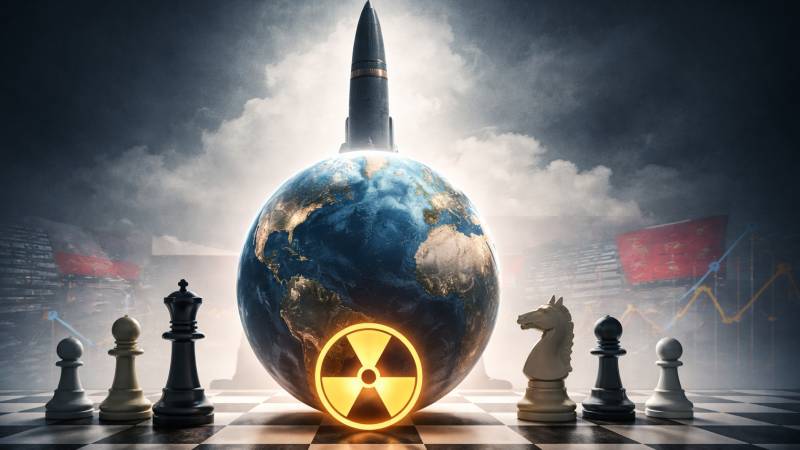
The brazen US action against Venezuela, culminating in the arrest of its sitting president, has once again exposed an uncomfortable truth of international politics: sovereignty is not a moral principle; it is a function of power. For countries watching from the Global South, this was not merely a Venezuelan episode; it was a reminder of how the world actually works when power asymmetries are stark, and deterrence is absent.
From the perspective of many states that have historically faced external pressure, it is difficult not to feel a grim sense of relief at possessing hard deterrent capabilities. Whatever a country’s internal weaknesses, economic fragilities, or political contradictions, the presence of nuclear weapons and credible long-range missile technology fundamentally alters how it is treated. That single fact alone forces even the most powerful actors to pause, calculate, and reconsider. No superpower or regional hegemon can act against a nuclear-armed state with the casual impunity on display in Venezuela. This is not triumphalism; it is realism.
Deterrence, particularly nuclear deterrence, remains the ultimate red line in a world where international law is selectively enforced and moral language often disguises raw power. The Venezuelan case underscores that countries without hard deterrence, even those with formal sovereignty and international recognition, remain vulnerable to coercive actions that would be unthinkable against states capable of inflicting unacceptable costs in return.
The global non-proliferation narrative rests on the assumption that restraint is rewarded and that international institutions offer protection. Yet history keeps contradicting this belief. Iraq dismantled its weapons programmes and was invaded. Libya abandoned its nuclear ambitions and saw regime collapse. Venezuela, militarily weak and economically isolated, has now witnessed a direct violation of its sovereignty at the highest level.
In contrast, nuclear-armed states, however problematic internally, are treated with extreme caution. North Korea, despite diplomatic isolation and economic fragility, has not been invaded. Iran’s nuclear threshold status itself has acted as a shield against direct military action. States possessing credible deterrence are pressured, sanctioned, negotiated with, but not physically subdued. The stark lesson many capitals will draw from Venezuela is blunt and unavoidable: deterrence works, norms do not unless backed by power.
It should therefore surprise no one if this unfortunate episode accelerates quiet reassessments in countries that have long relied on treaties, alliances, or goodwill for their security. Nuclear weapons and advanced missile systems are increasingly viewed not as instruments of aggression, but as insurance policies against coercion, humiliation, and selective application of the so-called international order.
Deterrence prevents the knock on the door, whereas state capacity ensures no one wants to knock in the first place
Feeling thankful for the protection afforded by deterrence is understandable. Strategic weapons buy space, space to negotiate, to resist diktat, and to avoid the most extreme forms of coercion. They ensure that even adversarial relationships are managed through pressure and diplomacy rather than force. But deterrence should not be mistaken for immunity. Nuclear weapons prevent direct invasion; they do not prevent sanctions, diplomatic isolation, economic strangulation, or internal destabilisation. Venezuela did not collapse simply because it lacked weapons. It collapsed because economic decay, institutional erosion, and international isolation made it strategically expendable.
This distinction is crucial. A nuclear arsenal is a shield, not a foundation. It can compensate for certain vulnerabilities, but it cannot indefinitely substitute for economic resilience, political legitimacy, and state capacity. The danger lies in allowing deterrence to breed complacency, naively assuming that because tanks cannot roll across borders, the state is secure. In reality, modern coercion rarely arrives on tanks. It arrives through financial systems, trade chokepoints, legal mechanisms, and narratives that delegitimise governments while normalising intervention.
Deterrence also imposes discipline on its holder. When escalation risks are existential, miscalculation becomes catastrophic. Nuclear-armed states must operate with greater strategic sobriety, not less. The double-edged nature of deterrence narrows the room for reckless behaviour even as it blocks external adventurism. This is where long-term security thinking must mature. Strategic comfort derived from weapons should translate into smarter diplomacy, not louder rhetoric, stronger institutions, not defensive nationalism, economic relevance, not isolation. Truly secure countries are not only feared, but they are also needed. Economic integration, trade leverage, technological relevance, and diplomatic networks create forms of protection that no missile technology can provide.
There is, however, a broader and more troubling consequence that cannot be ignored. Episodes like Venezuela do not merely affect the targeted state; they reshape threat perceptions across the international system and may well create a dangerous global ripple effect. When a superpower demonstrates that sovereignty can be overridden in the absence of hard deterrence, it sends a powerful signal to every strategically vulnerable country: restraint is a liability. This is how arms races begin, not from ideology, but from fear.
States that once invested in treaties, confidence-building measures, or conventional balances may now quietly conclude that only strategic weapons guarantee survival. If a new global arms race emerges, whether nuclear, missile-based, or through other forms of strategic deterrence, it will not be driven by reckless ambition, but by rational responses to precedent. In that sense, responsibility will lie less with those who seek deterrence than with those who have made deterrence appear indispensable.
The irony is plain. The very power that speaks most forcefully about non-proliferation may, through such actions, be undermining it. When enforcement is selective and power is unchecked, incentives tilt decisively towards militarisation. The world becomes not safer, but more brittle, more suspicious, more heavily armed, and less governed by restraint.
The Venezuelan episode strips away comforting illusions. It reminds us that in the final analysis, power still defines protection. Those who lack leverage must either acquire it or accept vulnerability. Deterrence prevents the knock on the door, whereas state capacity ensures no one wants to knock in the first place.
Ignoring either lesson risks repeating the same tragedy, in different capitals, under different pretexts, but driven by the same unforgiving logic of power. Today, we are living in an age where the architecture of international law, treaties, pacts, accords, and covenants is collapsing, not by accident but under the weight of powerful states in a world where power, money, and coercion trump rules.