

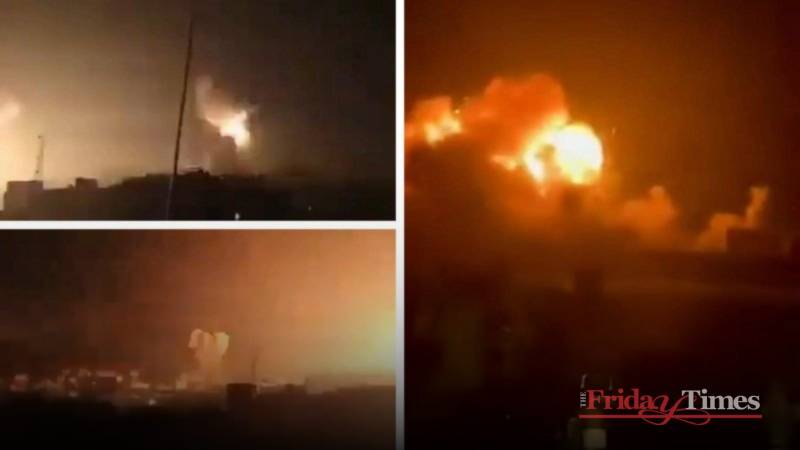
Immediately after the Indian missile attack over Pakistan and AJK in the early hours of April 7, the U.S President Donald Trump stated in the Oval Office that conflict escalation between the two neighbors was a matter of ‘shame’ but will end soon. He also pointed out that such an attack was predictable because something was going on, and the two countries have been in a state of confrontation for a long time. The U.S State Department was reported as stating that it was monitoring the situation closely. The U.N. Secretary General urged India and Pakistan to exercise maximum restraint, and a meeting of the UN Security Council held on May 6 and in a closed-door session, discussed the seriousness of Indo-Pak escalation of the crisis.
Almost two weeks after the Pehelgham terrorist attack in which 26 Indian tourists were killed, India has retaliated by hitting 9 sites in Pakistani Punjab and AJK. Reports about civilian losses of the Indian attack are pouring in, with Pakistan claiming to have given a matching response to the Indian attack.
Certainly, Indian operation ‘Sandoor’ is different than what had happened in Pulwama and Balakot in February 2019 because this time the situation is quite alarming. Can the present armed conflict between the two nuclear neighbors be de-escalated, and will the international community, particularly the United States, intervene to prevent a nuclear showdown in South Asia? Or like February 2019, in May 2025, crisis de-escalation will be done? Will India and Pakistan cross the red line and plunge South Asia into a total war? Reacting to the Indian missile attack, the Inter-Service Public Relations (ISPR) of Pakistan and the Prime Minister termed it as an act of war. According to the reports, Pakistan closed its airports and India few days ago conducted civil defense exercises by testing its air raid sirens.
The immediate cause of the Indian attack from New Delhi’s point of view is a terrorist act in Pehelgham, which enraged the people of India. Refusing to consider Pehelgham as a false flag operation, the Indian media and people at large called for seeking revenge. Unlike Pulwama of February 2019, in which several dozen Indian security personnel were killed in a terrorist attack, in Pehelgham, tourists were killed, and according to eyewitnesses, the attackers identified the religious identity of tourists, and after they were found as Hindus were shot dead.
Economic implications of war with India over Pakistan will be lethal, but New Delhi’s ambition to emerge as the world’s third-largest economy will be shattered
India refused to accept the Pakistani offer of holding a neutral international investigation of that attack. Islamabad condemned that attack and held the Modi government responsible for launching a ‘false flag’ operation like Pulwama of February 2019 for political consumption. In 2019, the BJP government used Pulwama to win the May-June 2019 general elections, and this time it is using Pehelgham to win state elections in Bihar. Using ‘Pakistan card’ in domestic politics of India has been the hallmark of the BJP and other Indian political parties for a long which reflects the contradiction in the policies of the Modi regime.
Following the escalation of the Indo-Pak conflict in the backdrop of a terrorist incident in Peshawar, one needs to examine how things will unfold and whether sanity will prevail between the two nuclear-armed neighbors or both will act in an irrational manner. If the situation on the ground is not stable and armed conflict between India and Pakistan leads to a conventional war in that case what will be the economic implications on the two countries?
India is confident that it can take care of the economic costs of conflict with Pakistan because it is the world’s fifth-largest economy, and by 2027, it will be third third-largest. But, New Delhi has undermined the fact that an armed conflict or even total war, barring the use of nuclear weapons, will destabilise India’s economy. Certainly, the economic implications of war with India over Pakistan will be lethal, but New Delhi’s ambition to emerge as the world’s third-largest economy will be shattered.
One needs to analyse the prevailing escalation of the Indo-Pak conflict from three angles. First, how far will the international community, particularly the United States, Russia, and China will intervene to prevent war in South Asia? In the past, particularly following the attack on the Indian parliament in December 2001, leading to an escalation in Indo-Pak tension and events of Pulwama and Balakot in 2019, the United States and other international players prevailed and succeeded in preventing an all-out war between the nuclear-armed neighbors. But, this time, the situation may be different because the manner in which India launched missile attacks over Pakistan and AJK, the result will be further escalation of their conflict. Pakistan’s retaliation against India will lead to counter-retaliation from New Delhi.
India’s strategy will be like the Kargil conflict of 1999 to escalate its troop mobilisation over international borders with Pakistan and take measures to block the coast of Pakistan by denying supplies to the port of Karachi. How far India will be able to sustain military confrontation with Pakistan along the LoC and international borders, including the maritime coast, is yet to be seen. It also depends on which strategic planners in Islamabad and New Delhi are able to control the situation. Hawks from both sides will try their utmost to sustain the present level of conflict.
Second, the Indian side is mindful of Pakistan not adhering to the ‘no-first use’ of nuclear strike in an armed conflict. New Delhi also knows that for every Indian retaliation, there will be counter-retaliation from Pakistan, and following the suspension of the Indus Water Treaty (IWT) and open threat by Prime Minister Narendra Modi of depriving Pakistan of water from the Indian side, Islamabad has termed such measures as an act of war. It will be alarming for the West, including the United States, of Pakistan’s threat to use nuclear weapons if India launches a conventional attack. There are voices in India arguing that India should abandon its ‘no-first use’ policy.
The Indian side is also suggesting that in order to prevent Pakistan from exercising the nuclear option, the United States should act fast and deprive Islamabad of its nuclear arsenal. How that option can be utilised by the U.S is yet to be seen, but Indian strategic minds are hoping that the U.S will act to denuclearise Pakistan, as it will not allow Islamabad to use nuclear weapons or the nuclear arsenal reaching the hands of Islamic extremists. For that matter, the U.S, after taking possession of Bagram air base in Afghanistan, is a case in point. That airbase, which was a strategic asset for the U.S, came under the Taliban control in August 2021, but the Kabul regime reportedly agreed to hand over Begram airbase to the United States for its use in the recent past.
According to analysts, Begram air base can be used by the U.S to deny Pakistan its nuclear arsenal under their possible activation and use in case armed conflict with India gets serious. Is the U.S is thinking in such terms is yet to be seen, but Indian strategic minds argue that time is very short and Washington must act now before it is too late and Pakistan decides to launch a nuclear strike against India. It is also argued by them that to activate nuclear weapons will take time, and the U.S has a system whereby it can be alerted and take steps accordingly.
Finally, unless the UN Security Council and other international actors like the European Union, Saudi Arabia, Japan, and others play an immediate role to de-escalate tension in the region, India and Pakistan will either continue with their military standoff or proceed further to launch new targets. It is expected that, before it is too late, the world will act and prevail over India and Pakistan to de-escalate tension. Failure to do so will result in a massive catastrophe in South Asia and beyond.