

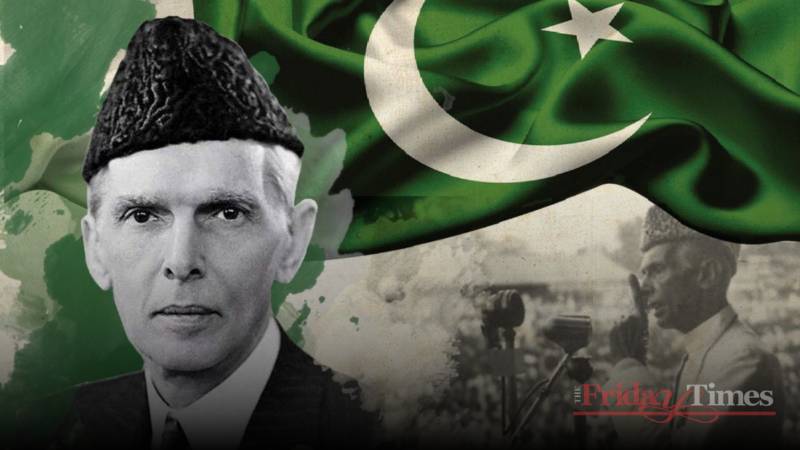
How does a modern Pakistani, living in the 21st century, approach the legacy of a founding father who was first and foremost a great barrister and secondly a consummate politician? I have spent most of my adult life obsessing over this question and have not yet found a satisfactory answer. I have done so not just as an admirer of Mr Jinnah, which I am, but also out of genuine interest in examining the vexed question of religion and state in Pakistan. That Jinnah was a cold-blooded logician, by his own admission, is well known—but that is what complicates his legacy even further. If the Two Nation Theory he championed from 1940 to 1947 confounds, even more complicated is the "Multiple Jinnahs" theory. In many ways, Jinnah’s own career represented the vicissitudes of Muslim South Asia. Unless we take into account his entire political career, it is impossible to solve this puzzle.
When Jinnah started his political career in 1904, it was firmly as an Indian nationalist in the Congress fold, ignoring altogether the Sir Syed school of thought which held that Muslims should stand apart from the Congress and Indian nationalism. Even in the 1920s when asked, Jinnah was given to saying, “I am an Indian first, second and last.” In the 1900s his Indian nationalism was even more pronounced. For example, when the famous Simla deputation met the Viceroy to seek special representation for Muslims, Jinnah vociferously condemned it as an example of the British policy of divide and rule. He was a trenchant critic of both the separate electorates and the All-India Muslim League. In 1910, Jinnah fought and won the election to a Muslim seat on the Viceroy’s Council as a Congressman—significantly defeating the pro-British candidate fielded by the Muslim League.
In 1913, when he finally joined the Muslim League (while simultaneously retaining his membership of the Congress), he put the condition to his sponsors that his “loyalty to the Muslim League and the Muslim interest would in no way and at no time imply even the shadow of disloyalty to the larger national cause to which his life was dedicated.” As a lawyer too, he continued to defend dissidents and political leaders accused of sedition, including notably Tilak before the Bombay High Court. As a legislator, Jinnah could be uncompromising and even stubborn, not just in his opposition to official British policy of privileging British bureaucracy over the natives, but also in his secularism. Speaking as early as 1912, Jinnah repeatedly asked the legislature to overrule religious law and custom, especially on the question of intercommunal marriage, arguing that nothing should stop the educated Indian classes from marrying freely and that laws requiring them to renounce their faith or for one party to convert to the faith of the other were inherently unjust and wrong.
At no point was anyone in the Muslim League allowed to bring forth and pass a resolution calling for an Islamic state, yet just six months after Jinnah’s death, his closest lieutenants overrode minority objections and passed the Objectives Resolution, which did precisely that
In his admirable crusade against child marriage during the Sarda Bill deliberations, Jinnah faced off both orthodox Muslims and Hindus, famously and quite bluntly telling his constituents to elect someone else if they wished him to back down from his support for the bill. When Section 295A was being added to the Indian Penal Code, Jinnah sought to protect bona fide academic criticisms of religion, and it was through his efforts that the words “deliberate and malicious” were added as necessary elements of the offence. Even as late as 1928, he was trying to get Muslims to agree to joint electorates and voluntarily give up separate electorates.
These enlightened positions did not, however, stop him—upon invitation from Punjab’s notable Muslims like Iqbal and M. D. Taseer—from boarding the train and taking up residence in Lahore’s Faletti’s Hotel to appear as the advocate in appeal against the conviction of Ilm Din, the hugely popular murderer of Rajpal in the aftermath of the Rangila Rasul controversy. In this case, he forwarded the usual criminal law arguments against the credibility of witnesses and, in the end, meekly argued for mitigation: that Ilm Din was only 19 or 20 years of age and had been motivated by feelings of veneration for the founder of his religion, and that it was for this reason that his sentence should be changed from death to life imprisonment. Mercifully, neither argument was granted by the Lahore High Court.
To be fair, the idea that Muslims of India saw themselves as a distinct people and entity was not Jinnah’s doing. A partition of India along religious lines would have happened regardless of Jinnah. Indeed, it is not surprising that he took up the cause—it is more surprising how long it took him to do so. Even as late as 1939, he insisted on changing the name of Mian Kifayet Ali’s scheme from “Pakistan” to “Confederacy of India.” In the days leading up to the Lahore Resolution, Jinnah called for the joint governance of the common motherland. Until March 1947, Jinnah was willing to accept a Pakistan that was an autonomous region within a united India. As perceptive historians like Anil Seal and jurists like H. M. Seervai have noted, it was not Jinnah who wanted partition but the Congress party.
On 11 August 1947, days before the creation of Pakistan, speaking as the president of the Constituent Assembly of Pakistan, Jinnah did a volte-face on the Two Nation Theory—as if the old Jinnah who had championed a secular Indian nation above all else was reborn. Arguing that it was this division that had led to the subjection of the Indian nation for close to 200 years, he called for a Pakistan where Hindus would cease to be Hindus and Muslims would cease to be Muslims, “not in a religious sense, for that is the personal faith of an individual, but in a political sense as citizens of the state” and “religion, caste or creed had nothing to do with the business of the state.” This speech caused enormous backlash from his supporters, who wondered if their Quaid-e-Azam had abandoned the basic principle on which Pakistan was founded.
Anxious to allay their fears, Jinnah made his speech at the Karachi Bar Association, where he said that the Constitution of Pakistan would not be in conflict with Sharia and that Islamic principles promised democracy and equality of all, including the minorities. Certain sections also date an alleged letter from Jinnah to Hassan al-Banna of the Muslim Brotherhood asking him to aid in making his government purely Islamic around this time. I say “alleged” because there is absolutely no primary source evidence for this letter. In March 1948, Jinnah declared: “Pakistan is not going to be a theocratic state—to be ruled by priests with a divine mission. We have many non-Muslims—Hindus, Christians, and Parsis—but they are all Pakistanis. They will enjoy the same rights and privileges as any other citizens and will play their rightful part in the affairs of Pakistan.”
The same month, he vetoed a bill by the Punjab Assembly seeking to enshrine Sharia as part of statute. This was not the first time Jinnah had vetoed attempts to tie down Pakistan to a religious policy. In 1943, he vetoed a resolution in the Muslim League calling for the establishment of Hukumat-e-Ilahiya in Pakistan (i.e. a government of God based on the model of the rightly guided caliphs of Islam). In 1944, he vetoed a resolution calling for the expulsion of Ahmadis from the Muslim League. At no point was anyone in the Muslim League allowed to bring forth and pass a resolution calling for an Islamic state, yet just six months after Jinnah’s death, his closest lieutenants overrode minority objections and passed the Objectives Resolution, which did precisely that.
Jinnah is a bulwark against those who want Pakistan to become a theocratic state to be run by priests with a divine mission
Would Jinnah have endorsed such a resolution? In my opinion, no—but regardless, we have the resolution from people who knew him better than the rest, such as Liaquat Ali Khan and Zafrullah Khan. The political expediency which necessitated the resolution is clear to any student of history so far as Liaquat Ali Khan is concerned, because when Liaquat met Nehru the next year, he explained away the resolution as merely one concerning personal law. Zafrullah Khan, on the other hand, seems to have felt very deeply that an Islamic state formed under the Objectives Resolution would treat all citizens equally regardless of their religion.
What we get from Jinnah’s seemingly public retreat from his position that religion should have nothing to do with the business of the state—or that religion was merely a matter between man and God—and from Liaquat Ali Khan’s pusillanimous surrender to the dictates of religious actors like Maulana Maududi outside the assembly, is that the Muslim majority in Pakistan wanted some expression of their Islamic identity in the Constitution. Jinnah probably wouldn’t have objected to ceremonial deism, and Liaquat Ali Khan probably intended it to be that, but the Objectives Resolution went beyond ceremonial deism. It circumscribed democracy with the line “as enunciated by Islam” and by limiting the exercise of this democracy within the permissible “sacred” limits of Islam. I don’t think Jinnah would have endorsed it.
Jinnah was a man of many contradictions, no doubt. In the view of this writer, the speech made to the Constituent Assembly takes precedence over his generally vague statements about democracy being compatible with Islam or Islamic principles. We must also recognise that a popular leader can often get trapped—or become a prisoner to—their own followers. Jinnah’s dilemma was perhaps best articulated by his great opponent Jawaharlal Nehru, who penned this extraordinary, if partisan, portrait of Jinnah’s role in the Muslim League as well as Indian history:
“Mr M. A. Jinnah himself was more advanced than most of his colleagues of the Moslem League. Indeed he stood head and shoulders above them and had therefore become the indispensable leader. From public platforms he confessed his great dissatisfaction with the opportunism, and sometimes even worse failings, of his colleagues. He knew well that a great part of the advanced, selfless, and courageous element among the Moslems had joined and worked with the Congress. And yet some destiny or course of events had thrown him among the very people for whom he had no respect. He was their leader but he could only keep them together by becoming himself a prisoner to their reactionary ideologies. Not that he was an unwilling prisoner, so far as the ideologies were concerned, for despite his external modernism, he belonged to an older generation which was hardly aware of modern political thought or development... He had left the Congress when the organisation had taken a political leap forward. The gap had widened as the Congress developed an economic and mass outlook. But Mr Jinnah seemed to have remained ideologically in that identical place where he stood a generation ago, or rather he had gone further back, for now he condemned both India's unity and democracy... It took him a long time to realise that what he had stood for throughout a fairly long life was nonsensical... Mr Jinnah was a different type. He was able, tenacious, and not open to the lure of office, which had been such a failing of so many others.”
So we take in stride that Jinnah was a politician who, while principled and without the lure of office, had become entangled in a blanket that he found hard to rid himself of. I certainly don’t subscribe to the school of thought forwarded by Pervez Hoodbhoy and his ilk who propose to jettison Jinnah altogether. Whatever the contradictions on the issue of the actual role of religion in the state, Jinnah was remarkably consistent on two points:
- That Pakistan shall not be a theocracy.
- That all Pakistanis, regardless of their religious belief, would be equal citizens.
It is not just about the now four percent minorities in Pakistan, but about those Pakistanis who choose not to believe as well. In recognising Jinnah’s contradictions, we must not throw the baby out with the bathwater. Jinnah is a bulwark against those who want Pakistan to become a theocratic state to be run by priests with a divine mission.
The idea of jettisoning Jinnah is not new. Allama Shabbir Ahmad Usmani had told his colleagues in Deoband to look at Jinnah as the British Christian captain of the ship headed for Hejaz. Relegating Jinnah and his liberal secular ideology was always the game plan for both the religiously orthodox as well as others in the League. Many of them saw Jinnah as nothing more than a vakil who could then be dismissed. We—who care about Pakistan—must resist any such attempt to do so. Jinnah’s political career and his clear pronouncement on 11 August 1947 are inconvenient facts for those who would want to fashion Pakistan in accord with their own narrow-minded ideas about the country. Everyone who wants a secular, democratic Pakistan must press ahead with these inconvenient truths. It is a foothold that none of us can afford to cut off.