

From the cricket pitch to the corridors of global diplomacy, Pakistan has once again found itself at the centre of international headlines. On the sporting front, the news has been less than encouraging for its fans. Yet, in the realm of global politics, Pakistan appears to be gaining a new momentum. Whether it is the much-touted discovery of oil and gold reserves, the state’s swift response to India’s Operation Sindoor, President Donald Trump’s unexpected words of praise, or the recent signing of strategic agreements with Saudi Arabia — Pakistan’s visibility on the world stage seems to be expanding in striking ways. This sudden prominence raises important questions: why is Pakistan, long perceived as a struggling or transitional economy, now capturing the attention of global powers? And more crucially, what does this shift signal about its trajectory?
The year 2025 in many ways was a turning point for Pakistan. After nearly three years of internal and external turbulence, the country finally seems to be moving on the right path, at least on the international front. At home, political and social challenges persist. However recent mineral findings provide a glimmer of hope.
The discovery of vast copper and gold reserves, estimated at around $60 billion, has attracted the attention of global investors. According to a feasibility study, the mining is to be powered entirely by solar, and a remarkable 25% rate of return is projected. In June, Barrick and Komstau finalised a $440 million equipment deal for the Reko Diq mine, with a broader $7 billion investment commitment. Adding to this momentum, significant gold deposits worth nearly PKR 800 billion were discovered in Attock earlier this year.
Oil, which accounts for nearly one-fifth of Pakistan’s total imports, has long been playing a key role in inflationary pressures and trade imbalances. Recent reports of oil reserves discovered in Pakistan’s territorial waters have therefore generated excitement and scrutiny. At a time when traditional oil-rich states are experiencing gradual depletion of reserves, and the Middle East remains embroiled in conflict, the possibility of Pakistan emerging as one of the world’s largest reserve holders is geopolitically significant. Such a discovery would not only reduce Pakistan’s dependence on oil imports but could also reposition the country as a potential supplier within the global energy market. This growing resource profile has already drawn international attention. US President Donald Trump, in a rare public acknowledgment, went so far as to suggest that Pakistan might one day export oil to India. More concretely, recent MoUs signal a $500 million US investment in Pakistan’s mineral sector.
For a struggling economy, these shifts represent Pakistan’s potential to leverage its resource wealth into long-term strategic influence, provided that governance, transparency, and sustainability are not compromised in the process.
Another defining moment for Pakistan in 2025 came through its military response to India’s Operation Sindoor. Following the Pulgham attack, India claimed that Pakistan was the main culprit behind the attack, and as a result attacked several sites within Pakistan. Pakistan’s counter-operation, codenamed Buyan al-Marsoos, demonstrated an unexpectedly robust show of force in which Pakistan Air Force downed six Indian aircraft, including Rafales, which were touted for their stealth capabilities. Additionally, the launch of Shaheen-I missiles successfully destroyed several military installations across the border, forcing India to table talks for cease-fire.
Strategically, the operation signalled to the global community that Pakistan remains a capable and unpredictable military power. The response, which displayed technological sophistication and precision, caught many international defence analysts off guard, which ultimately underscores Pakistan’s advanced deterrence capacity. For Pakistan, this was more than a tactical victory, it elevated the country’s standing in the international security circles, ultimately reinforcing its image as a state that cannot be sidelined in South Asia’s military balance.
In the last conflict with India, China played a pivotal role as it provided intelligence support as well as advanced weaponry, cementing itself as Islamabad's leading security partner. On the issues of defence, China has also become Pakistan's leading trade partner and largest investor
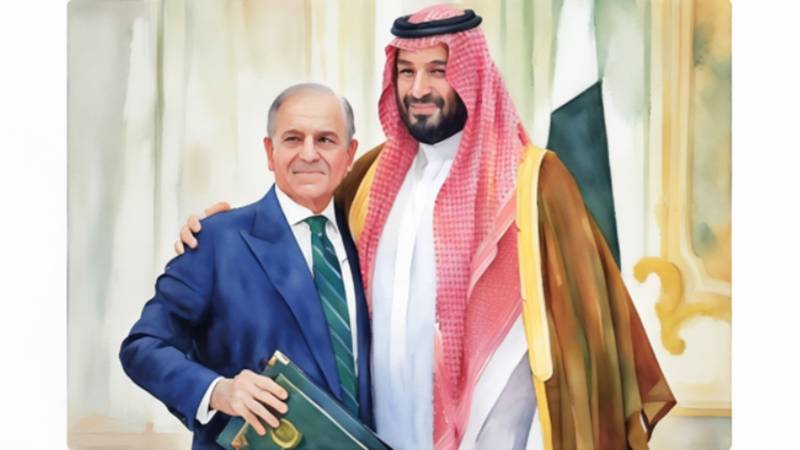
Pakistan’s elevated image in the international security circles can further be cemented by the fact that Islamabad achieved a major breakthrough with the signing of the Strategic Mutual Defence Agreement with Saudi Arabia, which is publicised by some as the first “Muslim NATO.” The pact commits both states to treat aggression against one as aggression against the other, while expanding cooperation across conventional forces, nuclear policy, and intelligence sharing. Although its full scope remains undisclosed, the agreement signals a historic shift in Gulf and Asian security alignments.
The move comes amid waning trust in Washington following Israel’s strikes in Qatar. Saudi and Pakistan have seized the moment to present an alternative security framework, which other GCC states may eventually join. For Pakistan, the deal offers both prestige and leverage: it reinforces its role as the only Muslim nuclear power and secures vital Saudi economic support at a moment of internal fragility.
Nonetheless, there is a caveat which is equally significant. India can perceive this is a threat to itself, and the pact can heighten tensions with Delhi and provoke sharper scrutiny from Washington and Tel Aviv, both already uneasy about Pakistan’s nuclear posture. The Agreement can also bring Tel Aviv and India closer, which could potentially create a diplomatic squeeze for Islamabad. Therefore, while Pakistan’s image in Islamic geopolitics is elevated, there still lies a risk for geopolitical frictions with the West.
Relations with Washington, however, appear to be on an upward trajectory. In recent months, frequent engagements between the civilian and military leaderships of both states have signalled a thaw. President Trump has gone as far as to describe Pakistan’s Prime Minister as a “great man,” while also extending rare praise to the Pakistani military for its performance in Operation Buyan al-Marsoos. On the economic front, Pakistan has benefited from the lowest US tariff rate in South Asia (19%), which is even lower than that imposed on India, traditionally a far stronger trading partner of Washington. Added to this are the recently signed MoUs in the mineral sector, which have paved the way for American firms to invest half a billion dollars into Pakistan’s resource economy.
Together, these advances portend more than symbolic goodwill; they portend a possible strategic alliance entwined with economic opportunities, resource diplomacy, as well as a re-evaluation of long-standing alliances.
Islamabad, however, must be prudent. History remembers that the relationship between the US and Pakistan, even if often mutually beneficial, has rarely shown stability. Pakistan once was a valuable ally during the Soviet invasion of Afghanistan, providing valuable support to Washington's regional plan. But after the Soviet exit, this alliance fell apart into sanctions as well as diplomatic isolation. Such precedents still throw long shadows even to the present day. As such, even as Pakistan may be regaining significance before the United States through geography, resources, as well as military value, it must be careful. To secure long-term gains, Islamabad will need to base this rapprochement on common interests rather than temporary convenience, thus ensuring historical patterns do not recur.
China remains considered one of Pakistan's most reliable and constant allies, a relationship that has become more vigorous as Beijing rises to the ranks of a global superpower. In the last conflict with India, China played a pivotal role as it provided intelligence support as well as advanced weaponry, so cementing itself as Islamabad's leading security partner. On the issues of defence, China has also become Pakistan's leading trade partner as well as largest investor, as initiatives such as the China-Pakistan Economic Corridor (CPEC) reshape Pakistan's infrastructure, energy landscape, as well as connectivity potential.
In February 2025, Asif Ali Zardari's state visit to Beijing again strengthened these ties. The two sides agreed to widen trade and investment, push through long-pending CPEC projects, and expand defence and security cooperation. Notably, the agenda also included technology as well as education, where agreements were signed to encourage digital innovation as well as academic exchange. For Pakistan, the rewards of this relationship are multiple: Chinese investment provides an economic lifeline, enhanced defence cooperation beefs up deterrence, while cooperation in the fields of technology as well as education holds the key to long-term building up of capacities. At a time of global shifts in alignments, the relationship of Pakistan with China, therefore, continues to be simultaneously a source of strategic anchor as also economic resilience.
As the year 2025 progresses, Pakistan stands at a unique juncture; while it continues to grapple with internal challenges, its external relations convey strength, potential, and a newly discovered significance. The alignment of resource discoveries, military assertiveness, and strategic alliances with nations as varied as Saudi Arabia, the United States, and China has propelled Islamabad back into global prominence. The extent to which this period translates into a prolonged ascent will hinge not only on the nation’s ability to leverage these advantages but also on its capacity to mitigate risks, avoid excessive reliance, and ensure that economic benefits are directed toward structural reforms. For Pakistan, the promising future that appears attainable will necessitate more than mere luck—it will require foresight, stability, and the political determination to transform potential into permanence.