

The US-Iran war has entered a dangerous new phase. With American and Israeli airstrikes entering their second week, Washington is quietly pivoting to a strategy as old as empire itself: activating the Kurds for a ground war against Tehran.
Only a day after the start of Operation Epic Fury, on 1 March, President Donald Trump held telephone discussions with the two strongest leaders of the Kurdistan Region of Iraq: the Kurdistan Democratic Party (KDP) representative Masoud Barzani and the Patriotic Union of Kurdistan (PUK) representative Bafel Talabani.
According to Axios, these talks were facilitated by Israeli Prime Minister Benjamin Netanyahu, following several months of behind-the-scenes lobbying. The message sent by Washington could not have been clearer: America wants the Kurds to wage its war.
To the Kurds, this is bitterly ironic in historical terms. Under the Shah, Iran had been in full support of Kurdish rebels against Baghdad. Today, the roles are reversed. Washington is now trying to arm the Kurds against Tehran.
The epicentre of this crisis is the capital of the autonomous Kurdistan Region in Iraq, Erbil. Four armed drones were shot down on 2 March over the US military base at Erbil International Airport. Islamic Resistance in Iraq, an Iran-backed group, has taken responsibility for various attacks. Prime Minister Masrour Barzani has denounced these attacks.
But Baghdad is in an impossible situation. Prime Minister Mohammed Shia Al Sudani insists that "the state, through its institutions, alone possesses the right to decide on war and peace" and has vowed to prevent anyone from "dragging Iraq into conflicts." Yet Iraq is already being dragged.
The reality is stark: without Iraqi territory as a supply line and staging ground, any US-Kurdish operation against Iran would be almost impossible. Iraqi soil has become America’s rear area in the war. The Iraqi government faces an archetypal dilemma: by choosing to side with Washington, it risks division along Shia-Kurdish lines; by siding with Tehran, it loses Western support and faces potential internal uprisings.
The rationale in Washington is that, with aerial support, these forces could hamper the Iranian Revolutionary Guards Corps, establish a buffer zone, and even trigger a larger revolt
Another volatile dimension lies in Syria to the west. In January 2026, the interim government in Syria, led by Ahmad Al-Sharaa, and the Kurdish-led Syrian Democratic Forces (SDF) signed a comprehensive integration agreement, under which the SDF agreed to participate in Syrian state institutions. It was a small yet significant step towards stabilising northeast Syria.
That deal is now threatened. Should the United States actively support the SDF as part of a wider approach against Iran, Damascus will abandon the January agreement. A US-backed Kurdish group operating on Syrian territory will not be condoned by the Syrian government. This scenario could trigger a new Syrian civil war just as the country appeared to be moving towards resolution.
Another dangerous variable is Turkey. Ankara has spent decades fighting the PKK, which it designates as a terrorist organisation. Just days before the ongoing war, jailed PKK leader Abdullah Öcalan demanded new laws to further reconciliation and urged Turkey to embrace a legal framework to achieve peace. These steps were welcomed by President Recep Tayyip Erdogan.
All of this could unravel in a single night if the United States mobilises the SDF – which Turkey views as a branch of the PKK in Syria – to act against Iran. Ankara has repeatedly warned that it cannot accept any empowerment of Kurdish forces across its border. If the peace process in Turkey collapses and violence resurfaces in southeastern Turkey, its repercussions will be felt far beyond the region.
America has faced similar scenarios before. In 2003, Washington realised it could not control Iraq without Kurdish cooperation. Again, the SDF proved to be America’s most trusted ground ally during the anti-ISIS campaign. The pattern is familiar: local allies are employed and later discarded.
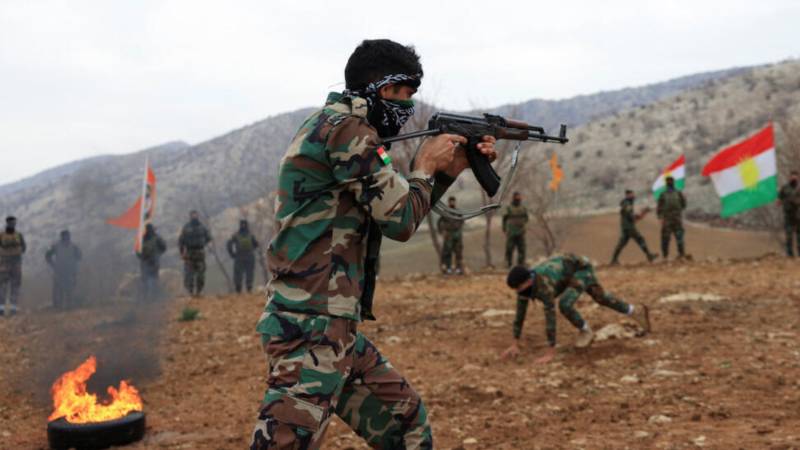
Now, Trump seems to believe that the Kurds can serve as the ground army, replacing America’s own ‘boots on the ground’. Several thousand Iranian Kurdish fighters are active along the Iran-Iraq border. The rationale in Washington is that, with aerial support, these forces could hamper the Iranian Revolutionary Guards Corps, establish a buffer zone, and even trigger a larger revolt.
However, former US officials have raised concerns. Ex-State Department official Jen Gavito cautions that arming Kurdish factions will only exacerbate instability in the region, undermine Iraq’s integrity, and empower rogue armed groups.
What will Iran do? Activate its proxies against Kurdish cities? What happens if the weak government of Baghdad collapses? What if Turkey’s peace process fails and the PKK resumes armed conflict? What becomes of Syria’s January accord?
This strategy will thrust the Kurds into an active role, deemed useful by Washington. Yet for Iraq, Syria, Turkey, and Iran, that utility comes at an exorbitant cost. The United States may believe it can calibrate its intervention, but the Middle East does not allow calibration; it operates like dominoes.