

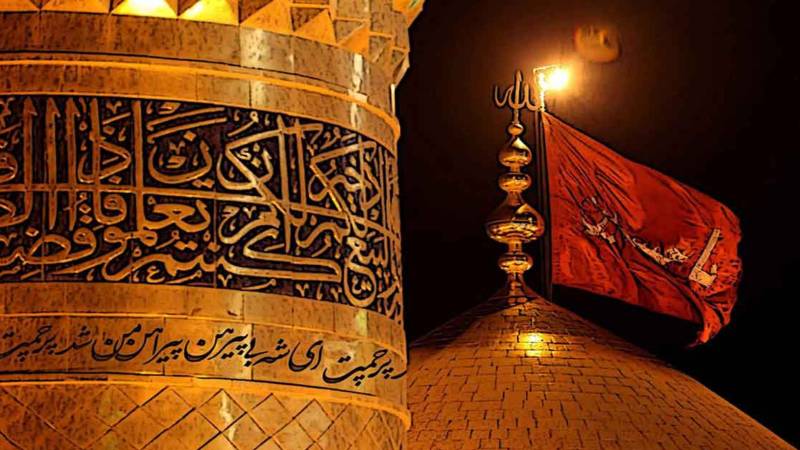
The almost 1,350-year-old refusal of Imam Hussain, the grandson of the Prophet Muhammad (PBUH), to pledge allegiance to the unjust and incompetent ruler Yazid was an act with monumental moral, spiritual, and ethical dimensions. It was far more than a mere power struggle.
Events, especially those that unfolded between Imam Hussain’s refusal to pay allegiance to Yazid, to supporting the people of Kufa’s call to actively resist Yazid and finally the martyrdom embraced by the majority of his 72 companions, speak of a profoundly principled resistance. Imam Hussain did not rise for power. He rose to preserve the essence of Islam, the purity of Allah’s message, his grandfather Allah’s Beloved Prophet Muhammad (PBUH), and his father—the Prophet Muhammad’s declared spiritual successor Imam Ali A.S.—tutored him.
When Imam Hussain ultimately left Medina with a small caravan of companions and family—numbering just 72 souls—it was not a military campaign. It was a procession of conscience. Among them were the most vulnerable: his six-month-old infant son, his little daughters, his valiant sister, and his aged companions. From children to elders, this group embodied the complete human spectrum—innocence, wisdom, courage, and devotion.
As the battle of Karbala, an acutely asymmetrical battle, would unfold, the world would witness the unique and glorious martyrdom that would remain etched in all human hearts and minds who refuse to surrender before numerical and brutal strength… who would instead embrace the strength of human goodness. Hussain’s martyrdom would live till the end of time… as will the conviction that justice and humanity trample power… a conviction writ large 1,400 years later on the starving, brutalised, fragile yet iconic Palestinians.
Subsequently, the events that led to the martyrdom of the Prophet’s beloved grandson were heart-wrenching. They were soul-stirring, soaked in tragedy and grandeur. In the plains of Karbala became a theatre of profound paradoxes—the beautiful and the ugly, the sacred and the profane, the divine and the brutal—all coexisted.
We witnessed Yazid’s forces preventing Imam Hussain’s caravan, the Prophet’s family including infants, access to the Euphrates water. Yet, in the face of this barbarity, what emerged from Hussain and his companions was a commitment to compassion, dignity and truth, that has echoed through centuries.
At Karbala it was compellingly demonstrated into eternity that without living by the ethics of Islam, the mere label of Muslim does not automatically enable us to join the ranks of Allah’s believers
Karbala was not merely an event in world history. It was, and remains, a defining moral lesson—a testimony to Islam’s emphasis on unwavering ethical conduct, even in the darkest of hours. The martyrdom of Karbala was the ultimate embodiment of Islamic values. The stand taken by Imam Hussain illuminated several foundational principles of Islam that ought to guide believers today. Seven are noteworthy:
One, standing against oppression. Imam Hussain refused to pledge allegiance to Yazid’s oppressive and morally wanting regime. Instead, the Imam stood with the weak, the voiceless, and the oppressed even at the cost of his life. When letters poured in from the people of Kufa, begging him to lead them against Yazid’s rule, the Imam consented to protect the spiritual and ethical message of Islam from being co-opted by tyranny. His journey to Karbala was an act of moral defiance.
Two, resisting oppression. Islam, often referred to as a complete way of life, is not just a personal moral code—it is a guide for the individual and the collective. Imam Hussain’s stand was with the oppressed, the weak, the vulnerable—the orphans of society. His refusal to bow to tyranny was a message for all times: never remain silent in the face of injustice.
Three, leadership is an acute responsibility not a privilege; hence leadership in Islam is not about command, instead it is about accountability towards Allah and His people. It is about guiding those you are accountable for, defending their rights, and leading by example. Imam Hussain showed that leadership requires courage, sacrifice, and a willingness to sacrifice for the sake of truth and justice.
Meanwhile, at Karbala, Hussain’s leadership was mindful of not burdening those not in leadership roles. While he guided his companions at Karbala, on the night of Ashura, Imam Hussain extinguished the lamp in his tent and gave his companions the option to leave, saying: “I release you from your pledge to me. The enemy wants only me; you are free to go.” Yet, not one left.
Three, Islam calls for substance over mere label. Every act and decision of Imam Hussain at Karbala demonstrated this ethics, courage and unflinching conviction of purpose in accordance with the Islam he imbibed from the teachings of Prophet Muhammad (PBUH) and from Imam Ali—teachings in contrast to other opportunistic outlooks of Islam. After all, at Karbala it was compellingly demonstrated into eternity that without living by the ethics of Islam, the mere label of Muslim does not automatically enable us to join the ranks of Allah’s believers. Could slaughtering the family of Allah’s Beloved Prophet (PBUH), who he personally raised, be a qualifying trait to enter the ranks of believers?
Four, Islam demands from us consistent goodness, not selective ethics. True goodness, as taught by Islam, is not dependent on convenience or personal preferences. Stay with the good, the ethical even in the face of betrayal or hostility. At Karbala, when Hurr ibn Yazid, one of the commanders in Yazid’s army, first intercepted Imam Hussain’s caravan and denied them access to water, Imam Hussain still gave water to Hurr’s soldiers and even their horses at a time when he himself was rationing water. Later, when Hurr repented and joined Hussain, the Imam embraced him with grace. In the Prophet’s (PBUH) household the Imam had witnessed goodness in action at all times, under all circumstances—regardless of the trials and tribulations they faced. Imam Hussain upheld this stellar tradition even on the battlefield, when facing death, destruction and dispossession.
The legacy of the iconic Imam belongs to the human race, not to any one religion
Five, at Karbala, integrity was upheld despite the hell the Imam and his family faced. To be truly among Ashraful Makhluqaat—the noblest of Allah’s creation—a person’s character must be whole and undivided. Integrity means that one’s actions, words, and inner values align. From financial honesty to fulfilling promises, from kindness to elders to maintaining relationships, Islam calls for unity of character. Imam Hussain and his companions, at the ultimate testing times in Karbala, were a model of integrity in action—never compartmentalised, always holistically congruent. As they suffered hunger, thirst, and death, their conduct reflected integrity in worship, speech, action, and relationships.
Despite all the unspeakable suffering and torture, despite being denied water for three days, no ethical code was ever violated by the Prophet’s family. On the battlefield, Hussain honoured Islam’s rules of engagement his grandfather had tutored and himself followed. He did not attack first, nor allow cruelty, even when under siege. Respect for elders, and care for the young, all stood intact—because in Karbala, faith was not compromised for survival.
After Imam Hussain’s martyrdom, his sister Bibi Zainab A.S. led the remaining ill, injured and tortured members of the Prophet’s family. Speaking truth to power, Bibi Zainab at Yazid’s court quoted from the Holy Qur'an to warn him of what awaits him. For example, from Surah Al-Imran, Bibi recalls: "Do not be satisfied with this temporal achievement; this time passes quickly and Allah will punish you. You will be humiliated."
Six, with no mission or no position does Islam allow licence to violate ethics. In Karbala, Imam Hussain showed that even a righteous mission against oppression and tyranny does not permit even the Prophet’s family and all others to transgress in thought, word, or deed. In Islam, the ends do not justify the means. No matter how noble your mission, it does not grant you a licence to violate ethical codes. At Karbala, the Imam’s mission was not defined only by its purpose but also by the purity of the methods, word, and deed.
Seven, Islam demands steadfastness on the path of truth. Karbala stands as the supreme testimony to this. Despite unbearable suffering, despite the loss of his loved ones, Imam Hussain never wavered. He embraced martyrdom with grace and gratitude to Allah. His sacrifice of 72 companions was not for power—it was for preserving the soul of Islam. Even when his six-month-old son Ali Asghar’s neck was pierced by Hurmala’s arrow as he lay in his arms, Hussain did not waver from his stance. The steadfast Imam, although a devastated father, collected in his palm the dripping blood from the child’s throat, looked towards the sky and then downwards towards the earth, and finally applied it to his own face. No rain will fall if I throw the blood towards the skies and no food will grow if I throw the six-month martyr’s blood on the ground, said the Imam. He then buried his son, submitting to Allah: “I bow before your will.”
Imam Hussain’s stand was a timeless blueprint for moral courage, integrity, and the spiritual triumph of truth over tyranny. Today, as the world continues to grapple with injustice, moral ambiguity, and selective compassion, Karbala remains an inspiration, a signpost for all of humanity, a call to rise with resolve and resistance, no matter the cost, against oppression and for justice.
The legacy of the iconic Imam belongs to the human race, not to any one religion. And till the end of time.