

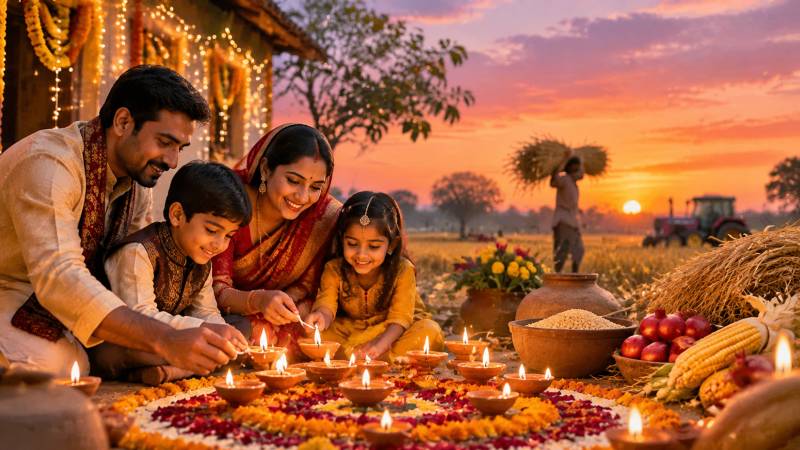
Before a harvest reaches a festive table, it passes through months of uncertainty. Someone prepares the soil, waits for rain, watches the weather and hopes that the crop will survive. When the grain finally comes home, relief becomes joy. Families gather. Food is shared. The earth’s generosity finds expression in human gratitude. This November, two great celebrations invite us to remember that relationship. Diwali falls on 8 November 2026, while American Thanksgiving follows on 26 November. Their presence in the same month offers a meeting of traditions shaped in different lands, yet connected through harvest, renewal, family and sharing.
Diwali is widely recognised as the festival of lights, but its agricultural and seasonal character deserves equal attention. UNESCO describes Deepavali as marking the last harvest of the year and the beginning of a new year and season. In this setting, light accompanies the hope that follows a successful harvest and the promise of another cycle of life. For farming communities, prosperity was something tangible: grain to store, seed for another sowing, healthy livestock and enough food to sustain a household. The festive lamp can be understood against this world of dependence on soil, water and seasonal rhythms. Cleaning homes, preparing food and gathering relatives give renewal a physical form.
This connection naturally turns our thoughts towards the ancient agricultural societies of South Asia, including the Indus Valley Civilisation. The people of Mohenjo-daro, Harappa and other settlements sustained their communities through farming, crafts and trade. Their world reminds us how deeply the history of this region is rooted in the earth. Diwali has ancient associations with the Kharif harvest, the sowing of Rabi crops and the seasonal transition into Hemant. The narrative linking it to Rama’s return is often understood as a later association. In Hindu tradition, Lakshmi belongs to an earlier cosmic age, Satya Yuga, and her worship is believed to predate Rama, with his family also honouring her. From this perspective, Rama may have returned on an already auspicious festive occasion after completing fourteen years of exile.
Diwali also carries several sacred meanings. Many Hindus associate it with Rama’s return to Ayodhya after exile; other traditions emphasise Krishna and Narakasura or the worship of Lakshmi for prosperity and well-being. Jains remember Mahavira’s liberation. Sikhs observe Bandi Chhor Divas around the same time, commemorating Guru Hargobind’s release from imprisonment. Some Newar Buddhists also celebrate through their own traditions. These varied meanings show how a festival can hold several kinds of memory: seasonal, domestic, spiritual and communal. Its significance cannot be exhausted by a single story.
Before a harvest reaches a festive table, it passes through months of uncertainty. Someone prepares the soil, waits for rain, watches the weather and hopes that the crop will survive. When the grain finally comes home, relief becomes joy.
Across the ocean, Thanksgiving also brings the harvest into the home. Its familiar American narrative recalls a gathering at Plymouth in 1621, attended by English colonists and Wampanoag people, including their leader Ousamequin, commonly known as Massasoit. A surviving English account describes three days of feasting and the presence of approximately ninety Wampanoag men. Yet gratitude in America did not begin with that gathering. Indigenous peoples already maintained their own traditions of giving thanks. Nor did the Plymouth meal immediately establish the annual national holiday familiar today.
The modern American observance developed over centuries. Writer and editor Sarah Josepha Hale campaigned for a national Thanksgiving. In 1863, during the Civil War, President Abraham Lincoln issued a proclamation calling for thanksgiving and remembrance of those suffering from the conflict. Alongside appreciation for abundance stood a plea for healing. Today, the Thanksgiving table carries memories as well as food. An empty chair may recall someone who has died; an extra chair may welcome someone far from home. A family recipe can preserve the presence of a grandmother long after her voice has fallen silent.
But Thanksgiving also carries painful memories. For some Native Americans, it is a National Day of Mourning, recalling dispossession, violence and the losses associated with colonisation. An honest celebration must make room for those voices. Gratitude gains depth when it includes an understanding of whose land, knowledge and labour helped sustain the feast. The reach of both festivals is immense, although their populations cannot be compared through one simple count. Diwali is commonly described as involving more than a billion celebrants. For context, Pew Research Center’s estimates published in 2025 placed the global Hindu population at nearly 1.2 billion in 2020. Other religious communities also participate, but religious population figures are not a census of festival attendance.
For American Thanksgiving, a Pew survey conducted in November 2024 found that 91 per cent of US adults celebrated it. This demonstrates its broad national reach, although it is not an exact count of all celebrants worldwide. Here, the comparison concerns the American November holiday. Behind these vast numbers are intimate scenes: a child shielding a diya from the breeze, a parent preparing sweets, a student travelling home, a host setting another place at dinner. Festivals become meaningful through such acts of care.
Their arrival in the same November does not establish a common historical origin. It offers an opportunity to recognise a shared human dependence. Food reaches us through the work of farmers, labourers, transporters, shopkeepers and those who cook. Water, soil and a liveable climate support every meal. Prosperity rests on relationships that daily life often teaches us to overlook. For people in Pakistan, particularly in the agricultural landscape of Sindh, this connection is familiar. A crop is a livelihood, a season is a hope, and water can determine a family’s future. These celebrations can encourage respect for the people who grow our food and friendship across religious boundaries. A greeting to a Hindu neighbour, an invitation to someone living alone, a meal shared with a struggling family or fair payment for a worker can carry the spirit of celebration beyond its appointed day. This November, the lamp and the harvest table offer two gentle reminders: appreciate what sustains life, and share it with others. The earth gives through the labour of many hands. Our celebrations become richer when gratitude returns through our own.