

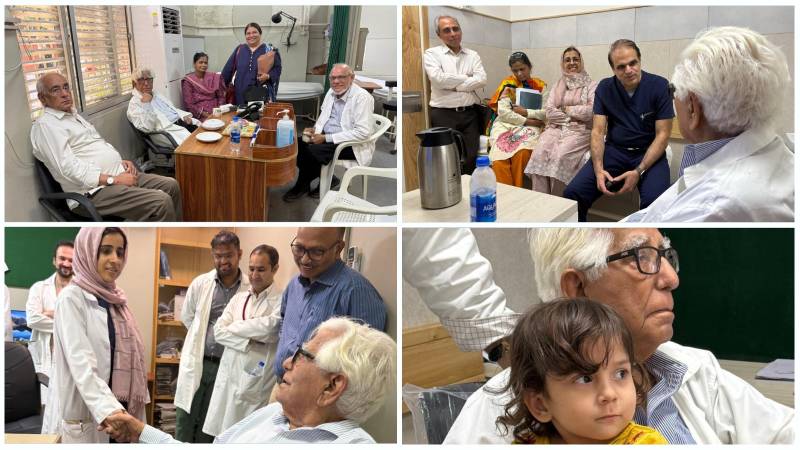
On my last trip to Karachi, I had the opportunity of spending extensive time at a uniquely inspiring place – a place of compassion, camaraderie, dedication, mentorship and excellence – all led by a group of tightly knit individuals whose leadership and vision have turned an eight-bedded unit of the Civil Hospital into a multidisciplinary healthcare powerhouse.
I don’t think I’m the first visitor to say that the Sindh Institute of Urology and Transplantation (SIUT), whose complex of buildings rises over Ranchore Lines and other parts of the city, is a special place. However, I do think I have spent enough time at the institution and, in particular, with those intimately linked to it, to be able to confirm that if I were a patient in need of care, or a young doctor in search of training or employment, this is the place I would wish to be.
It is Ramzan, and we are sitting in the dimly lit Liver Transplant OPD (out-patient department) at iftar, a handful of us around cups of tea, samosas and jalebis, served to us by Iqbal, who has worked at the Institute for almost twenty years. This is a common thread. As I speak to the people around me – doctors, nurses, administrative staff, peons, lift operators- I learn that this institution is made up of hardcore loyalists. On average, people who work here stay here – sometimes for decades, sometimes for entire lifetimes.
I can’t count the number of staff members who have shared their SIUT “origin” story with me during my visit – the circumstances in which they were hired by Dr Rizvi, or the professional, social and emotional bonds that bind them to this institution. The real challenge is retirement and how to ease employees out of an institution that they regard as “home”. If success were measured solely by retention or staff happiness, SIUT would come out on top. In fact, one senior paediatric urologist I spoke to laughingly acknowledged that “SIUT is an addiction.” And he wasn’t wrong.
This is nowhere more apparent than in the Liver Transplant OPD tonight after iftar has ended and the conversation turns to the past, as it often does in the presence of Dr Adib Rizvi, founder and director of SIUT. With his hallmark shock of white hair, he presides quietly over the gathering, his head tilted to one side, the hint of a smile on his face as he listens to his younger colleagues, now middle-aged, reminiscing about the early days.
I turn to the doctors who joined him decades ago as youthful trainees and listen raptly to them talking about how Dr Rizvi first coaxed them to the Urology Unit at Civil, then worked them mercilessly, teaching them surgical skills but so much more – compassion, ingenuity, humour, an exacting work ethic and, above all, a passionate drive to fight till the end for all patients, especially the disenfranchised.
A visiting Italian physician is not here to impart specialised knowledge or skills from the West but to learn a surgical procedure from our surgeons
I quietly turn on the recording feature on my phone and sit back, enjoying the mischievous banter between them and the tentative interruptions of Dr Rizvi himself, as reminiscences trigger associations. “Rizvi Sahib, do you remember Phul?” asks one senior paediatric urologist, recounting the story of an early kidney transplant patient who also suffered from TB. “His sister was a match but couldn’t donate because her husband refused. But five minutes with Rizvi Sahib and he was ready to escort his wife to the hospital personally!” His colleague adds, “Sir, there was also Shahnaz, remember? One of the first cadaver-transplant patients with an infected wound?” He turns to me, “Rizvi Sahib sat by her bedside for two-and-a-half days till she was out of danger, and she eventually made a complete recovery!” Dr Rizvi’s modest reply of “she recovered because of the whole team” prompts general laughter as if this stock response from him has been heard many times before. “Learn that, show us how it’s done, then we’ll talk!” his mentees challenge each other with grins.
The contention that “Sir has something in him which can’t be taught” raises important questions about the nature of mentorship and example, particularly at SIUT. Dr Rizvi’s work ethic sets the tone for the institution. When he enters the building, everyone stands to attention, mops are wielded by eager cleaning staff, and there is a joyful bustle of conspicuous activity. More than that, one can sense genuine love and admiration for him, a certain tenderness in the way that colleagues treat him, even when he is giving an errant staff member one of his legendary dressing-downs.
While he vehemently denies his individual importance in favour of the “team”, people admire him for his leadership and vision. Junior doctors, ultrasound techs and nursing students flock to him for selfies, children want to hold his hand and ask him questions. In this day and age, it is creditable that Pakistan counts this pioneering transplant surgeon as one of its celebrities. “You don’t know,” a senior member of the secretariat whispers to me, smiling, “We saw Sir in his prime – he was something!”
At SIUT, seniors have an easy yet exacting relationship with their trainees. While there is banter over cups of tea and samosas at iftar, when there is work to be done, it is all business. The same doctors-in-training who met Dr Rizvi in the conference room of the old Paeds Urology Unit at iftar, shook his hand and took photographs, are buzzing around the brand-new out-patient department in the SIUT Children’s Hospital, along with other young professionals, including nursing staff and ultrasound technicians.
Everyone is engaged and working quickly. On average, they see a staggering 300 to 400 patients in a single day. This beautiful building, with its wide-open spaces and huge windows, is the fruition of a decade of fundraising and construction effort. On 25th March 2025, there is a feeling of elation as patients, staff, and physicians take ownership of it for one of the first outpatient clinics. There, I spend an afternoon sitting in on half a dozen appointments in the Paeds Urology out-patient clinic, watching with interest as these junior doctors present cases and seek guidance from their seniors.
The same afternoon, I feel a sense of pride as I learn that a visiting Italian physician is not here to impart specialised knowledge or skills from the West but to learn a surgical procedure from our surgeons. At SIUT, foreign visitors are a common sight. This cross-fertilisation of knowledge is an essential part of its mandate as a vibrant teaching institute, built steadily over time through professional and personal interactions.
Relationships made at SIUT are not temporary: they are for life, and are based on a system of compassionate, personalised care that is, in the modern world, fast becoming a thing of the past
During my short time in Karachi, there are at least two events: the British Medical Journal presents a special award to Dr Rizvi via Zoom and Dr Kathy Jenkins, Professor of Paediatrics at Harvard Medical School and Executive Director at Boston Children’s Centre for Applied Paediatric Quality, gives a talk. However, over the next month, there is even more collaboration: FAJR Scientific, led by Dr Sarah Badran, works with SIUT’s Paediatric Cardiology Unit to implant the first Harmony valves in young patients in Pakistan; and a virtual meeting is held with Professor Mohiuddin, a pioneer of xenotransplantation in the US and one of National Geographic’s 33 changemakers of 2025. Later, Paeds Urology hosts a British surgeon who has been collaborating with SIUT for over twenty years, followed by one from Chile. And this, all in the space of just six weeks.
This spirit of intellectual curiosity and academic collaboration is befitting an institution which boasts cutting-edge technology, including a recently launched robotic surgery programme. Many Pakistani “firsts” have taken place here: the first liver transplant in 2000; CBEC, the first centre dedicated to bioethics in the region in 2005; the first robotic surgery programme in 2021; the first implantation of Harmony valves in 2025 by the first dedicated Paediatric Cardiology Unit established in 2022 – and that’s just to name a few. Departments are also active in local and international conferences, and papers are submitted to journals around the world. In fact, as the head of the Paeds Cardiology Unit told me, one of the seminal works published this year in the Journal of the American College of Cardiology had two authors from SIUT.
However, SIUT provides educational opportunities for all health professionals, not just physicians. In addition to a nursing school, the Institute provides hands-on training for a number of ancillary disciplines, including, but not limited to, dialysis, intensive care, anaesthesia, respiratory therapy and radiology, under the umbrella of the Sindh Institute of Medical Sciences (SIMS). Students are taken on merit, and the courses are free of cost, with a nominal requirement to commit to two years of employment at SIUT.
Many physicians and support staff who have been trained at SIUT are now working at hospitals throughout the country. It is a well-known fact that SIUT’s inspirational volunteer programme for students of Karachi’s high schools is often a life-changing one for teenagers, many of them returning year after year to benefit from the structured syllabus, camaraderie and atmosphere of committed service.
Although I am not an entirely unbiased observer, my experience of SIUT is not unique. Like any sprawling institution, it isn’t perfect. However, what sets it apart is not just its culture of collaboration and self-development. It combines expansive vision and the desire to “dream big” with a passionate attention to the minutest of details. Where else would you find a transplant surgeon gently reassuring a fearful patient who is crying over an impending surgery? “Take courage. It’s going to be okay” just took a second of his time, a fleeting moment of personal interaction, but it must have made all the difference to that young woman. This institute has the foresight to invest in 21st-century technology but also has the humility to remember what made it special in the first place: the kind of personalised care that you would only expect to find in an eight-bedded unit.
This is one of the reasons why SIUT has one of the most successful transplant rates in the region. With over 8,000 kidney and liver transplants to date, the Institute follows each patient and their donor for life, providing both with supportive care not only for transplant issues but for all health concerns, including free doctor consultations, labs and medicines. Using a special care model, Medical Social Workers liaise with patients, donors and their families to make the experience as seamless as possible. It is thanks to the efforts of SIUT’s Medical Social Workers that the donor base has changed over the years from predominantly female to an equal male-to-female ratio. This has been done through their continuous efforts to educate families on selecting a donor that fits the requirements rather than simply putting forward female members of their clan.
Clearly, SIUT has grown organically, from a handful of dedicated individuals to four thousand strong. However, the feel of the institution – what propels it forward, keeps it whole and makes it exceptional – is the fact that it is one very large, sometimes dysfunctional, but always loving, family. Here is a place where a physician will stay up all night with a colleague nursing an ailing mother, where the director’s wife prepares meals for the first kidney transplant patient, where patients once operated upon as infants return proudly to their surgeons to talk about what they have studied and where they are working now. In the last six months, I have watched how SIUT employees rally around those among them who have faced personal challenges – the loss of a beloved sister, the sudden death of a son in his prime whose organs were selflessly donated, and the diagnosis of a serious illness. The help that this exceptional community provides to its members goes well beyond medical care.
It is obvious that relationships made at SIUT are not temporary: they are for life, and are based on a system of compassionate, personalised care that is, in the modern world, fast becoming a thing of the past. What makes this even more remarkable is that this care is provided by an institution of four thousand employees for an annual patient base of over 3.5 million. That it is done at zero cost to the patient (including labs and medication), owing to the unique community-government partnership that funds it, is definitely cause for wonderment and jubilation.