

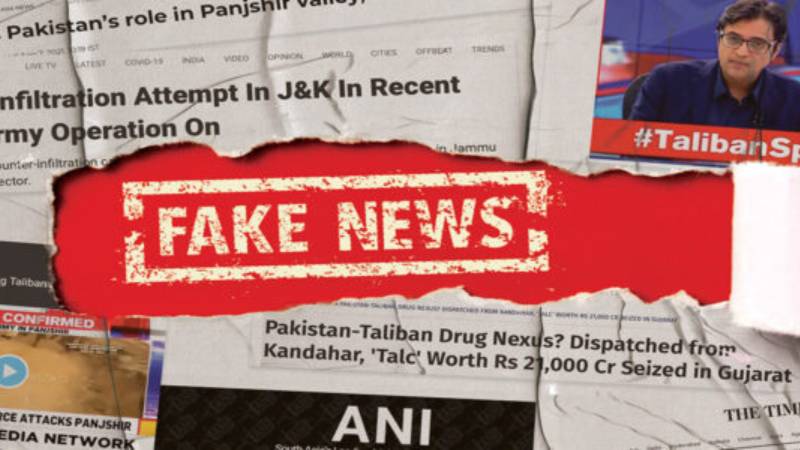
In times of insanity, talking sense becomes a revolutionary act. Talking more insanity might raise the ratings of TV channels, but the cost can be the blood of millions. What is happening in the Indian and Pakistani media after the tragic Pahalgam attack is only fueling the fire of hatred. The Indian press quickly blamed Pakistan for the attack, even before an official statement from the Indian government.
The question is: why do sensationalist talk show hosts jump on the bandwagon and start spreading fake news? The answer is simple—journalists work for media channels that operate on a business model. These models survive on the attention economy, and what catches a common viewer’s eye more than sensationalism? But this simple money-making mechanism is not easy to understand for the average person. For the common mind, the suited, booted, and well-spoken TV anchor seems to know best. The confidence with which journalists speak on TV has more to do with their job security than with any holy commitment to the truth. Unfortunately, this profit-driven model can cost millions of innocent lives if the sole motive behind speaking on-screen is to gain views and ratings.
The level of insanity has escalated to the point that even once-reliable sources of information have succumbed to sensationalism and emotional appeals. The Indian media has reached dangerous levels of war-mongering and jingoism. One of the most alarming aspects of this jingoism, often overlooked, is the false parallel being drawn between the Israel-Hamas conflict and Indo-Pak skirmishes.
Indian media has gone so far as to draw parallels between Pakistan and Hamas in a bid to appeal to public sentiment, are they indirectly signaling an Israeli-style genocide in Pakistan?
A news program, Vantage, aired on Firstpost and hosted by renowned Indian journalist and analyst Palki Sharma, has repeatedly mentioned Hamas and its tactics while discussing Pakistan-India relations post-Pahalgam attack. Such analogies not only distort public understanding but can also escalate tensions by portraying state actors through the lens of non-state militant behavior. Drawing comparisons between Hamas and Pakistan—or Israel and India—ignores complex geopolitical realities. Hamas is a non-state actor without formal recognition, while Pakistan is an internationally recognized sovereign state with a conventional military.
Despite these simple facts, the Indian media continues to liken a terrorist organization to a sovereign state, thus framing Pakistan as a brutal threat. Under the guise of condemning terrorism, Indian media is effectively justifying what Israel has done in Palestine. The Hamas-led attack on Israelis on 7th October 2023 led to the genocide of innocent Palestinians who had no involvement in the violence. This incident added another dark chapter to the brutal history of the Israel-Palestine conflict. The United Nations raised alarms over the humanitarian crisis in Gaza, and the International Court of Justice reviewed Israel’s obligations under international law concerning the treatment of Palestinians. Likewise, human rights organizations like Amnesty International condemned Israel’s blockade of Gaza and labeled its activities there as "cruel and unlawful."
Now, if the Indian media has gone so far as to draw parallels between Pakistan and Hamas in a bid to appeal to public sentiment, are they indirectly signaling an Israeli-style genocide in Pakistan? Such a dystopian scenario may seem like a filthy dream—but both India and Pakistan are nuclear-armed nations. If one is harmed, the other will surely face the consequences. A sane voice on either side of the border would never desire such devastation, but alas, sanity does not always prevail in the majority.
Unlike the historical role of the media, today’s prevailing insanity signals a dangerous direction—one that is not progressive. There was a time when journalists upheld ethical standards on both sides. Instead of igniting flames, Indian and Pakistani journalists played a crucial role in de-escalating tensions through initiatives like Aman Ki Asha. This initiative was jointly launched by prominent Indian and Pakistani media outlets—the Jang Group and The Times of India. A two-day strategic seminar was held under its banner, attended by security officials, diplomats, politicians, and intellectuals from both nations. It was a journalistic effort to ease tensions between the two nuclear-armed neighbors. Under Aman Ki Asha, several programs were organised in both countries to foster goodwill and encourage people-to-people contact.
That was a time when journalism meant more than chasing ratings. A similar initiative is desperately needed now, as India and Pakistan teeter on the edge of conflict. The voices in the media industry must retreat from this madness and speak rationally in the face of escalating tensions. They must promote peace, not populism, or else this ratings war and populist agenda could cost the lives of millions for a cause that benefits no one.