

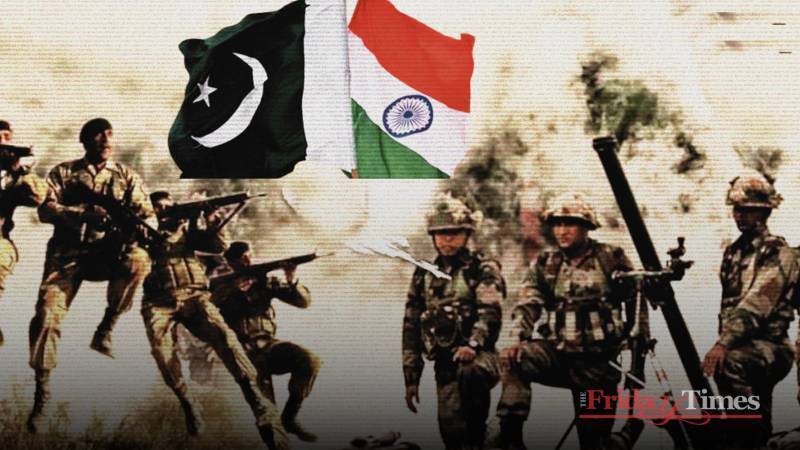
No doubt, Kashmir is a bone of contention between India and Pakistan and a nuclear flashpoint as well. Both countries have fought four wars over Kashmir. India has always blamed Pakistan for sending terrorists into Indian-held Kashmir. In fact, India has not recognised the indigenous Kashmiri freedom movement that started within the occupied valley against Indian atrocities and illegal occupation.
India has deployed more than 700,000 troops in the occupied Jammu and Kashmir and always blamed Pakistan for sending militants into Indian-held Kashmir. But Pakistan has always denied such allegations and asked for credible evidence. However, India has never shown any credible evidence to Pakistani authorities or the international community.
In fact, Pakistan has presented to international media credible evidence of Indian involvement in various terrorist incidents across Pakistan, including in Balochistan. In a recent press conference, Pakistani authorities showed the international community credible evidence of Indian involvement in the recent attack on the Jaffer Express, which killed hundreds of innocent people in Balochistan. The Indian media has always glorified terrorists and still backs Baloch separatists in Balochistan.
In the recent Indo-Pak war, India once again blamed Pakistan for sending militants into the occupied Jammu and Kashmir region, but Pakistani authorities once again denied such allegations and asked for evidence. Then India started its propaganda against Pakistan and initiated war hysteria.
After the defeat in the conventional war against Pakistan, India’s doctrine of regional hegemony completely collapsed in the South Asian regional context
Pakistan not only denied such charges but also asked for an independent inquiry through the United Nations or any third country. India, however, refused and attacked several civilian sites in Pakistan which it claimed were terrorist hideouts or safe havens. In Indian missile attacks, several mosques were targeted, and many innocent women and children were killed.
During the recent tensions between the two nuclear rivals, the role of the Indian media has proved quite irresponsible; it further escalated the situation. Throughout the war, Indian media spread disinformation and hatred against Pakistan and manipulated public sentiment by spreading fake news.
But Pakistan showed restraint and used all diplomatic channels to not only defuse the situation but also demonstrated its full commitment towards international peace and regional stability and security.
Throughout the conflict, Pakistani officials and diplomats were fully prepared and repeatedly reaffirmed Pakistan’s stance for global peace and regional stability. Pakistan reiterated its commitment to resolving all issues, including the core issue of Jammu and Kashmir, through peaceful negotiations with India. But Islamabad also made it clear that Pakistan’s desire for peace should not be considered a sign of weakness and warned Delhi that in the case of any misadventure against Pakistan, Islamabad would respond with full force.
India targeted many places of worship in Pakistan, killing innocent women and children. In response to Indian aggression, Pakistan retaliated and shot down seven Indian fighter planes, including three French Rafales, shocking the entire world. This once again demonstrated the air superiority of the Pakistan Air Force and the high standard of training of Pakistani combat pilots.
In the 1965 Indo-Pak war and the 1967 Arab-Israeli war, Pakistani fighter pilots had already surprised the world by displaying their capabilities in various dogfights and shooting down many Indian and Israeli fighter jets.
In recent escalations, India also used Israeli drones in Pakistani civilian areas. In response, Pakistan used Turkish drones. Later, India targeted Pakistani airfields. In retaliation, Pakistan targeted several military installations, airfields, and ammunition storage sites in various parts of India.
During the whole conflict, the U.S. Secretary of State, Mark Robbio, and the Secretary of Defence engaged with the leadership of both countries to prevent further escalation. But after Pakistan’s full-scale, massive, and decisive response to Indian aggression, the U.S. President finally intervened and played a vital role in securing an immediate ceasefire between the two nuclear powers. He also offered mediation on the core issue of Kashmir.
The recent escalation ended not only with a complete Indian conventional military defeat but also revealed India’s diplomatic isolation—not just in South Asia, but across the international community. It shattered India’s dream of regional hegemony and challenged its ambitions of being a "watchdog" in the South Asian region.
On the other hand, it was a tremendous victory for Pakistan in the conventional war against a seven-times-larger enemy. It highlighted the capability, discipline, extraordinary courage, and high training standards of the armed forces of Pakistan. They shot down seven Indian fighter planes, including French Rafales, destroyed the Russian S-400 defence system, and downed Israeli drones.
On the diplomatic front, throughout the war, Turkey, China, Iran, and Azerbaijan supported Pakistan and condemned Indian aggression. The people of Bangladesh also supported Pakistan and condemned Indian attacks. A retired Bengali general advised his government that if India attacks Pakistan, then Bangladesh should also attack India.
Meanwhile, the U.S. President intervened, facilitated a ceasefire between the two nuclear rivals of South Asia, and offered mediation on the Kashmir issue. This was also a historic diplomatic defeat for India. It challenged India’s long-standing stance that the Kashmir issue can only be resolved through bilateral talks between India and Pakistan. Secondly, India failed to build a credible narrative against Pakistan regarding Islamabad’s alleged support for militants in occupied Jammu and Kashmir. Thirdly, India was unable to justify its attacks on Pakistani territory and failed to gain diplomatic or moral support from the international community. Fourthly, India could not use the “China card” during the escalations and failed to win support from major European powers and the United States.
In recent statements, Indian Foreign Minister Jaishankar repeatedly claimed that India had nothing to do with the Russia-Ukraine war and labelled it as Europe’s internal conflict. India disapproved of sanctions against Russia and continued importing low-cost petroleum products, citing national interest.
Now, in the wake of the recent Indo-Pak conflict, Europe also disapproved of India’s role as a regional "watchdog" in South Asia—especially after India’s brutal defeat in the conventional war against Pakistan. This exposed India’s military weaknesses and severely damaged its image as a global and regional power. It also significantly reduced India’s future chances of becoming a permanent member of the United Nations Security Council.
According to some experts, India has paid a heavy price for its poor foreign policy choices. Now India must realise that without a solution to the core issue of Jammu and Kashmir, it cannot play a global or regional role. The international community now understands that Kashmir is a nuclear flashpoint between the two nuclear states, and during the recent conflict, the U.S. President had to intervene before it escalated to a nuclear level.
After the defeat in the conventional war against Pakistan, India’s doctrine of regional hegemony completely collapsed in the South Asian regional context. On the other hand, the conflict highlighted Pakistan’s conventional military capabilities in modern warfare.
Pakistani, Chinese, and Afghan foreign ministers recently met in Beijing to enhance cooperation and discuss the extension of CPEC through Afghanistan. Islamabad also urged Kabul to curb terrorism and help eliminate cross-border militancy. According to some experts, Pakistan, Turkey, China, Iran, and Afghanistan can play a vital role in ensuring peace and stability in South Asia.
Now it is time for both India and Pakistan to begin a composite dialogue to resolve all outstanding issues, including the longstanding Kashmir issue, which remains a nuclear flashpoint and a grave threat to international peace and stability.