

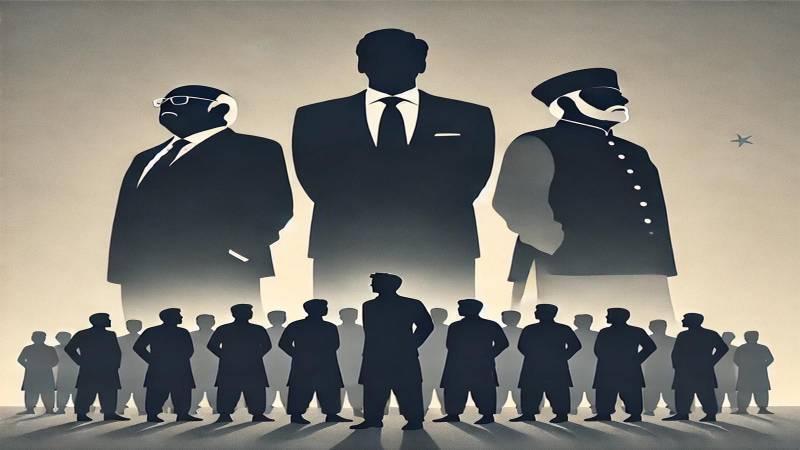
On the morning of 5 July 1977, General Zia-ul-Haq imposed martial law in Pakistan. The tanks rolled in with the usual promises: to save the country, to cleanse politics, to restore order. Many Pakistanis — including the educated and urbane — breathed a sigh of relief. Finally, someone had come to “fix” things.
Zia-ul-Haq’s imposition of martial law marked the beginning of one of the darkest chapters in Pakistan’s history. His damage to the country extended far beyond politics and culture; it was existential. After toppling an elected government, Zia launched a campaign of politically motivated, shallow, and hypocritical Islamisation. His regressive policies were not rooted in faith but in power — a calculated strategy to entrench his rule. In doing so, he deliberately fuelled sectarian and ethnic divisions, weaponising identity to divide and dominate through a ruthless policy of divide and rule.
The consequences were catastrophic. Pakistan, once a young nation with aspirations to join the ranks of modernising states like South Korea, was recast on the global stage as an extremist, jihad-exporting country, increasingly hyphenated with a war-torn Afghanistan and defined by militancy rather than progress. And it was all done in the name of political survival — with the backing of Cold War allies like the United States, whose support came at the cost of Pakistan’s soul.
Zia’s actions tore apart the fragile social fabric of a nation still struggling to forge its identity. In a country as diverse as Pakistan, his policies didn’t merely polarise — they fractured the very foundations of unity, undermining the possibility of a cohesive, inclusive national future at a moment when it was needed most.
The moment of Zia’s imposition of military rule — like so many before and after — also reflected something deeper than a simple military coup. It was yet another chapter in a long history of yearning: the desperate search for a saviour, a messiah, a strongman who could rescue Pakistan from its own dysfunction. This instinct, this recurring impulse to look upward instead of inward, has defined Pakistan’s political culture since before the nation was even born.
After 1947, Pakistan inherited not just territory but a paternalistic political imagination rooted in the belief that people needed someone, not something, to lead them
But where does this come from? Why does such a large segment of even Pakistan’s educated class — lawyers, engineers, civil servants, academics — continue to place faith in singular figures rather than systems, in personalities rather than institutions?
A Habit Formed in Decline
The Muslim political psyche in South Asia was shaped not just by colonisation, but by a long, painful decline from power. When the Mughal Empire began to crumble in the 18th century, the anxiety among Muslim elites was not just about losing rule, but about losing meaning. With the empire went identity, authority, and order.
In this context, the 18th-century scholar Shah Waliullah made a decision that still echoes ominously in South Asian history. Fearing complete collapse, he appealed to Nadir Shah, the Persian conqueror, to invade India and restore Islamic rule. Nadir Shah obliged — by sacking Delhi and massacring its residents.
Waliullah’s appeal wasn’t just a political miscalculation; it reflected a mindset — one that sought salvation not through collective reform, but through outside, top-down force. That pattern would repeat, in different forms, again and again.
The Caliphate and the Cult of Authority
Jump to the early 20th century. As British rule tightened its grip over India, Indian Muslims again looked elsewhere for hope — not to self-governance, but to the crumbling Ottoman Caliphate. Maulana Mohammad Ali Jauhar, a brilliant Oxford-educated journalist and politician, declared that he would “rather be a slave under the Caliph than free under the British.” He was a lion in speech, a nationalist in spirit, but his political romanticism remained fixated on a centralised Islamic authority — far removed from the realities of India’s plural, democratic future.
This emotional and political dependence on distant power — imperial, religious, or military — became a recurring thread in Muslim political thought in South Asia. After 1947, Pakistan inherited not just territory but a paternalistic political imagination rooted in the belief that people needed someone, not something, to lead them
Post-Partition: A Vacuum for Strongmen
Pakistan’s founding father, Mohammad Ali Jinnah, was a constitutionalist — a believer in law, debate, and democratic process. But after his death in 1948, the new country lacked both democratic depth and institutional maturity. What filled the vacuum was not consensus-building politics but military and bureaucratic centralisation.
The first military coup came in 1958 under Ayub Khan, welcomed by many as a “moderniser.” It wouldn’t be the last. Zia-ul-Haq and Pervez Musharraf followed decades later, each cloaked in the familiar rhetoric of reform and renewal. Each, too, received endorsements — overt or tacit — from segments of the business class, technocrats, and urban professionals who saw democracy as too messy, too corrupt, and too slow.
The messiah myth wasn’t limited to religious populism. It came dressed in suits and uniforms, with PowerPoint presentations and five-point reform agendas.
But What About South Korea and Singapore?
In recent years, many Pakistanis — especially in elite circles — have moved away from religious messianism and toward more secular authoritarian admiration. They point to countries like South Korea, Singapore, and China as proof that democracy isn’t necessary for development.
Strong nations aren’t built by messiahs, but through patient, unglamorous work like education, industry, meritocracy, and inclusive politics
The argument goes something like this: “Look at Korea under Park Chung-hee. Look at Singapore under Lee Kuan Yew. Look at China’s growth. We don’t need democracy — we need discipline, order, and a strong leader who can get things done.”
It’s a seductive narrative — and it’s not without merit. South Korea did industrialise rapidly under authoritarian rule. Singapore became a global hub under centralised leadership. China lifted millions out of poverty through one-party control.
But what these comparisons often miss is context.
Park Chung-hee may have been a dictator, but he built institutions, not just palaces. His government invested massively in education, exports, and meritocratic governance. Lee Kuan Yew was autocratic, but he was also obsessed with clean governance, technocratic rigour, and long-term planning. Even China’s one-party system depends on a sprawling, sophisticated bureaucracy — not on a single strongman.
South Korea and Taiwan eventually transitioned to democracy — not in spite of their development, but because of it. Economic progress empowered their middle classes to demand rights, not just roads.
Pakistan’s Authoritarians: All Power, No Reform
In contrast, Pakistan’s authoritarian eras have been marked by hollow promises and short-termism. Ayub Khan’s industrial growth failed to trickle down. It was based on an industrial policy of import substitution and rent-seeking, not a vision of building a globally competitive, export-driven economy. Most Pakistani political analysts miss this crucial difference — often due to a limited understanding of the discipline of political economy.
Zia-ul-Haq’s economic model was simply to milk aid and extract rents by exploiting Pakistan’s so-called geostrategic location. He did nothing to build the country. His Islamisation fractured society along sectarian lines. Musharraf’s “enlightened moderation” was compromised by his double game — supporting jihadists and covertly the Taliban.
None of them built strong civilian institutions. None reformed the education system meaningfully. None curbed elite capture or transformed the bureaucracy. They ruled, but they didn’t build.
Worse, many of them pursued foreign patronage — especially from the United States — rather than national self-reliance. They traded sovereignty for dollars and left society more polarised, not less.
The Real Work Is Boring — And Necessary
Pakistan’s problems — inequality, extremism, a weak justice system — cannot be solved by one man, or one regime. They require institutions that outlast individuals, and a political culture rooted in participation, not passivity.
Strong nations aren’t built by messiahs, but through patient, unglamorous work like education, industry, meritocracy, and inclusive politics
Time to Grow Up Politically
The messiah complex is, at its core, a form of political immaturity — a refusal to believe that people can govern themselves, that institutions can evolve, that progress doesn’t need a uniform or a halo. It is easier to fantasise about a saviour than to do the hard work of investing in people, building infrastructure, civic engagement and structural reform.
But Pakistan cannot afford these fantasies any longer. The world has moved on. The tools of power are changing. A nation of 240 million cannot be ruled by one man with a slogan. It must be built by its people — all of them, together, messiah or not.