


The Kachhi Kolhi and Baghri residents of the now-deserted Bhit Shah Railway Station have breathed new life into old structures. They have creatively converted the once-dilapidated ticket room, waiting area, station master's office and employees’ quarters. These abandoned spaces have been transformed into vibrant and functional living quarters, with designated areas for mandirs, bedrooms, sitting rooms and guest quarters known as autaqs. Consequently, the abandoned structure now gives the impression of a lively and bustling abode.
If one stands to face north, this feeder line is situated to the east, or on the left. The Bhit Shah Station is a stop on the Tando Adam to Mehrabpur line, coming after Mulla Makhan Station. The new residents, who have long since settled in, do not have any recollection of the station’s glorious days. They are completely unaware of how the Sindh Feeder Railway once connected twenty-one small towns and stations through its extensive network that stretched from Tando Adam to Mehrabpur Junction, passing through Sakrand and Tharushah.
According to Gul Hassan Lakho, the former station master of Tando Adam Station, this feeder line was quite profitable until the late 1980s, generating revenue from both passenger and freight services. Lakho further explained that the line’s business began to deteriorate in the early 1990s due to several converging factors. The National Logistics Cell’s aggressive intrusion into the freight business, coupled with the development of new road networks, significantly cut into the railway’s market share. Moreover, a worsening law and order situation, frequent railway accidents, widespread corruption within the department, poor services, and a pervasive lack of client care among railway staff all contributed to the decline. The opportunistic role of railway trade unions also severely affected the feeder line's viability, leading to its eventual closure.
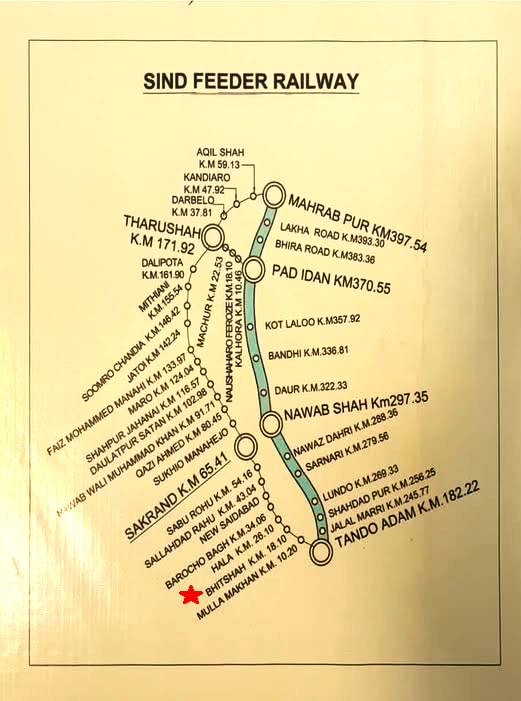
During my visit to the Bhit Shah Railway Station last week, I had the opportunity to meet Hero Kolhi, who specifically emphasised his identity as Hero Kachhi Kolhi, not simply a Kolhi. He shared with me how their community has repurposed the forgotten structures.
Upon inquiry, he told me that they are not Sindhi Kolhi, but rather Kachhi Kolhi, and that their forefathers had lived adjacent to Malokhani village in Matiari District. Like their ancestors, they were tenant farmers for Saeen Nazan Shah, a former Gadi Nasheen of Dargah Bhit Shah. He pointed towards the eastern portion of the Bhit Shah Station building, noting that his family lived in that part, which he called the ‘new building.’ He was correct; the lettering on the structure indicated a construction year of 1960.
He cited some events as time-periods and continued that the station’s decline began when Zulfiqar Ali Bhutto was executed. He elaborated that on that fateful day, an angry mob had burned some carriages that were halted on the northern side of the Hala Railway Station. Afterward, the number of passing trains was significantly reduced, and the end of the line’s service came when Murtaza Bhutto was murdered.
I then asked him about his community’s arrival and occupation of the railway station. He explained, “We came here in 1979. We first lived in an open space adjacent to the railway line, and then we noticed there was no staff. So, we used in it during hot days and rainy days.” He added that one day, some railway officials or thieves—he wasn't sure which—came and took away the tables, chairs, ticket-punch machines, telephone sets, and even lanterns. They were in such a hurry that they didn’t bother to lock the doors of the offices.
Subsequently, his community began to squat in the abandoned buildings, erecting walls to create separate living spaces, sealing the main platform’s arched doorways, and plastering over the ticket windows and notice boards with mud. He continued, “Soon after, we constructed our first durga maa mandir, and its completion brought a sense of happiness into our lives.”
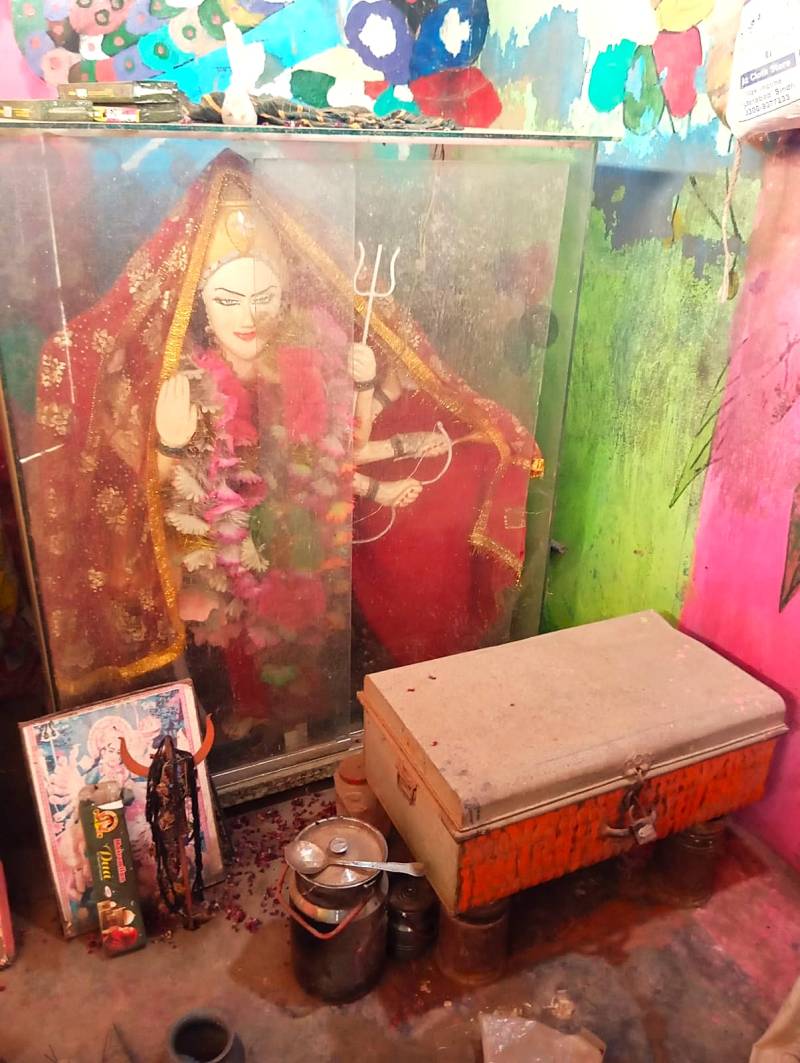
Hero happily told us that the puja begins with the filling of a sacred pot with water, which is then adorned with mango leaves and, if available, a coconut. Next, barley seeds (jau) are sown on a mound of soil. If the seeds sprout over the nine days of the ritual, it signifies that the devi is content. During those nine days, offerings of flowers, fruits, sweets, incense, and vermilion (sindoor) are made.
The platforms that once bustled with passengers for the Urs of Shah Latif now host a different kind of community - one that fears eviction twice a year, but continues to light its diyas in the dark
A Maharaj who was also present elaborated on a particular mantra, "Om Aim Hreem Kleem Chamundaye Vicche." He said that this mantra is a powerful invocation of the combined power of the three major goddesses—Saraswati, Lakshmi, and Kali—to grant knowledge, prosperity, and the destruction of evil. He summarised it as a concentrated prayer that calls upon the ultimate cosmic power to remove all hindrances and to bring about spiritual enlightenment and material well-being. Hero listened intently to the Maharaj and then added that the aarti ritual followed, which involves the circular motion of a lit diya before the deity, accompanied by the singing of bhajans.
Hero seemed in a mood to share more about their rituals, but someone called him. He told us that the occupants of the older railway station, which was constructed in 1930, were calling and felt that their story should also be heard. He laughed lightly and said that they likely thought we were there to list deserving people in connection with an upcoming flood relief effort.
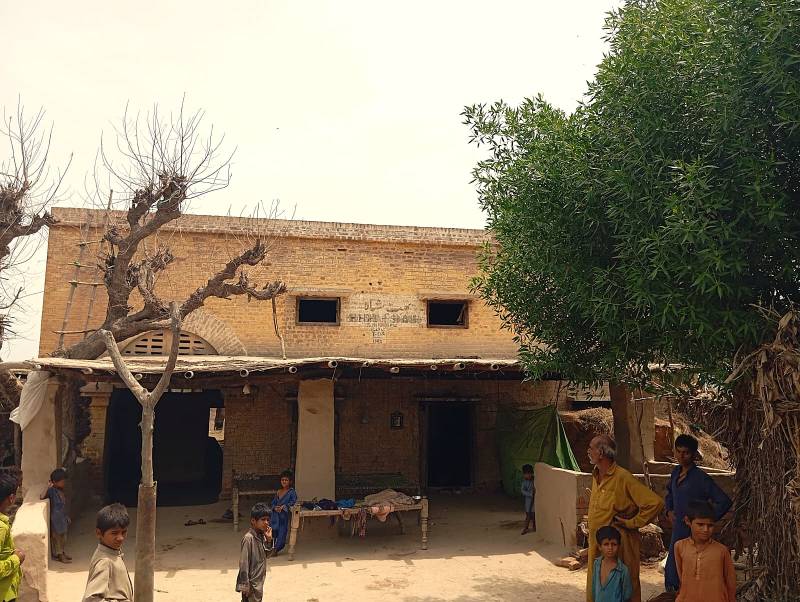
Hero led us to meet with Harji Kolhi, who also added "Kachhi" as a suffix to his name. We met with him and his family, and he told us that they had occupied this railway station after the flood of 2010. He added that they had come from Tando Adam. They also work on the agricultural lands of Nazan Saeen. He proudly showed us his family’s durga Mandir. I saw that their beautiful temple, established in a single room of the old building, had tall rectangular doors and windows topped with arches, and featured external canopies (chajjas) to protect against direct sunlight and rain.
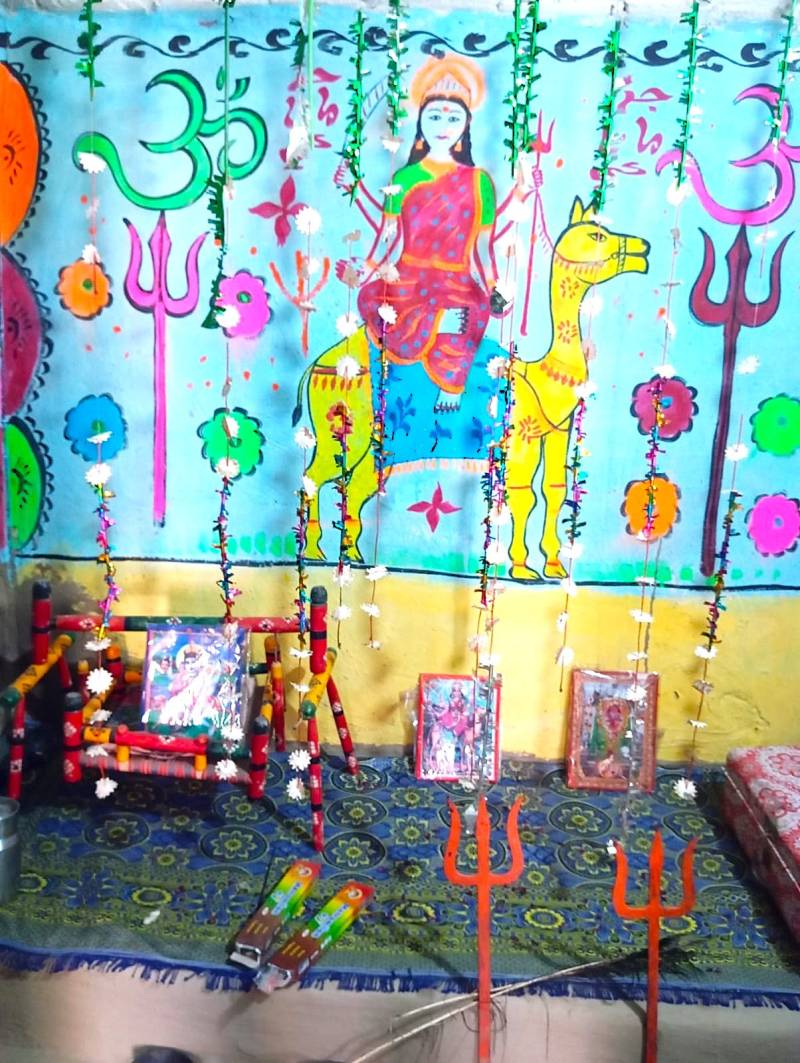
He opened the temple door, and inside, I saw an image of Durga sitting on a camel. The Maharaj who had accompanied us added that while Durga devi’s common mount is a lion, because ride on the represents her complete control over anger, greed, ego, and arrogance. Likewise, an elephant ride represents rain, prosperity, and a bountiful harvest, whereas a horse communicates war, conflict, and instability, and a boat symbolises natural calamities and floods. He said that the appearance of Durga on a camel, however, is a local interpretation that also signifies a year of instability or slow progress. He added that such an image of her is not as widely recognised as the other three.
Upon my inquiry, Herji told us when they came from Tando Adam to settle here, they also brought their own murti of Durga and established their own temple. However, there was that while there was already a Durga in the old building of the railway station belonging to the Kachhi Kolhi community. He then showed us some parts of the station that had been converted into buffalo sheds and even pointed out the high-level vents—the small rectangular openings—that had been closed off with bricks and mud.
Our conversation was interrupted again as a young fellow named Taro Baghri came and insisted we visit his community’s temple. I realised that he also thought we were from the minority department or some kind of survey team sent to assess who was entitled to receive financial support. He showed us his temple, which was quite simple compared to that of the Kachhi Kolhis.
Afterwards, we returned to the first building of the railway station and took some time to ask them more questions. Hero Kolhi told me that while they weren’t living here, they used to ride the train to visit Tando Adam. He said that one of his childhood desires was to have a railway worker’s hand lantern, like those used to inspect tracks and couple wagons. The workers would carry these lanterns at night, casting magnified figures with long, moving shadows. He even added that at times, he thought these lanterns gave the railway station the image of a temple. He also mentioned that it was a mesmerising scene to watch the red rear lanterns placed on the last wagon of a train.
He then added, “Now, when all these mandirs light diyas at night, it reminds me of the old days of my childhood, but I still long to have a hand lantern.” I laughed and told him that since he now owned the whole station, there was no need for a lantern. Just as we were about to leave, he held my hand and told me that sometimes, twice a year, the police come to vacate the building. It moves their belongings outside, and the takes some photos of the empty rooms and leave. Then, they simply put all their things back in the same place and order. It is his only worry, but still he longs to have a hand lantern. He took a deep sigh and said that there are now five temples in both buildings of railway station and on dark nights when the diyas are lit, he recalls his childhood days. He became silent for a moment and said: “Our diyas are now our lanterns, and this railway station of Bhit Shah that we have made our home is our mandir."
Most local people still remember that even in the 1980s, on the Urs of Shah Abdul Latif Bhitai, special trains were operated with a one-hour gap between Tando Adam and Bhit Shah. In those days, both platforms of Bhit Shah Railway Station were full of passengers, and it looked like a bustling market with hawkers and new shops opening everywhere. As I was leaving, a thought of Charles Dickens' short story The Signal-Man came to mind.
There is no resemblance in plot or characters with the residents of Bhit Shah Railway Station. But Hero Kachhi Kolhi’s longing for a lantern powerfully echoes Dickens’s character, whose world is defined by the very lanterns he tends to. For Hero Kachhi Kolhi, the lantern symbolises how light shapes the lives of those who aspire for it.