

“I learned from Hussain (AS) how to be wronged and be a winner, I learnt from Hussain (AS) how to attain victory while being oppressed”—Mahatma Gandhi
In the world, outcomes of most major and minor conflicts are determined on the basis of victory or defeat, and the participating members are categorised as either winners or losers. Momentary success may attract a great deal of applause, but it is only in the long run that the true nature of events unfolds itself. From recorded history, we know the fate of both conquerors and the vanquished—whether they were eliminated from the face of the earth, became totally subjugated, or evolved into powerful nations.
These days too, there is much contemplation about the ongoing Ukraine-Russia war, whether India or Pakistan won in the four-day conflict, whether the Iranians have shown their superiority over Israel in the eleven days of utter madness, and whether Gaza—a ransacked region—will no longer be home to Palestinians who were either brutally killed or forced to flee. Each party is harping its own tune while the ‘trumpeters’ are taking credit for ceasefires, heralding ‘peace’ in various contentious hotbeds. Only time will tell what will happen in the aftermath and what the resulting consequences will be.
One of the most powerful and progressive countries of the world today is Germany, but the path to achieving this status was strewn with mass devastation and the suffering of humanity in general, and women in particular, in the horrific outcomes of World War II. The period between 1945 and 1955 is brilliantly portrayed by Harald Jähner in his internationally acclaimed historical treatise Aftermath, where first-person accounts from articles and diaries show how this politically, economically and morally bankrupt country transformed itself into the modern state we see today.
Today, few can imagine the magnitude of the displaced population, the millions of released forced labourers and prisoners of war who were condemned to face an uncertain future in a completely wrecked homeland devoid of basic facilities. Heart-wrenching stories speak loud and clear about the torment borne by women in a war started by men—men whose actions were strongly resented in widely read periodicals of the time.
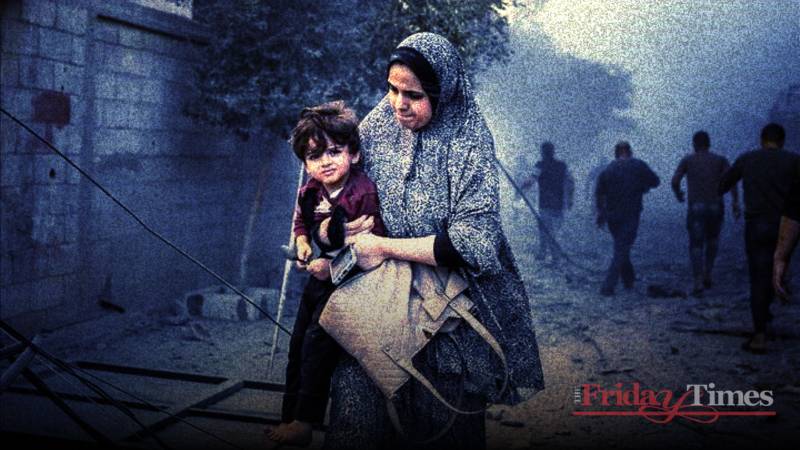
Regardless of whether males or females hold the destiny of nations in their hands, the truth is that women are the principal sufferers in the event of conflict—whether on a small scale or during major wars
Narrating the stance of women, the book says: “It was a fundamental female conviction that the lost war had been a male invention, even though women had in no way lagged behind in their enthusiasm for Hitler.” The author mentions the magazine Der Regenbogen, which contained articles portraying men as the chief cause of war, while women were more inclined towards peace.
While getting killed may seem easier, staying alive and enduring the torture of evil, along with the tragic loss of dear ones, requires Herculean strength and nerves of steel. Unfortunately, this burden usually befalls the so-called weaker sex who, throughout history, has been bearing and raising lives—only to lose them to others.
Hazrat Bibi Zainab (AS) is one such woman without whom Karbala would have been nothing more than a forgotten event of the past. The very reason Imam Hussain (AS) proved to be the ultimate victor and flag-bearer of his grandfather, Prophet Muhammad (PBUH), is due to the relentlessness of his able sister, who did not allow either the catastrophe of 10 Muharram 680 CE or the ensuing horrific incidents to affect her mental faculties.
She stood strong against the enemy who destroyed her entire clan and voiced her agony with emphatic speeches before Yazid’s full court. Under such circumstances—where many men would have been prone to heart attacks and strokes—she bravely outwitted Yazid’s sarcastic remarks, unveiling his malevolence to the then-perplexed foreign dignitaries present in the court. She corrected the false propaganda that the battle in Karbala was intended to subdue a rebellion against the Caliphate.
With fortitude and an absolute sense of purpose, Hazrat Zainab (AS) not only tolerated physical discomfort, humiliation, and mental torment, but also took on the reins of leadership—guiding her kindred through the excruciating ordeals of the horrific journey from Karbala to Kufa, and then to Damascus prison, where they remained confined for about a year.
One can only imagine how, during this uncertain period of captivity, she must have engaged herself in healing the wounds suffered by her companions and keeping them motivated with soothing words of wisdom. These were not easy tasks. They required strength of both faith and utmost surrender to the Almighty. Soon after being released, she passed away in 682 CE at the age of 56—but her brother’s mission, which she helped promote, remains alive even after centuries.
Interestingly, in December 2019, former President of the United States, Barack Obama, remarked: “If more women were put in charge, there would be less war, kids would be better taken care of, and there would be a general improvement in living standards and outcomes.” He also suggested “putting women in power, because men seem to be having some problems these days.”
Regardless of whether males or females hold the destiny of nations in their hands, the truth is that women are the principal sufferers in the event of conflict—whether on a small scale or during major wars. They lose their principal supports in the form of fathers, brothers, husbands, and sons; they are deprived of the security of their homes and thrown into uncomfortable shelters; if not killed, they are subjected to rape, violence and brutality; they are forced to do menial jobs and, at times, hard labour that may be beyond their physical capacity.
Yet it appears that even today, men have not learnt their lesson and continue to take pleasure in the tribulations of their deeply cherished females. In the end, one can only say— with due apologies to the supporters of Planned Parenthood, for twisting their infamous slogan—“If men got pregnant, abortion would be legal everywhere,” into: “If men could suffer the pangs of delivery, wars would be banned forever.” In the end, it always turns out for men especially as: “Heads we win, and tails, you lose.”