

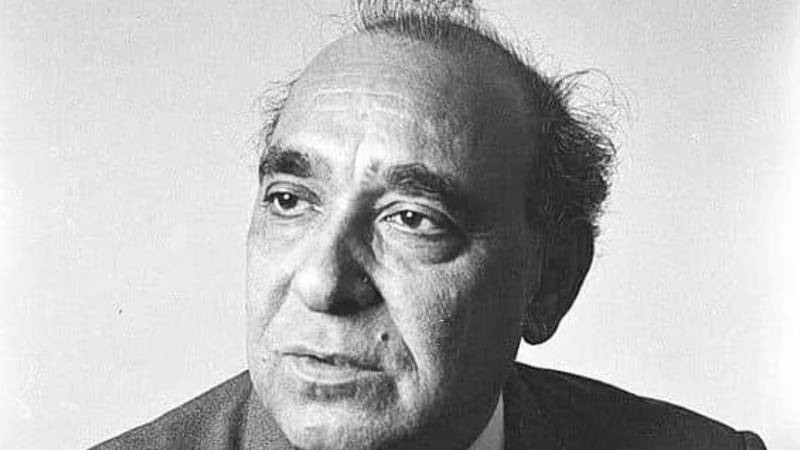
Krishan Chander was one of the fortunate Urdu writers who enjoyed equal popularity among both the elite and the common reader. He was born on 23 November 1914. There are differing accounts of his birthplace, with Wazirabad, Lahore, and Bharatpur all mentioned, but there is unanimous agreement that his parents were from Wazirabad, Gujranwala. His father was a doctor by profession and had a deep fondness for Urdu literature. Owing to the nature of his service, he was frequently transferred from one place to another. In this sequence, he was posted in Jammu. Krishan Chander and his siblings spent their childhood in the enchanting valleys of Kashmir. The landscape of Kashmir later became the backdrop for many of his short stories and novels.
Krishan Chander’s childhood was rich and lively. Along with his studies, he also took an interest in sports; cricket was his favourite game. His father believed that children should participate in extracurricular activities alongside formal education. In those days, parents paid special attention to the physical development of their children. His father even sent Krishan Chander and Mahendra to a wrestler’s akhara for training. But Krishan Chander’s inclinations lay elsewhere. He was deeply drawn to the world of art. Painting fascinated him, and he had a special interest in theatre.
He passed his primary examination from a school in Jammu and then enrolled at Victoria Jubilee High School, from where he completed his matriculation. He had a passion for reading books, especially novels. At school, he disliked his Persian teacher’s class, not so much because of the subject, but because of the teacher’s personality. He wrote a sketch of his Persian teacher titled Professor Blakey. At that time, Diwan Singh Muftoon’s weekly magazine Riyasat was quite popular. Krishan Chander sent his piece, Professor Blakey, to Riyasat. It was either his good fortune or misfortune that the sketch was published. When the news reached his father, he was extremely displeased that his son had ridiculed his teacher.
After passing matriculation, Krishan Chander turned towards Lahore. According to a well-known writer and the editor of the famous Urdu journal Saqi, Lahore in those days held the same importance in India as Oxford and Cambridge did in England. Lahore was a centre of political, intellectual, literary, and cultural activity. It was to this very city that Krishan Chander arrived, where his literary grooming was to take place and where he would take his first flight into the skies of fiction. He was admitted to FC College.
This was also the period when the freedom movement against British rule was gaining momentum, involving people from every segment of society. Among them were young revolutionaries led by Bhagat Singh, who believed in armed struggle for India’s independence. In Lahore, Krishan Chander was influenced by Bhagat Singh’s comrades and began attending their meetings. Those were the days when he lived at Guru Dutt Bhawan and was deeply affected by revolutionary thinking. When Bhagat Singh and his companions were arrested, Krishan Chander was also apprehended during the crackdown and imprisoned in Lahore Fort for a month. After several days of interrogation, he was finally released.
Life was passing pleasantly when one day he was informed of his transfer. The news struck him like a blow; it felt as if he had suddenly entered a blind alley
His political activities affected his studies, and he failed to secure the required marks in FSc to enter medical college. He completed his BA from the same college in the second division and then enrolled in the MA English programme. Because of his keen interest in literature, he was appointed editor of the college magazine. Interestingly, most of his writings during this period were in English. Around this time, he fell seriously ill. Jaundice left him physically drained. After recovering, in 1936, he wrote his first short story, Yarqan. He sent it for publication to Lahore’s well-known literary journal Adabi Duniya. The story was not only published, but the editor, Salahuddin Ahmed, also wrote a brief note, stating, “This man will prove to be a great writer of our language.”
Krishan Chander’s very first story startled readers. His second story, From Lahore to Bahram Galla, was published the same year in the renowned literary magazine Humayun. Its editor, Mian Bashir Ahmed, wrote in his note that after passing through the stages of age and experience, this writer would become a distinguished figure in Urdu literature. In the coming years, his prediction proved true.
Krishan Chander’s third story, On a Boat in Jhelum, was published in Humayun in 1937 and became a topic of discussion in literary circles. With his first three stories, he had created a stir in the literary world. He was now an integral part of Lahore’s literary life. He interacted with eminent figures such as Salahuddin Ahmed, Mirza Adeeb, Ahmad Nadeem Qasmi, Ashiq Hussain Batali, Chaudhry Nazir Ahmed, and Devendra Satyarthi. In the same year, he wrote his first radio play, Bekari.
Though his education was complete, Krishan Chander remained unemployed. During this period, he began attending meetings of the Progressive Writers’ Association. When he attended the 1938 conference in Calcutta, he met prominent progressive writers Professor Ahmed Ali and Sajjad Zaheer, and these meetings turned into deep friendships. Soon, he was elected Secretary of the Punjab chapter of the Progressive Writers’ Association. Influenced since his college days by revolutionary ideas that challenged class inequality, he felt a strong attraction to the Association’s manifesto and became actively involved in its organisational work.
Though many were writing at the time, Krishan Chander’s style stood apart. Reading him felt like walking through garden paths where colourful buds burst into bloom
By 1939, the Second World War had begun. India was under British rule, and Britain was a major party to the war. Just as soldiers fight on battlefronts, wars are also fought on the front of propaganda. Radio was chosen as the medium. At the time, the Director General of All India Radio was the renowned writer Patras Bukhari. Krishan Chander joined All India Radio Lahore as a programme assistant. It was here that he developed a serious interest in drama, which later proved immensely beneficial. Life was passing pleasantly when one day he was informed of his transfer. The news struck him like a blow; it felt as if he had suddenly entered a blind alley.
Krishan Chander was transferred from Lahore to the Delhi radio station. Leaving Lahore was not easy, but in Delhi, he found comfort in the presence of a galaxy of writers, including Jagan Nath Azad, Faiz Ahmed Faiz, N. M. Rashid, Saadat Hasan Manto, and Deen Muhammad Taseer. This period was the golden phase of his artistic life. He wrote numerous radio plays and lived in the Tees Hazari area. His salary was reasonable, yet money never stayed in his hands; by the end of the month, it was all gone. Despite a decent income, he often remained financially strained.
Once employed, his family began thinking of his marriage. In December 1939, he married an educated woman from Lahore, Vidya Datti. They had two daughters and a son. After marriage, Krishan Chander realised that he and his wife were poles apart in temperament, interests, and dreams. Yet, for the sake of the children, they carried on. Regardless of domestic circumstances, his literary journey continued with brilliance. During this time, his first collection, Tilism-e-Khayal (1939), was published in Lahore. This was followed by Nazare (1940) and Ghoonghat Mein Gori Jalay (1953).
Krishan Chander witnessed the experience of migration very closely. At the time of the 1947 Partition, he was in Delhi due to his job. With the announcement of Partition, the golden days of his life and the memories attached to them slipped across the border. FC College, where he had spent some of the best days of his life, and his home on Mohani Road in Lahore, where he had crossed many creative milestones, were all left behind. He witnessed riots, visited refugee camps, and listened to their stories. Being sensitive by nature, these tales disturbed him day and night. He began writing them down, immortalising his observations. Hum Wahshi Hain is a collection of such stories.
Though many were writing at the time, Krishan Chander’s style stood apart. Reading him felt like walking through garden paths where colourful buds burst into bloom. His prose possessed a natural ease in which colour and fragrance mingled. Consider these lines from From Lahore to Bahram Galla: “Colourful flowers were in bloom. Their fragrance perfumed the air. Jasmine and raspberry bushes were laden with fruit. Here stood delicate boxwood plants, while tall walnut trees spread their long branches, sheltering wild birds, such as woodpeckers, parrots, and sunbirds, whose feathers were as colourful as butterflies and whose calls were as enchanting as nightingale songs. Sometimes a bird would pass before the eyes, wings spread, gleaming like a rainbow.”
Whenever Krishan Chander described a scene, it seemed to come alive, breathing before our eyes. The same is true of his characters. In Adhay Ghantay Ka Khuda, the portrayal of Mogri is unforgettable: “Mogri with shining deep-black eyes, Mogri with lips glowing like embers. Nineteen-year-old Mogri. When she laughed, it felt as though blossoms were falling from apple branches.”
His mother wished he would become a judge. After completing an MA in English, he earned an LLB and began teaching law at a college in Lahore, but his heart remained devoted to storytelling. I often think that had he become a judge, Urdu literature would have been deprived of a towering fiction writer and novelist. Later, he ventured into film and continued writing until his last breath. On the evening of 4 March 1977, when death arrived, he was still writing.
Krishan Chander lived in Lahore, Delhi, Pune, Lucknow, and Bombay, yet Lahore always shone brightest on the canvas of his heart. His longing for Mohani Road and the lanes of Lahore remained unfulfilled, a dream left incomplete, as life so often does.