


Murad Yusufzai: Please tell us a something about your background and how you first became interested in art?
Shaista Momin: My name is Shaista Momin. I was born in Karachi in 1971. My father is associated with Urdu literature; he is a ghazal poet and was the editor of Sab Rang Digest, while my mother is a housewife. In my early childhood, I never had an interest in drawing, but my love for books is very old. My father taught me to read Urdu at a very young age, and since then books became my friends. I made the first sketch of my life when I was around twelve or thirteen years old. Before that, I was only limited to school drawing copies. I had no idea that creating images could become my passion.
Murad Yusufzai: Please tells us were there specific moments or people in your childhood that sparked your love for painting and calligraphy?
Shaista Momin: In my childhood, I used to look very closely at the sketches printed in digests. They were pen-and-ink sketches. I would spend a long time observing how faces were created with lines. I really liked Iqbal Mehdi’s sketches in Sab Rang. Apart from that, the literary magazines often featured Jamil Naqsh’s “woman and pigeon” on the cover. I also had a diary with Sadequain’s drawings on it. In one way or another, these artists left a deep impression on me.
The first sketch I ever made was of an Indian actress in my diary, and even I was surprised by it. I enjoyed making that sketch so much that the journey never stopped after that.
Murad Yusufzai: Who or what has been your biggest inspiration as an artist?
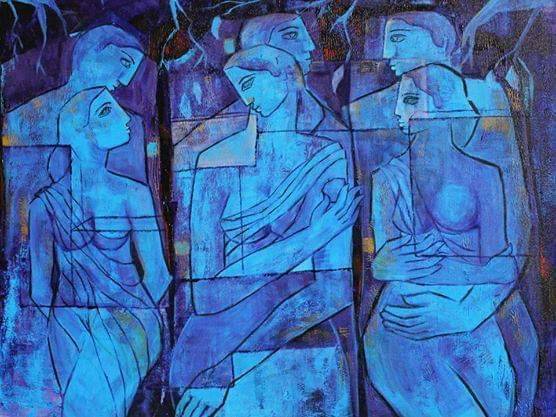
Shaista Momin: If someone asks me about my inspiration, it is “beauty.” And within beauty, especially the face of a woman. For almost every artist, the very first inspiration is beauty itself. That beauty may appear to them in the sights of nature—in the sky, the sea, flowing streams, in the face of a child, or in the wrinkles of an old person. It all depends on what surrounds us.
Since childhood, I have loved reading stories, and stories usually revolve around human beings. Human emotions, feelings, and struggles are the subjects of stories. I see a story in every human face. And being a woman, I have observed and felt the women of my society very closely. Perhaps that is why a woman’s face has always influenced me the most.
Murad Yusufzai: Please tell us how did your artistic journey begin –was there a defining moment?
Shaista Momin: Until matriculation, I had improved quite a lot at sketching just through my own practice. In those days, the medical field was the most preferred choice for girls. Every girl wanted to become a doctor. But I was never interested in doing what everyone else wanted to do. At that time, I had no idea that art could be adopted as a profession, nor did I know where one could study it. After taking my intermediate exams, I decided to learn art. Our financial situation did not allow me to study at any institution. I still had to find a way. Some of my father’s friends were artists, so we contacted them, and eventually I began learning from Iqbal Mehdi at his studio. There, I spent two years learning pen work.
Murad Yusufzai: You have showcased your work at several events in Pakistan, which exhibitions has been most memorable for you and why?
Shaista Momin: I have participated in many group shows. I have done three shows together with my husband, Momin Khan. In my opinion, every show is important for an artist, but the first show always remains the most memorable. My first show was organised by the French Ambassador at Alliance Française. We held this exhibition at his special invitation. This show is very memorable for me.
“Perhaps there is a certain melancholy and sorrow in my nature, which reflects in the eyes of the women I paint"
Murad Yusufzai: Would you like to describe your artistic style in your own words?
Shaista Momin: I work in acrylic medium because it dries quickly and its colours are vibrant. I love texture, so I create texture on the canvas using thick, heavy colours, and then I bring out the drawing from within it. I work in reverse, meaning I move from dark colours toward lighter ones. This gives depth to my painting and makes the process feel as enjoyable as sculpting.
Murad Yusufzai: Do your paintings reflect your own emotions and experiences as a women?
Shaista Momin: For an artist, nothing is truly personal, yet everything is gathered from the outside world, processed within, and churned in the depths of the self. So whatever emerges on the canvas inevitably contains a part of them. Perhaps there is a certain melancholy and sorrow in my nature, which reflects in the eyes of the women I paint. I don’t create it intentionally — it just appears on its own. This very sense of pain and anguish is perhaps the defining quality of my paintings.
Murad Yusufzai: How long does it typically take to complete a art work?
Shaista Momin: There is no fixed time for completing an artwork. Some artworks can even take years. But when it comes to livelihood, we have to finish the work on time. It also depends on the size of the painting. A small painting can be completed in a day or two, while a large painting can take anywhere from a week to fifteen days.
Murad Yusufzai: What kind of themes or messages do you try to convery through your art work?
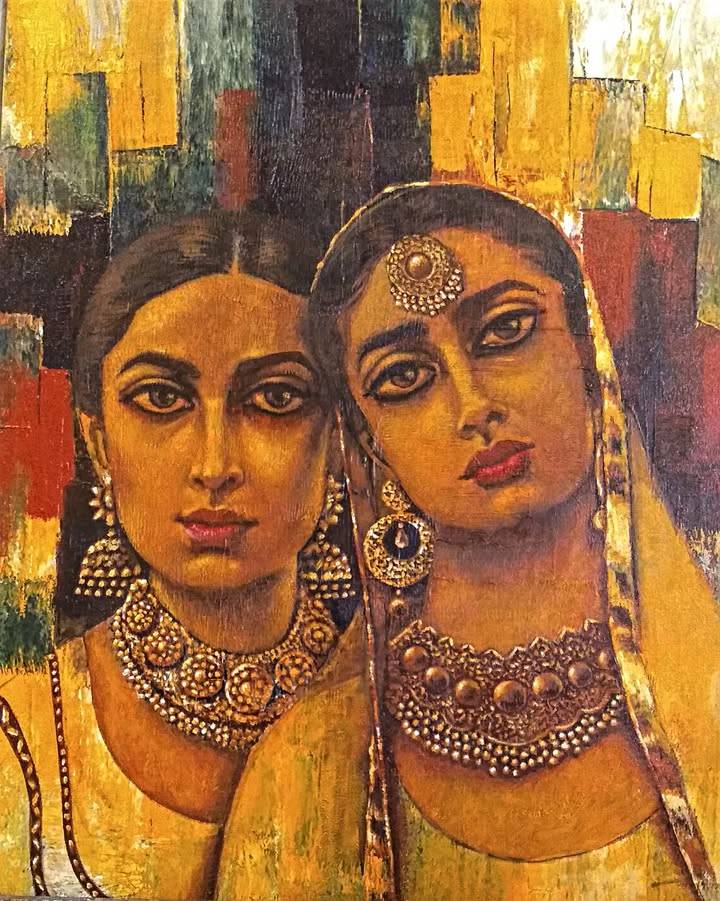
Shaista Momin: Until a few years ago, my theme revolved around women. In the motifs of women and doves, one could see a longing for freedom. In the theme of adorned women—wearing jewellery and beautifying themselves—the jewellery symbolised, for me, the chains of society in which women have been bound for centuries, chains that they themselves sometimes do not even recognise as confinement.
But for some time now, I have been studying spirituality. So in my paintings, elements have begun to appear that free a person from all bonds and carry them into the depths of their own being, where all conflicts dissolve and the self disappears. I am still on this journey myself, and therefore, my work is also gradually transforming.
Murad Yusufzai: Please tells us what challenges have you faced as an artist and how have you overcome them?
Shaista Momin: To answer this question, I would have to write my entire life story — but I will try to keep it brief. Art, in itself, is a challenge in our society. I have already mentioned the first challenge: due to financial constraints, I could not learn in any institution. But perhaps that turned out to be good for me. We do not have as many art institutions as we should, and thirty or thirty-five years ago, they were almost non-existent.
Art is a field in which you can never claim that you have learned everything. Something always remains. Every new painting comes with a new challenge.
My husband, Momin Khan, is a very senior and well-known artist. So convincing people who admired Momin to acknowledge my work was a major challenge. There was a time when I didn’t even have enough confidence to paint in Momin’s presence. I faced that challenge and set up my own separate studio. Gallery owners would often come to our house to pick up Momin’s work, but they wouldn’t even look at mine. I didn’t receive a good response from galleries, so I decided to carve my own path and started selling my work online. I began doing this when online markets hardly even existed. People began liking my work, and my paintings started selling. Today, I have built an identity for myself in figurative painting.
Apart from this, many challenges came simply because I am a woman. Many years of my life went into raising children. In our society, when a professional man asks for space, both family and the outside world give him that space. Responsibilities are eased so that he can focus on his work. But a woman is never given that facility. If guests are coming to the house or there is a family event, we women cannot say that we have work to do. We must fulfill all our duties like any other woman. This is why women in any field often cannot perform the way men do. I faced all these challenges myself. I worked twice as hard and pulled myself out of every difficulty, reaching a much better place today. If you have the fire of passion inside you, no one can stop you.
Murad Yusufzai: Can you walk us through your creative process –from concept to completion ?
Shaista Momin: I have already talked about my painting process. Sometimes the concept comes to me mentally, and sometimes I only see it after applying texture and observing it for a long time. There is a silent meditation with the canvas, and whatever emerges in the mind, I try to paint. Sometimes the painting itself shows what needs to be done next. Every painting has its own character, which, even in skilled hands, is never fully under our control. Sometimes, things happen that even surprise us. Painting certainly involves physical labor—it demands a lot of effort—but intuition always plays a role. If one follows the same pattern repeatedly, it will no longer be art; it will become mere craftsmanship and labor.
Murad Yusufzai: Can you explain the current art scene in Pakistan ?
Shaista Momin: In the last twenty-five years, Pakistan’s art scene has changed very rapidly. Three decades ago, Karachi had only two or three art galleries, and just two art institutes. But now, countless small and large art galleries are operating. With the expansion of the art market, more artists are also being produced. The younger generation is doing very good work, and their inclination—according to the needs of the time—is towards the contemporary school of thought. Pakistani artists are also making a name for themselves at the international level.
There is still a lot of room for growth in this field because art is still considered something only the elite are interested in. There is a need to bring it to the general public. The division and extremism growing in society can be reduced through art and other cultural activities.
Murad Yusufzai: What about your upcoming exhibitions or projects you re excited about them ?
Shaista Momin: Because of some personal commitments, I haven’t been able to work on any new theme or project for a while. I’m waiting for a moment of calm so I can finally translate the many ideas stored in my mind onto the canvas. I have also begun translating a few art books that I need to complete. The essays I’ve written on painters in Urdu must also be shaped into a book. I had started a series of conversations with artists on YouTube, which I hope to resume soon. There is so much to do that at times even a lifetime feels too short for it all.
Murad Yusufzai: Please tells us, what message would you to give to aspiring artists –especially young women who wish to express themselves through art?
Shaista Momin: Just like in every field, the number of women in this profession is also quite small. In art schools, there are many young women learning, but most of them are unable to continue afterward. Many take up teaching after completing their degrees—which is indeed a very important field—but they are unable to pursue art themselves.
Among the women artists I know, I always try to encourage them. There is no certainty in this profession. Not everyone can become a renowned artist. Not every artist can produce exceptional work. And even if you create outstanding work, there is no guarantee that the market will appreciate it. For this reason, many people leave the field halfway.
What I would like to say to young people is this: before entering this field, understand that you may have to face very difficult times. Don’t lose courage, and keep working hard. It is not necessary that you become an M.F. Husain. Just remember that even if we are only a drop in this vast ocean, we are still part of it. And in these chaotic times, we are creating beauty for the world—what could be greater than that?
Murad Yusufzai: During creative blocks or personal challenges, how do you stay motivated and inspired ?
Shaista Momin: There are many times in an artist’s life when they face creative block. My hack for such moments is to start from the beginning. I take myself back to the place where the journey began. I look at those early paintings again and try to recreate them. Sometimes I leave the work entirely and wait for the inner voice to awaken again.
As far as challenges are concerned, I believe I am a born fighter. Nothing seems impossible to me. I never get intimidated by problems; instead, I try to find solutions. Paths always open up if we don’t lose courage. Perhaps this mindset is the reason I have survived in the art industry.
Murad Yusufzai: If you could describe your art in one sentence what would it be?
Shaista Momin: I would describe all the art in the world with just two words: love and beauty.
These are not merely words — they are oceans. Everything is contained within them.
Murad Yusufzai: Many of you art work revolve around village girls –what emotions or stories do you hope to capture through them?
Shaista Momin: The women in my paintings are mostly shown in traditional clothing and jewelry. There are many reasons for this. As I mentioned earlier, jewelry for me is a symbol of social restraints — bangles like shackles, a nose ring like a leash. Throughout the evolution of human society, women has been subjected to exploitation in various ways under the patriarchal system shaped by economic structures. Alongside Zar and Zameen, Aurat has always been grouped as an object of possession — meaning she was never truly seen as a living, breathing human being.
My paintings narrate this very story of pain.
Murad Yusufzai: What role do light, colour and texture play in expressing emotion on your canvas?
Shaista Momin: In my first series The Silent Voice, I used darkness and light as symbolic elements. The face of my figure would remain in the dark. This represented how a woman’s identity—her very sense of self—has been overlooked.
A painting can always be understood in two ways. The first is the technical approach, in which one observes the colours, composition, drawing, and space to see how the artist has designed them—what the visual impact of the painting is. After that comes the question of what the painting is saying, its idea and message. Colours play an important role in both these perspectives. It is often believed that a good painting should have a balance of warm and cool colours. But in art, nothing is absolute.
My use of colour has always been experimental. In the beginning, I was afraid of colours. I don’t know why, but I never felt a friendship with them. That is why for many years I worked only in pen and ink. Even when I started painting, I worked in monochrome—where a single colour dominated the entire work. But in order to evolve, we must challenge ourselves, so I began using colours. However, I don’t apply specific colours to highlight a particular emotion; rather, my moods choose my colours. Often the painting itself tells us which colour belongs where.
Texture is very important to me. While creating a texture, many unique patterns appear on their own—patterns I could never create through planning. Texture gives my painting a sense of depth.
Murad Yusufzai: Do you sketch or plan each painting, or do you paint spontaneously as inspiration flows?
Shaista Momin: In the beginning, I used to plan my paintings carefully. I would prepare a sketch and layout, but now I mostly start directly. Most of the preparation happens in my mind. Sometimes, if I have a completely new idea, I make a sketch for it.
Murad Yusufzai: Do music, poetry literature influence your creative process? If yes what inspires you most ?
Shaista Momin: Literature has had a great influence on me. Since my paintings and I are not separate, it certainly affects not only my paintings but my entire creative process.
Murad Yusufzai: Finally, how would you like the world to remember Shaista Momin – the artist, the women and the storyteller ?
Shaista Momin: Everything we humans do is, in some way, an attempt to prove our existence. An artist, however, carries a profound desire to remain alive through their work. But once we understand the truth, that desire loses its meaning. I no longer wish to be remembered. My only wish now is that I may offer some benefit to this world through my being. And if I cannot, then at the very least I should remain harmless to the world. Whatever I have taken from this world, I hope I can return in equal measure.