


When the floodwaters engulfed the entire Naseerabad, a district situated in Balochistan, Pakistan, last year, August 2024, a farmer named Murad Ahmed witnessed in grief and anguish as the torrent wholly obliterated his rice fields. The fertile fields he nurtured for months had now turned into a wasteland overnight.
“The rice crops I had painstakingly cultivated have been swept away in the flash floods,” he speaks in a voice full of pain and grief. “This twenty-acre land used to take care of us,” he says, with shaking hands. “Now, it cannot even take care of itself as it has been reduced to mud and debris.”
65-year-old Murad is a father of three children, two sons and one daughter, who lives with his wife and elderly mother in Tepul Shakh Manjhoti, Naseerabad. His children have stopped going to school. “How can I afford their fees when the rice fields that used to provide for us have vanished?” he asks with a sorrowful tone.
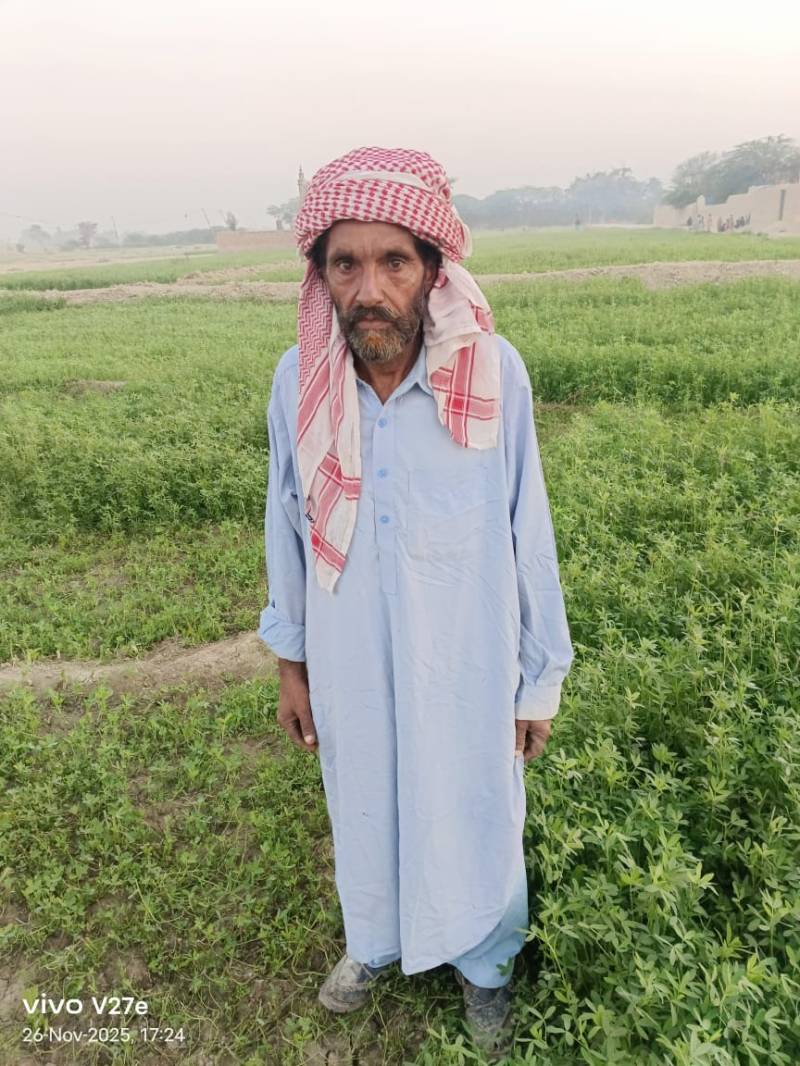
“Fertiliser expenses have skyrocketed, machinery costs have surged. After the flood, I have no resources to start over,” he explains. According to him, selling his wife’s jewellery last winter was the last option to make ends meet. “It was distressing to give up her jewellery,” he acknowledges with a faltering voice. “But what else could I do? Without it, we would have starved.”
Murad’s story hardly stands as unique. Throughout the province, from the heatwave-affected terrains of Turbat to the flood-prone plains of Naseerabad, residents are braving a bewildering dilemma: climate change is no longer a distant threat; rather, it is a consistent challenge. Persistent droughts, rising temperatures, erratic rainfall, and severe storms have exposed the climate policies of Balochistan’s government.
According to an official report compiled by the Balochistan Disaster Management Authority (BDMA), 21 people died, and 25 were injured throughout Balochistan owing to heavy downpours and flash floods. That same report notes that 251 houses were outrightly devastated, and 1,910 houses received minor damages. The report also mentions damage to infrastructure: around four bridges and 14 roads were washed out. On an agricultural level, at least 62 acres of cropland were wiped out in the flood.
“The government merely rambles about resilience, but how are we supposed to be resilient when we obtain no support when disaster strikes us?” Murad asks. “If the policies continue to remain on paper, the affected farmers like us tend to confront challenges regarding climate calamities. The government has, unfortunately, left us at the mercy of our own.”
According to relevant authorities, the government of Balochistan is taking effective measures towards adaptation. Kaleem Tareen, an Assistant Director in the Provincial Disaster Management Authority (PDMA), a climate change department of Balochistan, points out notable steps such as revamping traditional karez systems via the Revival of Balochistan Water Resources Programme, which is sponsored by the EU and FAO. “Adaptation is not only about setting up resilient infrastructure,” Tareen adds. “It is about reviving the systems that have sustained livelihoods for centuries.”
In 2023, the Balochistan government devised its climate change policy, which was marked as a landmark moment. It stresses sectoral priorities, such as water security, climate-tolerant agriculture, coastline preservation, and community readiness. It outlines a structural framework, such as a provincial climate change commission, which is not yet operational, and a climate change fund with an initial allocation of Rs 500 million to streamline climate finance.
The floods of Balochistan continue to serve as a grave caution that climate adaptation is not all about paper pledges; rather, it is about transforming policy into practice so that the people who are severely susceptible to climate change can survive, endure and mitigate its large-scale impacts
Investments in adaptation include the World Bank Balochistan Water Security and Productivity Improvement Project (BWSPIP), which is a huge investment of US$101.3 million related to the provincial water-adaptation agenda. For a province like Balochistan, which has long struggled due to poor governance, this was seen as an exceptional example of clarity and direction in the arena of climate change adaptation.
But the transformation from policy to practice continues to be a challenge. “Our policies are strong on paper, but converting them into real impacts is our biggest hurdle currently,” says Kaleem Tareen. “The key obstacle is converting paper into practice so that a farmer in Turbat or Naseerabad can genuinely feel it in their day-to-day life.”
However, for many locals, climate policies tend to remain theoretical. “Climate policies are designed regularly. When the downpour occurred, we witnessed nothing on the ground,” says Murad. His experience reflects a systemic concern: the growing chasm between decision-making in administrative offices and the ground-level realities of societies in distant areas.
Climate change activists caution that Balochistan’s fragility is worsened by its geography. Sudden floods, water insecurity, and desertification make the province highly susceptible to climate change. “Without proactive and community-based measures, adaptation plans are destined to fail,” says Izzat Ullah, a climate change activist based in Quetta. “We direly need a system that intervenes before disasters occur, not after.”
Community engagement, climate activists assert, is indispensable for genuine transformation. Policies that exclude local participation mostly fail to cope with climate vulnerabilities. Local councils, with participation from farmers, can possibly serve a leading role in supervising weather events, enhancing irrigation systems, and determining which crops to cultivate in accordance with changing weather conditions.
Climate financing is an additional impediment. While Balochistan obtains federal government and international funds for climate projects, delays in the release of funds and official blockages often hinder swift implementation. “Funds are allocated on paper, but the outcomes seldom reach the people who need them primarily,” Izzat Ullah elaborates.
The mental strain on farmers cannot be disregarded. Frequent losses from floods and droughts generate a sense of hopelessness and trigger mistrust. For Murad, each monsoon season is a trial of resilience. “Farmers aspire to endure and farm again, but how long can we rebuild ourselves if no meaningful change occurs?” he inquires.
According to climate change experts, adaptation must be included in long-term climate change planning instead of depending on emergency-based relief measures. Improving local administration, constructing robust infrastructure, advancing sustainable agriculture, and ensuring more open, transparent and impartial climate fund management are all indispensable in terms of turning policies into practice on the ground.
As the upcoming monsoon arrives in a few months, the farmers of regions like Naseerabad are poised to face the consequences. Murad Ahmed and his fellow farmers look at the skies with trepidation, hoping that, in this moment, climate policies will transform into adequate protection. For them, words on paper are not enough; they direly need real outcomes that seek to protect their lives and livelihoods.
This story is greatly pertinent owing to the recently concluded COP30 summit, where global leaders promised more finance for adaptation. But sadly, the details tend to remain ambitious, and no one knows where the funds will come from and how that money will be delivered to vulnerable regions like Balochistan.
The absence of concrete adaptation plans at both global and local levels leaves communities exposed to perpetual climate disasters. The recent COP30 aimed at tripling adaptation finance for vulnerable countries to $120 billion by 2030, but even this insufficient finance gets delayed. Adaptation funds are only effective when they are delivered on the ground.
In a nutshell, the floods of Balochistan continue to serve as a grave caution that climate adaptation is not all about paper pledges; rather, it is about transforming policy into practice so that the people who are severely susceptible to climate change can survive, endure and mitigate its large-scale impacts.