

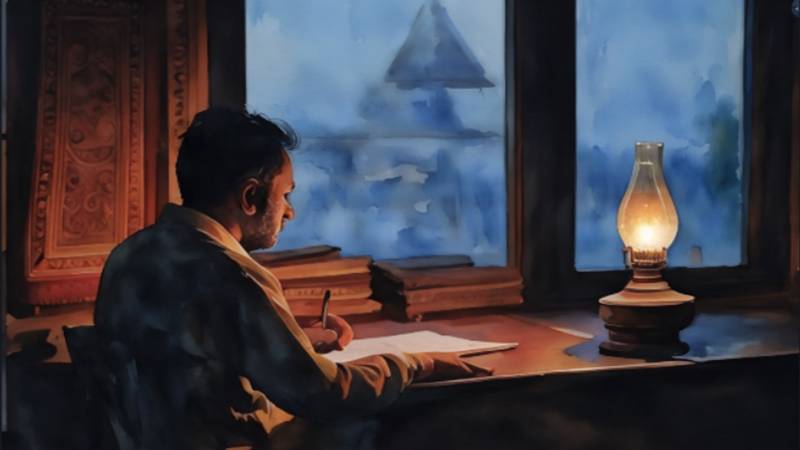
Urdu poetry has always been a rich and powerful form of expression. From romantic ghazals to spiritual verses, poets have used this language to touch hearts and stir souls. Among the many styles and themes found in Urdu poetry, one of the most important and impactful has been rebellious poetry. Rebellious Urdu poetry is bold, direct, and often dangerous for the poets who write it. It challenges injustice, questions power, and speaks for the unheard and oppressed. This form of poetry is not just about anger or protest; it is also full of hope, a love for truth, and a desire for a better world.
The tradition of rebellious poetry in Urdu dates back to the time of British colonial rule in India. Poets like Mirza Ghalib and Allama Iqbal laid the foundation by questioning the limits of society, religion, and politics in their own ways. While Ghalib’s rebellion was more philosophical and personal, Iqbal’s verses were openly political and visionary. Iqbal imagined a strong and free society, especially for Muslims, and spoke of self-respect, unity, and revival. His poetry lit a spark in many hearts and inspired people to think beyond the chains of colonial rule.
While these names are well-known, it is important to recognise that rebellious women poets were present even in the early periods, though their voices were often silenced or ignored in literary history. One of the earliest among them was Mah Laqa Bai Chanda (1767–1824), a poet from Hyderabad who not only composed bold Urdu ghazals but was also the first Indian woman to compile her own diwan (collection of poetry). Her verses showed emotional independence and intellectual sharpness in an era when women’s writing was rarely preserved.
Begum Rokeya Sakhawat Hossain (1880–1932), though more associated with Bengali prose, wrote Persianised Urdu and campaigned fiercely for women’s education and emancipation in colonial India. She was among the first Muslim women to speak out against the purdah system and gender discrimination, making her literary and activist work an early act of rebellion in the subcontinent’s Islamic culture.
Similarly, Nazr Sajjad Hyder (1894–1967), one of the early progressive Urdu women writers and mother of the renowned novelist Qurratulain Hyder, penned poetry and prose with a sharp critique of conservative gender roles. Her work gently rejected the idea that a woman’s place was only in the home, and her literary career paved the way for many women’s voices in the 20th century.
Rebellious Urdu poetry has never remained confined to books and literary circles; it has been sung in the streets, printed on banners, and echoed in protests
In the years that followed, rebellious Urdu poetry grew stronger. One of the most iconic names in this genre is Faiz Ahmed Faiz. Faiz was a poet, journalist, and political activist. He used simple but elegant words to express deep emotions of resistance and revolution. His poetry was not loud, but it carried great power. He wrote about prisoners, soldiers, lovers, and workers. His verses brought together the pain of personal loss with the suffering of nations. One of his most famous lines, “Bol ke lab azaad hain teray” (“Speak, for your lips are free”), became a symbol of freedom of expression. Faiz’s poetry often got him into trouble with the government. He was jailed, exiled, and banned, but he never stopped writing. His pen remained his weapon, and his words gave courage to many.
Another great figure in rebellious Urdu poetry is Habib Jalib. Jalib’s poetry was direct, passionate, and written for the common man. He did not use flowery language or complex metaphors. He spoke in the language of the streets and touched on the issues that affected ordinary people—poverty, injustice, dictatorship, and corruption. During the rule of military leaders like Field Marshal Ayub Khan and General Zia-ul-Haq, Jalib’s poems became slogans of resistance. He refused to stay silent in front of power and often recited his poems at public gatherings, despite threats to his life. One of his famous verses during Ayub Khan’s regime was: “Main nahin maanta, main nahin jaanta” (“I do not accept, I do not recognise”). His honesty and bravery made him the voice of the people, and his poems are still quoted in protests and movements.
In rebellious Urdu poetry, women poets have also played an important role. Fehmida Riaz and Kishwar Naheed are two powerful examples. Fehmida Riaz’s poetry was bold in both political and social terms. She challenged patriarchy, religious extremism, and dictatorship all at once. Her poems often mixed themes of love and politics, showing that both personal and public freedom are connected. Because of her fearless voice, she faced exile and threats, but she remained true to her pen.
Kishwar Naheed spoke about the strength and suffering of women in a male-dominated society. Her poetry dared to expose the harsh realities of gender inequality. In one of her famous poems, she wrote about walking without a veil and being stared at by society but refusing to be shamed. These women poets not only fought against political oppression but also broke the silence around women’s rights in a conservative culture.
Among their contemporaries and successors, Parveen Shakir also stood out with her gentle yet firm challenge to traditional gender roles. Though her poetry is often associated with romance and beauty, underneath lies a quiet defiance. She wrote about the struggles of working women, identity, and emotional freedom with a subtle yet sharp voice that resonated with thousands of women who saw their reflection in her words.
Another strong voice is that of Sara Shagufta, a deeply personal and painfully raw poet whose rebellion was rooted in her experience of mental anguish, social rejection, and gender-based violence. Her verses were filled with haunting metaphors and emotions that broke conventional boundaries. She wrote about trauma, female desire, and societal cruelty, often facing backlash for her frankness. Her life was short and tragic, but her work remains a painful reminder of the price many rebellious women poets have paid.
Similarly, in India, Razia Sajjad Zaheer, a progressive writer and poet, blended her commitment to social justice with her literary output, focusing on class and gender injustices with bold clarity.
These women, along with many emerging voices from regions like Kashmir and Balochistan, are expanding the meaning of rebellion in Urdu poetry. They speak not only about political change but also about emotional and cultural liberation. Through their words, they continue to challenge deeply rooted systems of control—be it patriarchy, state power, or cultural taboos.
Rebellious Urdu poetry teaches us a powerful lesson: never be afraid to tell the truth, even if your voice shakes
Rebellious Urdu poetry has never remained confined to books and literary circles; it has been sung in the streets, printed on banners, and echoed in protests. Music and poetry often come together in this tradition. The verses of Faiz, Jalib, and others have been turned into songs by singers like Iqbal Bano, Tina Sani, and the Laal band. One of the most emotional moments in Pakistan’s history was when Iqbal Bano sang Faiz’s “Hum Dekhenge” in a packed auditorium during General Zia-ul-Haq’s dictatorship. It was an open act of defiance, and the audience joined her in one voice. That poem, which speaks of the downfall of tyrants and the victory of truth, has become an anthem for every new generation seeking change.
The power of rebellious Urdu poetry lies in its ability to connect deeply with the emotions of the people while also inspiring them to think critically. It not only speaks of hunger and pain but also of dreams and courage. It attacks falsehood and celebrates hope. In times of fear and silence, these poets remind us that speaking out is both right and a responsibility. They show us that words can be stronger than weapons and that poetry can play a decisive role in shaping societies.
In today’s world, where censorship, extremism, and injustice still exist, rebellious Urdu poetry continues to be relevant. New poets are now carrying the torch forward. Some write online, others perform in cafés and colleges, and many use social media to share their work. They speak of human rights, climate change, mental health, and other issues that matter to today’s generation. They may not face the same kind of punishment that Faiz or Jalib did, but they still endure online abuse, threats, and isolation. Yet they carry on, proving that the spirit of rebellion in Urdu poetry is still alive.
It is important to remember that rebellious poetry is not just about anger or hate. It is based on a love for truth, justice, and humanity. These poets are not trying to destroy—they are trying to rebuild. They criticise not for the sake of it, but because they believe in something better. Their verses are not only full of pain, but also full of hope. They show us the darkness and point towards the light. In doing so, they help societies to heal, grow, and move forward.
Rebellious Urdu poetry is not just a part of literature—it is a part of history and a tool for social change. It has given voice to the voiceless, power to the weak, and dignity to those who are forgotten. It has survived censorship, exile, jail, and even death. And it will continue to survive, as long as there is one poet who dares to speak the truth and one reader who listens with an open heart.
Rebellious Urdu poetry teaches us a powerful lesson: never be afraid to tell the truth, even if your voice shakes. Whether it is whispered or shouted, written in ink or sung aloud, the truth has a rhythm, and poetry is one of its oldest and strongest instruments. Through all its beauty and pain, rebellious Urdu poetry reminds us that no matter how strong the oppressors may seem, the power of words can never be crushed.