

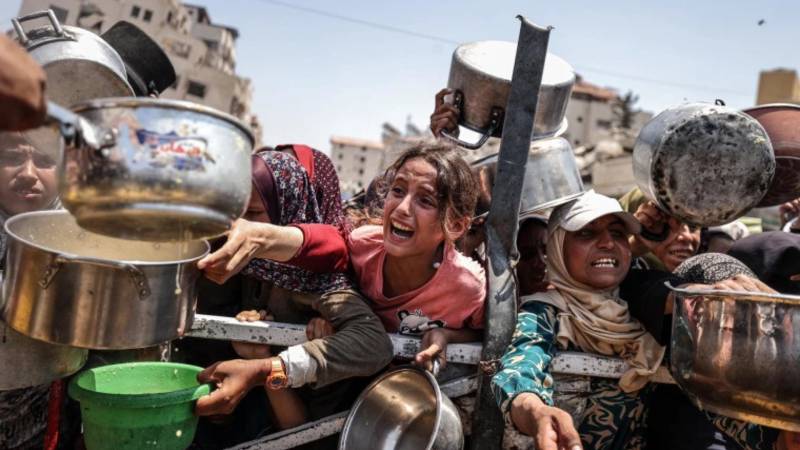
As the United Nations acknowledges that over 1,000 Palestinians have lost their lives while struggling to access food, often for just one meal a day, particularly when attempting to collect aid from distribution hubs, July has been the deadliest month since the current conflict between Hamas and Israel began. In the war-torn and genocide-stricken Gaza Strip of Palestine, one person dies approximately every 12 minutes due to the Israeli food blockade or military attacks.
Professor Alex de Waal, an expert on humanitarian crises, describes the horror of systematic starvation as 'minutely engineered, closely monitored, precisely designed.' He further notes that 'genocide is a societal torture.' However, despite global outrage and solidarity with the unarmed, innocent citizens of the Gaza Strip, they remain helpless. Meanwhile, the UN, humanitarian agencies, and the international community are merely paying lip service instead of taking concrete actions to pressure Israel to halt the genocide of Palestinians, which is evidently supported by the United States.
In a blunt warning, over 100 international humanitarian organisations issued a joint statement urging Israel to end its blockade, restore the full flow of food, clean water, and medical supplies to Gaza, and agree to a ceasefire. The statement highlighted the dire situation, noting that 'food markets are empty, human waste is piling up, illness is spreading, and people in Gaza are collapsing on the streets from hunger and dehydration.'
For nearly 18 years, Israel has imposed an illegal blockade on the occupied Gaza Strip. Since October 2023, the blockade has been intensified, severely restricting the entry of essential goods such as food, fuel, and medical supplies. This tightening of restrictions has exacerbated a dire humanitarian crisis, raising concerns that it forms part of a deliberate strategy aimed at causing significant harm and physical destruction to the Palestinian population in Gaza.
Gaza's Health Ministry reported that at least 115 Palestinians, including many children, have starved to death since Israel's war on Gaza began in October 2023, with most deaths occurring in recent weeks
On 7 October 2023, Hamas launched a deadly attack on Israel, prompting the Israel Defence Forces (IDF) to launch aerial campaigns and ground operations in the Gaza Strip. A brief respite came in January 2025 when the US, Egypt, and Qatar brokered a ceasefire between Israel and Hamas, ending 15 months of conflict.
However, this was short-lived, as Israel resumed its offensive in March 2025 with a large-scale military campaign across Gaza, including major cities like Gaza City, Khan Yunis, and Rafah. The subsequent two-month blockade on humanitarian aid has plunged Gaza into famine-like conditions, exacerbating a severe humanitarian crisis. The UN has condemned Israel's restrictive aid system, which limits distribution to a few sites and forces Palestinians to travel long distances for aid, citing it as a violation of humanitarian principles.
The conflict has escalated regional tensions across the Middle East, sparking a wider crisis. Following Hamas's 7 October attack, Hezbollah began targeting northern Israel, prompting months of cross-border clashes that ultimately led to the IDF's ground invasion of Lebanon. Meanwhile, Yemen's Houthi rebels have launched missile attacks on Israel and commercial vessels in the Red Sea, while other Iran-backed groups have carried out numerous strikes on US military bases in Iraq and Syria.
On 12 June, the International Atomic Energy Agency (IAEA) declared Iran in violation of its non-proliferation obligations, a determination not made in twenty years. In response, Iran announced plans to open a secret uranium enrichment site. The next day, Israel launched a unilateral military strike against Iran, targeting nuclear facilities, missile factories, and key personnel. Iran's Foreign Minister Abbas Araghchi condemned the attack as "an act of war," and Iran retaliated with drone and ballistic missile strikes. Israeli Prime Minister Benjamin Netanyahu justified the operation as a last-resort measure to prevent Iran from developing nuclear weapons.
Amidst the escalation, US President Trump expressed support for Israel's objectives and hinted at openness to regime change in Tehran, despite the recent resumption of nuclear negotiations. While the US initially claimed non-involvement, Trump later stated that Iran's refusal to negotiate had provoked the attack.
The conflict escalated further when the US directly intervened on 21 June, launching bunker-buster bomb strikes on three Iranian nuclear sites. The US claimed significant damage to Iran's nuclear capabilities, but the UN nuclear watchdog's head assessed the setback as temporary, estimating a delay of only a few months. In retaliation, Iran launched a missile attack on the Al Udeid Air Base in Qatar on 23 June 2025, targeting a key US military installation.
'The devastating impact on children in Gaza over the past many months has triggered an unparalleled mental health crisis among children of all ages, one that is truly without precedent,' said Liz Allcock, head of protection at Medical Aid for Palestinians.
Liz Allcock, who has been visiting Gaza for months, told the media that 'earlier, Gazans used to signal for cigarettes, now they signal for food,' as a large population struggles to get even one meal a day.
Gaza's Health Ministry reported that at least 115 Palestinians, including many children, have starved to death since Israel's war on Gaza began in October 2023, with most deaths occurring in recent weeks. Israel's total blockade, imposed in March, has severely restricted aid, triggering a dire humanitarian crisis. The UN warned of families "breaking down" due to hunger, with parents too weak to care for their children. UNRWA chief Philippe Lazzarini noted that those reaching clinics lack the energy, food, or means to follow medical advice.
As the humanitarian crisis in Gaza continues to unravel, it's clear that Israel and the US are in a state of denial about the devastating consequences of their actions. Despite overwhelming evidence of widespread suffering, starvation, and death, they remain obstinate in their support for policies that are perpetuating the crisis. Meanwhile, the international community, despite vocal support from the European Union and France, has proven woefully inadequate in its response, failing to translate words into meaningful action to hold Israel accountable and alleviate the suffering of the Palestinian people. The stark disconnect between rhetoric and reality has only exacerbated the crisis, leaving Gazans to bear the brunt of inaction and indifference.