

Amazingly, language is just not a medium of communication but a tool that can metamorphose an entire society politically, socially, and economically. According to Richard Rorty, a neo-pragmatic philosopher, language is a lens through which one can understand the meaning of the globe and its affairs. In this line, the speciesist language, verbal harassment, and prejudice against animals provide dark spectacles to the people with which they perceive animals as inferior creatures, ingraining hatred towards animals. Additionally, this discriminatory lingo makes human minds uphold negligence towards animals, exacerbating the vulnerabilities of the animals. These animal-degrading rhetorics are rampant in Pakistan, where the literacy rate is among the lowest states of South Asia.
Historically, many civilisations, like the Greeks and Romans, used to compare traits of animals with humans to degrade them, connecting negative stereotypes with animals. They used words like 'pig-headed,' for instance, for stubborn humans. With time, this derogatory verbiage also evolved to more negative phrases and metaphors against animals. For example, in the colonial era, phrases like 'savage beasts' were used by the colonial masters for the indigenous people to label them as uncivilised masses. Furthermore, imperialists, believers of racism, also called African people monkeys to portray them as ugly people, spreading pessimism towards voiceless creatures.
Additionally, many cultures, deep-rooted in dogmatic beliefs and superstitiousness, made false connotations with animals. For instance, black cats and owls were seen as bad omens. Similarly, many philosophers also used speciesist jargon in their theories. Jean-Jacques Rousseau, for example, in his social contractual theory, used the word 'serpent' to show the property as the root cause of chaos. Unfortunately, many years have passed, but still these terminologies, even in this digitalised era, are spreading hatred to marginalise voiceless animals. Many idioms, phrases, words, and slang depict the prejudice against animals. Phrases like 'dog-eat-dog,' 'scapegoat,' 'smell the rat,' etc., substantiate the aforesaid fact, perpetuating discrimination against animals in the age of artificial intelligence. Even academicians use anti-animal words. As a case in point, in political science, the word 'hawkish' is used to show aggressive elements.
Religious scholars must play their roles in depicting the true picture of human responsibilities towards animals regarding their protection and conservation, eliminating the hatred from society
This exploitative vocabulary also ruined the role of religion in protecting the rights of animals by misinterpreting the context of the scriptures. For example, it is misinterpreted in Islam that it is considered forbidden to keep a dog as a pet. Likewise, in Hinduism, dogs are considered reborn humans that were sinners in their previous lives. Such misinterpretations exacerbate negativity for animals among humans, promoting violence against them. In the same way, Jews consider goats as sinful creatures and sacrifice them because for them they are carriers of human sins.
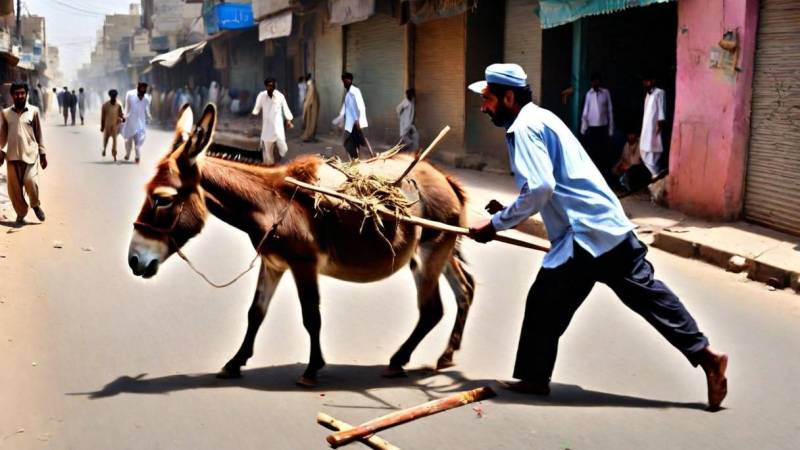
Talking about the case of Pakistan, this language is also prevalent here, depleting the respect for animals. For instance, the word dog is used to abuse other people. Likewise, donkeys are used to call people foolish and useless. Further, the snake is associated with the deceiver. Bitch is used for ill-mannered women. Therefore, this language is widespread and deep-rooted in different cultures and societies, including Pakistan, demeaning the animals.
This speech is not only confined to communication but has severe implications for the entire globe, including Pakistan. Having marginalised animals, this language promotes brutality and ill-treatment towards animals. Further, it barricades the concept of wildlife conservation, impacting ecotourism and, consequently, the economy of the state. Moreover, it encourages brutal and illegal activities against animals, like dogfighting and cockfighting, that humans make animals do for their entertainment, undermining the moral values of society. Likewise, it motivates oppressive legislation to operate in the political institutions against animals, like official orders of dog culling to control stray populations. Also, having spread oppression against animals, this language ruins the national standing of a state, labeling it as a speciesist state. Additionally, phrases like ‘curiosity kills a cat’ provide fertile ground for heinous crimes like killing and sexual abuse of animals —crimes that, in some cases, extend to human victims.
It is said that when there is a will, there is a way. So, there are solutions to cut the roots of this verbalisation. At present, organisations like PETA are highlighting this issue of prejudicial language against animals and its alternative words. However, this issue needs a long-term and consolidated solution. First, this phrasing can be impeded via reforms in the curriculum in which inclusive language and its importance must be discussed. With that, parenting style can inculcate inclusivity in the minds of the children. For instance, folklore is a tool to transform the minds of the kids regarding the importance of animals and humans' responsibility to protect them. Further, education impacts the behavior of the people. To follow this, as per the David Easton behavioralism model, the political behavior of the people impacts the legislation. So, education must be promoted to make people well aware so that they can minimise the use of zoophobic language. That would help the legislators to make animal-centric policies, establishing an inclusive society. Furthermore, religious scholars must play their roles in depicting the true picture of human responsibilities towards animals regarding their protection and conservation, eliminating the hatred from society.
To conclude, Pakistan has been struggling with multifarious issues. Globally, it is perceived as an animal apartheid nation because it ranks among the worst performers in animal welfare and is categorised as “E” under the Animal Protection Index (API), underscoring its failure to safeguard wildlife. This worst performance is underpinned by the animal discriminatory language, evaporating empathy from the hearts of people for animals. However, the aforementioned solutions are a panacea to the problem if implemented in letter and spirit, lest the exclusive environment add more waves of extremism into society.