

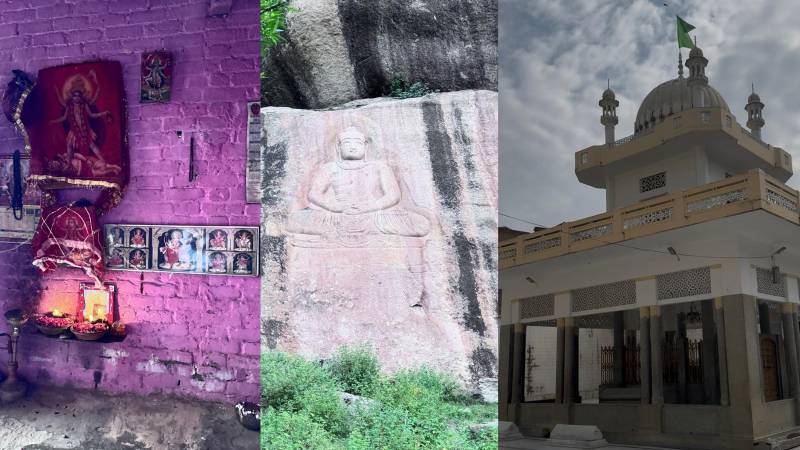
There are 1,400 stupas in the lands of Udyana, where the Suvasta (Swat River) has nourished settlements for as long as history has been able to record humankind’s settlements.
As I absorbed the artefacts in the Swat Museum, in between relief work activities, to decompress from the plight of the inhabitants in 2025, I better understood the romanticisation of history as the golden age. Sadly, in Swat’s case, today is much worse off in every sense if we look at its ancient, incredible history.
The heart of the Gandhara graveyards of incredible settlements tells us about trading, successful, educated, spiritually advanced civilisations that lived here. The seat of Buddhist learning, it attracted communities from all over, creating a cosmopolitan society.
I only managed to see the massive stupa in Barikot, but I was determined to see at least one Buddha stone carved into the mountain while I was here.
After one long, very depressing visit to Yakh Tange, we stopped in Shakhorai village/Jahanabad at the foothills of the Hindu Kush mountain. Traumatised by listening to the stories of death, we needed to decompress.
Mussarat Bibi, Reema Bibi, along Shah Husain sb, we trekked up for 45 minutes, weaving on a footpath going upwards. We walked past two cluster hamlets. Huffing and puffing, Mussarat Bibi and I followed our two other agile athletic companions.
The simplicity and serenity of Lord Buddha is unexplainable. I could not see him all the way until I did. Apt really. The thought actually came to my mind, maybe he does not want to reveal himself to me, because I am not worthy.
A pink hue surrounds Lord Gautama Siddhartha Buddha, like the hues of the sun – the rays of light when it rises and sets every day in the cycle of life for eternity.
There is an enormous scope here for microfinance insurance companies to socially mobilise and step in and expand their base
I was later told the Taliban in 2006 tried very hard to destroy this image of peace, love and kindness for all creations of the Almighty; they eventually managed to deface a part of his face, but the Italian restoration archaeologists managed to restore him in 2017.
We have no Buddhists in Swat or in Pakistan left, but Swat has many Hindu, Sikh and Christian communities who have lived here for generations and millennia.
Many of the shops destroyed along the Nadi running through Swat on both sides include Sikh shopkeepers. I met several of them in their Gurdwara in Main Bazar (Kafera neighbourhood).
There are approximately 180 families and growing. Eight families were particularly affected with loss of everything – home, shops, inventory, personal belongings, etc. In the urban flooding, cloth shops, printing press shops, and fridge shops they owned were wiped out.
I spoke to Granthi Bansri Lal je and Pavan Kumar, along with Homi Singh sb, who introduced me to many of the women in their community after morning kirtan (6:30 am). We talked about their lives and what they went through.
I spoke about health, hygiene and the dignity kits we were distributing. The donations we shared cannot restore their shops or inventory, but I assured them their request for assistance from the government or corporate social responsibility, along with perhaps insurance companies, I would advocate through my writings and lobbying.
We discussed the possibility of taking out insurance in the future for disaster mitigation measures. In principle, Kumar and Homi sb said it is a sensible idea, but the lack of understanding and importance of such measures is a challenge.
Moreover, where the culture of not paying taxes exists, especially where it is exempt in the Malakand Division, the idea of paying regularly for a future possible disaster does not make sense to most. We discussed at length the importance of self-help and mitigation measures where possible, especially amongst earning communities.
There is an enormous scope here for microfinance insurance companies to socially mobilise and step in and expand their base.
As it was Sunday, we went to Landikas, where St Luke’s Church is located, to meet the 100-plus Christian community who live around Mingora. Pastor Kaisar Shabaz introduced us to his flock, and we had an opportunity to speak to many before Sunday mass began.
What stayed with me during Sunday mass was the repeated message of gratefulness and gratitude that both Pastor Shabaz emphasised and the three ladies of the community read out from the Bible.
Pukhtunkhwa is the land of many civilisations, in fact gave birth to the Vedas on the banks of this very part of what we call Pukhtunkhwa
I thought to myself, a community which is particularly vulnerable in every imaginable indicator and shunned in Pakistani society, is sermonising and inculcating gratitude, love thy neighbour and do more for your greater community.
I asked the pastor why so many Christians were non-literate and so vulnerable when so many Pakistanis were educated in incredible missionary schools.
The pastor was quite blunt and said poverty has rendered too many uninterested in education and too many are addicted to drugs and alcohol. The church does not have the number of schools or resources to educate its flock.
For example, Sangota, the only Christian missionary school, is too far away for most to attend and is not sufficient for the number of children that need to be educated.
In his sermon, he raised the plight of others, flooding that has happened in Punjab and Sindh as calamities for so many millions of Pakistanis and they should be grateful that they survived theirs.
As they sang hymns and celebrated life, my heart cried. There is so much love and kindness despite so much injustice.
In Khantoti Muhalla, Makan Bagh, we met with many members of the Hindu community who have lived here forever. There are approximately 180 families that reside in three or four neighbourhoods in Mingora.
Thankfully, most of them are educated and working class. There were about 12–15 families who were affected by the recent flash flooding, which partially destroyed their homes and completely washed away all their belongings.
We heard their woes and gave them a token of assistance collected by the generosity of those who trust my work in emergencies. We also shared the sanitary kits and explained the importance of personal hygiene for health resilience.
While we spoke of basic human needs, it was very clear that the lack of a space for the community to come together, a mandir or a community centre, was a priority.
There is no established temple/mandir, a request they made emphatically to us several times. Pandit Jee, along with several community members, asked for our intervention for the Auqaf/government to make this happen.
They said at some point they were allocated 20 lakh rupees for building a mandir/community centre but they require land to build upon. If they were allowed to use this money instead to purchase a plot, they would readily find the funds to build their community centre.
I think this is a very fair request. A people, a community, which predates us by several millennia, is owed one community centre at the very least. My suggestion would be that Peshawar should allocate land and build them a mandir.
Pukhtunkhwa is the land of many civilisations, in fact gave birth to the Vedas on the banks of this very part of what we call Pukhtunkhwa. Our heritage is shared and is connected to both Buddhist Gandhara and the Vedic civilisation before them.
Before I left Mingora, I went to pay my respects to Hazrat Shaikh Abdul Ghafoor Mujaddid Saidu Sharif, affectionately known as Saidu Baba Sharif, the patron saint of Swat.
We must own and protect equally all our people. That is Pukhtun. I think he would agree.