

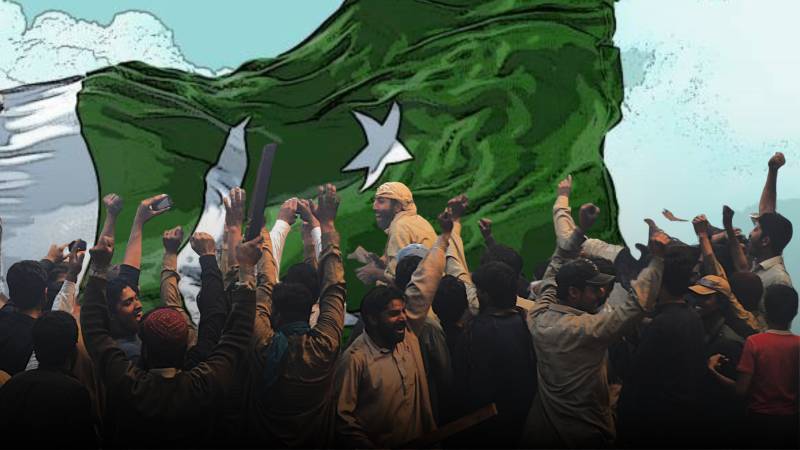
History is merciless with irony. Those who once cried for justice, those whose identities were forged in exclusion, too often lose their moral compass when they gain space or influence. They mimic the very cruelty they once denounced. Pakistan, amid its fractured politics, offers no shortage of examples.
Take the discourse around Palestine. As Gaza lay in ruins, countless Pakistanis marched in solidarity. Yet some elites, many from minority or liberal backgrounds, twisted solidarity into silence or rationalisation. One Dawn editorialist wrote, “the truth is currently struggling against a tide of comforting falsehoods,” critiquing simplistic narratives of resistance while undermining an entire movement of protest.
Even within Pakistan, hypocrisy is palpable. The Aurat March, a powerful demonstration for dignity, rights, and equality, has sparked sneers not only from conservatives but also from liberal elites. Consider actor Ahmed Ali Butt, who dismissed the movement as “heavily funded just to disrupt the family structure of Pakistan” in his podcast, invoking tropes of foreign influence to delegitimise a grassroots demand for justice.
Meanwhile, some minority intellectuals basking in urban liberal circles choose derision over solidarity, ridiculing Muslims for praying or fasting. Their disdain is not liberation, it’s assimilation. It signals a hunger for acceptance in global “progressive” spaces at the cost of historic empathy.
History is merciless to those who cheer the oppressor while pretending to stand for the oppressed
Psychology gives us the framework. Anna Freud called it identification with the aggressor: to escape vulnerability, the oppressed imitate their oppressors. Once empowered, that mimicry hardens into conviction. Leon Festinger’s cognitive dissonance theory shows how such individuals resolve their moral conflict. Embracing Zionist stances or mocking feminists clashes painfully with their own marginalisation, so they recast the narrative: this isn’t hypocrisy. It is rationality, modernity, enlightenment.
Sociology strips away the pretence further. Henri Tajfel’s social identity theory reveals that group belonging often eclipses moral consistency. For Pakistan’s urban elite, validation often flows not from one’s roots but from acceptance in international liberal circuits. Pierre Bourdieu’s concept of symbolic capital suggests that suffering once conferred moral legitimacy. Now, having succeeded, they spend it by distancing themselves from their origins, often brandishing denial, disdain, or ridicule against those who look like them.
This paradox isn’t uniquely Pakistani. Jews, once victims of genocide, now impose apartheid-like policies in Palestine. Hindu elites, long subjugated under colonialism, now spearhead Hindutva majoritarianism. In Pakistan, our pseudo-liberals and minority elites often mimic that same moral bankruptcy, mocking Muslims, deriding feminists, turning history’s mirror away from the powerful.
Victimhood does not guarantee virtue. It never did. Power unmasks more than oppression ever could. When challenged, these self-styled champions resort to gaslighting, deflection, and personal attacks. Their politics is not about justice but about status; not about truth but about belonging.
The moral test isn’t how one suffers in weakness. It’s how one behaves in strength. By that measure, many of our so-called progressives fail spectacularly. They justify oppression. They sneer at dignity. They cloak betrayal in claims of freedom.
No matter how well you paint it, stripes don’t turn a donkey into a zebra. History is merciless to those who cheer the oppressor while pretending to stand for the oppressed.