

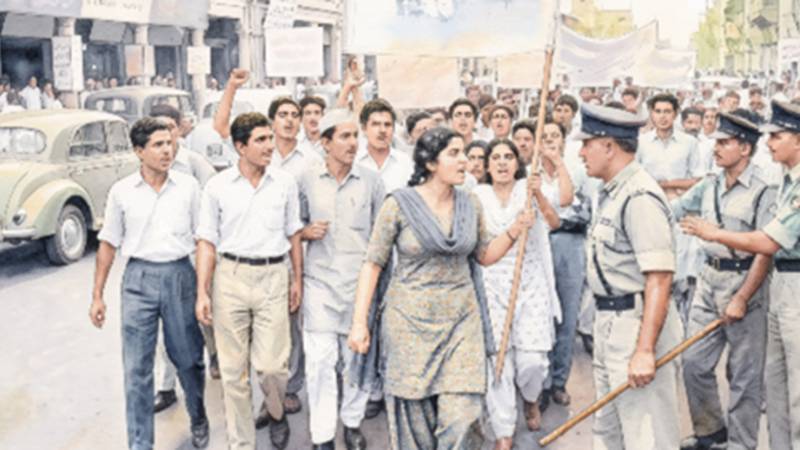
The history of Pakistan is often told through the lens of the elite class and politicians, yet the true pulse of its democratic spirit once beat in the corridors of its colleges. For decades, the students of Sindh acted as the nation’s conscience. Their struggle was never merely about grades or campus facilities; it was a battle for the soul of a young country. As Milan Kundera famously noted, the struggle against power is the struggle of memory against forgetting. To look back at the years 1953, 1967, and 1984 is to remember a time when youth stood as a bulwark against tyranny.
The Baptism of Fire: The 7th of January 1953
In early 1953, barely five years after the birth of the state, Karachi witnessed a movement that set the tone for decades of activism. These students did not seek radical upheaval; they sought modest human rights. They requested a fair fee structure, the establishment of libraries, and the basic tools of science—laboratories. Above all, they sought the dignity of future employment.
These young men and women did not rush to the streets in a fit of pique. They reached out to the Central Education Minister, Fazlul Rehman, with repeated appeals. Their letters went unanswered, and their voices met a wall of bureaucratic indifference. When diplomacy failed, organisation began. Under the joint banner of the Inter-Collegiate Body (ICB) and the Democratic Students Federation (DSF), they marked the 7th of January as ‘Demands Day.’
The march was peaceful, yet the state’s response was primitive. Near Paradise Cinema in Saddar, the police opened fire on the unarmed crowd. The streets of Karachi ran red. While official counts claimed eight deaths, Daily Imroz courageously reported seventeen. This violence did not cow the students; it galvanised the nation. The grief from the streets of Saddar travelled to the classrooms of Punjab and crossed the waters to Dacca.
Historically serving as nurseries for national leadership, student unions taught young Pakistanis how to debate, organize, and lead without resorting to violence
It is vital to correct the historical record regarding these pioneers. Reactionary forces often branded the DSF as anti-state to justify their suppression. Yet, these students—led by figures like Muhammad Sarwar of Dow Medical College, Haroon Ahmed, and Mirza Kazim—never raised a slogan against their country. They fought for a Pakistan that valued its thinkers more than its enforcers.
Cold War Shadows and the Rise of the NSF
As the mid-1950s approached, the geopolitical climate shifted. Pakistan aligned itself with Western blocs through the Baghdad Pact. With this shift came a domestic hardening. The state viewed progressive student politics as a threat to its global alignments. In February 1954, the government moved with a heavy hand, banning the DSF and throwing its leadership into prison.
However, one cannot kill an idea by jailing its proponent. The students simply transformed. They regrouped under the National Students Federation (NSF). This organisation became a juggernaut of democratic expression. In campus after campus, from Karachi University to the interior, right-wing reactionary groups fell in student union elections. This surge of youth power was so potent that it eventually forced General Ayub Khan to declare his retreat from future elections. The NSF did not just produce activists; it produced a generation of intellectuals (Dr Adib ul Hassan Rizvi, Abid Hassan Manto, and Meraj Muhammad Khan) who would shape Pakistan’s civil society for the next fifty years.
The Spirit of Jamshoro: The 4th of March 1967
While Karachi’s streets were a theatre of protest, a parallel fire burned in rural Sindh. The resistance in the interior focused on a deeper existential threat: the "One Unit" scheme. This administrative manoeuvre sought to erase the distinct cultural and political identity of the provinces.
In March 1967, the University of Sindh in Jamshoro became the epicentre of a historic revolt. Students from Liaquat Medical College, the Engineering College, and the Agricultural College in Tandojam joined forces. They did not just fight for their own rights; they fought for the autonomy of their land. They resisted the unlawful removal of their Vice Chancellor and stood firm against the interference of the Hyderabad Commissioner, Masroor Hasan Khan.
The state’s playbook remained unchanged from 1953. Instead of dialogue, it chose the baton. Near the site of the former Rajputana Hospital, police arrested 207 students. They beat them ruthlessly and hauled them to Central Jail Hyderabad. These names—Yousaf Leghari, Masood Noorani, Jam Saqi, Aijaz Qureshi, Mehboob Shaikh, Yousaf Memon, and others—became synonymous with Sindhi resilience. They proved that the campus was not just a place for books, but a fortress for the rights of the people.
The Great Silence: 1984
The landscape of student politics shifted significantly in 1978 with the birth of the All Pakistan Mohajir Students Organization (APMSO). Founded by Altaf Hussain and his peers at Karachi University, it initially sought to champion the rights of Mohajir students. By 1983, it dominated the unions. However, the rise of such powerful, independent groups unnerved the martial law regime of General Zia-ul-Haq.
On the 9th of February 1984, the state struck a blow from which the country has never fully recovered: Zia-ul-Haq officially banned student unions. He perceived these organisations as a threat to his grip on power. While the ban was briefly lifted during Benazir Bhutto’s 1988 administration, a 1993 Supreme Court ruling effectively sealed the campuses shut.
The Consequences of a Banished Generation
The death of student unions marked the beginning of a darker era. Historically, these unions served as nurseries for national leadership. They taught young people how to debate, how to organise, and how to lead without resorting to violence. When a democratic outlet is removed, the energy of the youth is not removed; it is merely forced into unhealthy channels.
In the absence of unions, fragmented pressure groups emerged. Without the accountability of elections, campus politics turned toward violence and infighting. The earlier era of peaceful advocacy gave way to the introduction of weapons and the blackmailing of authorities. The vacuum left by organisations like the NSF and DSF was filled by groups that often lacked democratic norms.
The human cost was even higher. Harassment on campuses increased. Female students, once protected by the collective decorum of organised student movements, found themselves in positions of extreme distress. Murder entered the hallowed halls of learning—a student in Hyderabad, another in Karachi, and a college principal in Larkana fell victim to this new, unregulated violence.
The Duty of Memory
I have chosen the above phrase as the conclusion of this brief essay, because history shows a striking similarity between the bureaucrats of the past and the rulers of today. Whether it was Naqvi in 1953 or Masroor Hasan in 1967, the approach remained the same: crush the protest, jail the student, and avoid the conversation.
Yet, the legacy of the 7th of January and the 4th of March remains etched in the collective memory of Sindh. Those dates represent more than just protests; they represent a time when students believed they could change the world through collective action. To ignore this history is to doom the future. Without reviving the democratic culture of student unions, the state continues to deny its youth the chance to learn leadership and civic responsibility. We must honour the names of the doctors, lawyers, and activists who spent their youth in jail cells so that others might speak freely. We must remember, because forgetting is the final victory for power.