

In an increasingly fragmented world marked by protracted conflicts, humanitarian crises and fragile post-conflict societies, United Nations (UN) peacekeeping remains one of the viable institutions for maintaining international peace and security. Among the troop-contributing countries, Pakistan stands out as a consistent, credible and committed partner of the UN. For over seven decades, Pakistan’s role in UN peacekeeping missions has not only reinforced global peace efforts but also strengthened its diplomatic position and moral standing on the global stage.
Pakistan is one of the Top Troop-Contributing Countries (TTCC) to UN peacekeeping missions. Early examples of Pakistan’s participation in peacekeeping operations include: (i) the Democratic Republic of the Congo in 1960; (ii) the transition of Western New Guinea from Dutch rule to Indonesian control in 1963; and (iii) the Iraq–Kuwait War in 1990.
In acknowledgement of the extraordinary efforts by Pakistani troops to help manage the transition of Western New Guinea from Dutch rule to Indonesia, the then Chinese Prime Minister Chou En-Lai said, “The only example in the UN’s history when a UN military force had gone in, performed its role honestly and come out was Pakistan’s military contingent in Indonesia.”
According to the Ministry of Foreign Affairs (MoFA), over 235,000 Pakistani peacekeepers, including military, police and civilian personnel, have served in 48 UN peacekeeping missions worldwide since 1960. Pakistan has been involved in missions across continents, from Africa to Asia, often in challenging environments.
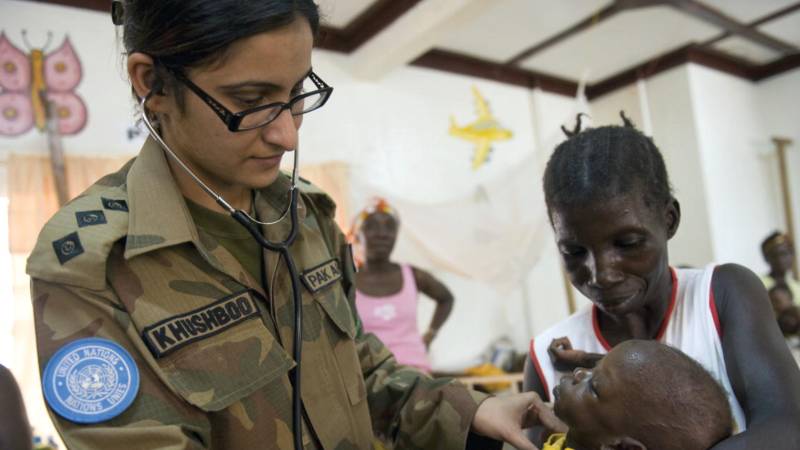
Pakistan also hosts one of the oldest UN peacekeeping missions, the UN Military Observer Group in India and Pakistan (UNMOGIP), tasked with monitoring the ceasefire along the Line of Control in the UN-recognised disputed territory of Jammu and Kashmir. It is worth mentioning that Pakistan’s women also contribute to UN peacekeeping missions worldwide in various roles, including police, military and health services. According to MoFA, over 500 women have participated in UN peacekeeping missions to date. Pakistan is also among the first countries to achieve the UN’s deployment goal of 15 per cent female staff officers.
In February 2025, the UN Secretary-General, Antonio Guterres, appreciated Pakistan's role in maintaining international peace and security through its UN peacekeeping contributions. In 2025, Pakistan ranked as the fifth-largest contributor of peacekeeping personnel in the world. According to the Permanent Mission of Pakistan to the UN, New York, Pakistan is one of the largest troop contributors, with 8,230 peacekeepers, constituting over 9 per cent of the UN's total deployment.
Currently, Pakistani peacekeeping forces are serving in several UN peacekeeping missions, including: (i) the UN Stabilisation Mission in the Democratic Republic of the Congo (MONUSCO); (ii) the UN Mission in South Sudan (UNMISS); (iii) the UN Multidimensional Integrated Stabilisation Mission in Mali (MINUSMA); (iv) the UN Peacekeeping Force in Cyprus (UNFICYP); and (v) the UN Operation in Somalia (UNOSOM).
More than 100 countries contribute troops and police for UN peacekeeping missions. Pakistan is number one. It is impossible to speak about the history of UN peacekeeping without highlighting the contribution of Pakistan
This reflects Pakistan’s commitment to supporting global peace and security through multilateral efforts in some of the most challenging environments. In 1993, the then Deputy Commander of UN Forces in Somalia, Major General Thomas M. Montgomery, appreciating the dedication and professionalism of Pakistani peacekeeping troops, said that “Pakistani soldiers have been completely dependable even in the most difficult circumstances. They have shouldered a huge and dangerous load of the United Nations’ operation in Somalia and the Somali people.”
On 29 May 2025, commemorating the International Day of UN Peacekeepers, the UN honoured the remarkable sacrifices and contributions of Pakistani peacekeepers. To date, 181 Pakistani soldiers have laid down their lives in the pursuit of global peace and stability. Furthermore, over 97 Pakistani peacekeepers have been awarded the prestigious Dag Hammarskjöld Medal, the highest honour bestowed by the UN, recognising their exceptional dedication and unwavering commitment to maintaining peace across the world. This acknowledgement underscores Pakistan’s vital role and steadfast resolve in supporting international peacekeeping missions.
Pakistan has taken a significant step to further professionalise its peacekeeping role by integrating the UN Field Medical Assistants Course (FMAC) into its pre-deployment training for uniformed peacekeepers.
This UN-led course, part of the Triangular Partnership Programme (TPP) under the Department of Operational Support, equips personnel with critical life-saving medical skills to stabilise casualties in volatile and remote mission environments until advanced care is available — a capability that directly enhances troop safety and mission effectiveness.
Building on the UN’s standard seven-day FMAC, the Pakistan Army has developed an extended fourteen-day Combat Medics Course (CMC) that blends FMAC modules with additional training tailored to environmental hazards and specific field risks, and has translated the curriculum into Urdu to ensure broader comprehension among its forces.
By adopting FMAC principles and focusing on training of trainers to sustain internal instructional capacity, Pakistan is not only boosting the medical readiness of its peacekeepers but also reinforcing its long-standing commitment to global peace and security through improved preparedness and protection of personnel on international missions.
Pakistan’s institutional investment in peacekeeping capacity is both substantial and strategically significant. In 2013, Pakistan established the Centre for International Peace and Stability (CIPS), a state-of-the-art training institution at the National University of Sciences and Technology (NUST), dedicated to the training and professional development of its peacekeeping personnel. CIPS has introduced 200 courses and provided training to more than 4,000 of Pakistan’s peacekeepers.
In August 2013, during the inauguration of CIPS in Islamabad, the then UN Secretary-General Ban Ki-moon underscored Pakistan’s exceptional standing in UN peacekeeping missions. He noted, “More than 100 countries contribute troops and police for UN peacekeeping missions. Pakistan is number one. It is impossible to speak about the history of UN peacekeeping without highlighting the contribution of Pakistan.” This institutional commitment reflects Pakistan’s long-term vision not only to sustain but to further enhance the effectiveness, professionalism and global impact of its peacekeeping contributions, reinforcing its role as a cornerstone of international peace and security.
To address today’s challenges to UN peacekeeping missions, Pakistan, along with the Republic of Korea, co-hosted the UN Peacekeeping Ministerial Meeting in Islamabad in April 2025, with the theme “Towards a Safer and More Effective Peace: Using Technology and an Integrated Approach.” This meeting highlighted various challenges, including financial sanctions, growing threats to the safety and security of UN peacekeepers, the targeting of UN peacekeeping operations through disinformation, and the destabilising effects of new and emerging technologies.
To conclude, Pakistan’s contribution to UN peacekeeping missions stands as a powerful testament to its enduring commitment to international peace, stability and multilateralism. Pakistani peacekeepers have consistently demonstrated professionalism, discipline and sacrifice, often operating under the most dangerous and complex conditions.
With thousands of troops deployed, hundreds of lives laid down, and countless civilians protected, Pakistan has earned global respect as one of the UN’s most reliable troop-contributing countries. As global conflicts grow increasingly complex, Pakistan’s peacekeeping legacy offers both credibility and moral authority within the international system. Beyond military contributions, Pakistan’s role highlights its commitment to humanitarian responsibility and conflict resolution, with its peacekeeping operations serving as an integral part of Islamabad’s multilateral diplomacy.