

Viktor E Frankl's Man's Search For Meaning, the classic tribute to hope from the Holocaust, stands as one of the most profound books I've ever had the privilege of reading. This masterpiece is built upon the concept of logotherapy, a form of psychotherapy that empowers individuals to find significance in their suffering. Frankl's narrative draws heavily from the experiences of those imprisoned in Nazi concentration camps, where the extremity of cruelty seemed to defy all human endurance. When asked why they chose not to succumb to suicide, despite the unimaginable horrors, the prisoners' responses revealed a deep-seated resilience. Some held on to the hope of reuniting with their loved ones, while others found solace in their creative talents or cherished memories.
These factors, though seemingly fragile, proved potent enough to fortify the prisoners' spirits against the dehumanising environment of the camps. Through logotherapy, Frankl illustrates that even in the most trying circumstances, humanity can transcend its outward fate. The prisoners' capacity to find meaning in their suffering rendered their experiences, though marked by hunger, humiliation, fear, and anger, somehow tolerable. This was made possible by the power of cherished memories, faith, humour, and the beauty of nature.
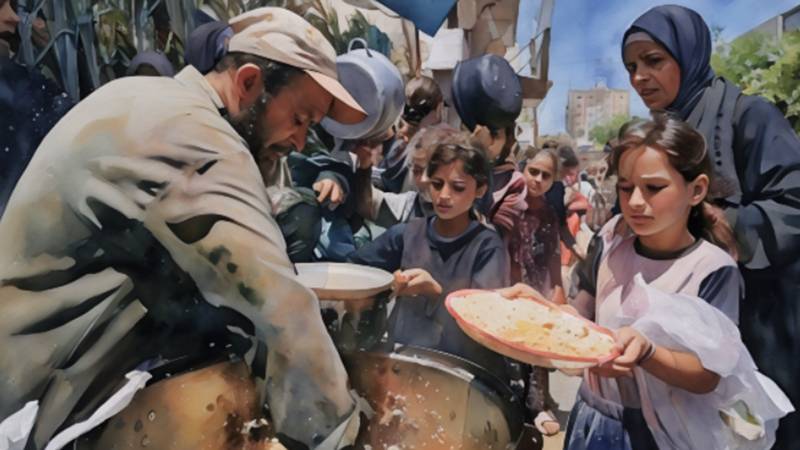
The Gaza Humanitarian Foundation (GHF), touted as a lifeline by some, has been denounced by critics for murky methods applied and demoralising impact on the Palestinian population. Many view it as a weapon of war, designed to punish and degrade the Gazans, rather than provide genuine support
The relevance of Frankl's logotherapy can be starkly observed in the current plight of the people of Gaza. Following the 7 October 2023 Hamas attack and the ensuing war crimes, Gaza has been reduced to rubble. The collective punishment inflicted upon the Gazans has led to an unprecedented humanitarian crisis. Approximately 2 million people are on the brink of starvation, with many dying due to famine, lack of medicine, and basic necessities. The refugee camps bear an eerie resemblance to the concentration camps of the past, with emaciated bodies and desperate cries for help. Despite the dire circumstances, the Gazans' resilience is a testament to their deep-rooted connection to their land, faith, and collective consciousness and subsequently searching meaning in suffering. Their love for Palestine, their ancestral homeland, and their unwavering commitment to their identity, fuels their determination to survive against all odds. The scent of olive trees, the mass graves of martyrs, and the shared memories of their struggle, continue to inspire fresh resolve in the face of Israeli aggression. Recall the little girl who chided the Trump presidency for floating the idea of permanently relocating people from the Gaza Strip to Egypt and Jordan.
The Gaza Humanitarian Foundation (GHF), touted as a lifeline by some, has been denounced by critics for murky methods applied and demoralising impact on the Palestinian population. Many view it as a weapon of war, designed to punish and degrade the Gazans, rather than provide genuine support. The aid's distribution, based on the concept of "good" and "bad" citizens, only serves to exacerbate the existing humanitarian crisis. Reportedly, Jake Wood, the head of the controversial Gaza Humanitarian Foundation (GHF), recently quit the coveted post, saying it would not be able to fulfil the principles of "humanity, neutrality, impartiality, and independence." In the face of such adversity, the question arises: what drives the Gazans' resilience? The answer lies in their faith, their land, and their collective determination to preserve their identity and way of life. Despite the ongoing destruction and humanitarian crisis, the Gazans' spirit remains unbroken, fuelled by their love for Palestine and their desire for freedom and independence. According to the United Nations Office for the Coordination of Humanitarian Affairs, Gaza is the "hungriest place on Earth" and the enclave's entire 2.3 million people face "catastrophic hunger". As per international media reports, more than 30 Palestinians - the hungry - were gunned down while they were trying to reach a food aid site in Gaza. The eye witnesses are quoted by the Associated Press as saying that Israeli forces had opened fire as they headed towards the aid distribution site in Rafah run by the Gaza Humanitarian Foundation (GHF).
In an opinion titled "Cages feeding: how Gaza was failed again" in TRT Global, Husam Marrouf wrote: "Rafah, Gaza – In Gaza, a new day of torment unfolded under the shadow of hunger and desperation. Thousands of Palestinians, many already weak from months of starvation, made the long trek—some walking over 10 kilometres from central and southern Gaza—to reach aid distribution points on the southwestern edge of Rafah. This was the first major food distribution conducted not by the United Nation's historic agency UNRWA, but by a US private security contractor known as Gaza Humanitarian Foundation (GHF), whose presence was enforced under Israeli pressure and opposed by the UN, who argued this system violates the principles of neutrality and humanitarian independence. Instead of relief, the scene resembled a concentration camp. Desperately seeking food, Palestinians were corralled into metal cages under the desert sun, forced to wait in unbearable heat with no toilets, no water, no shade, and no shared language with the American staff."
It suffices to take a portion of preface from his intellectual enterprise Man's Search For Meaning - The classic tribute to hope from the Holocaust by Viktor E Frankl that reads: "From his autobiographical fragment the reader learns much. He learns what a human being does when he suddenly realises he has 'nothing to lose except his ridiculously naked life.' Frankl's description of mixed flow of emotion and apathy is arresting. First to the rescue comes a cold detached curiosity concerning one's fate. Swiftly, too, come strategies to preserve the remnants of one's life, though the chances of surviving are slight. Hunger, humiliation, fear and deep anger at injustice are rendered tolerable by closely guarded images of beloved persons, by religion, by a grim sense of humour, and even by glimpses of healing beauties of nature - a tree or a sunset. But these moments of comfort do not establish the will to live unless they help the prisoner make larger sense out of his apparently senseless suffering. This is the central theme of existentialism: to live is to suffer; to survive is to find meaning in the suffering. If there is purpose in life at all, there must be a purpose in suffering and in dying. But no man can tell another what his purpose is. Each must find out for himself, and must accept the responsibility that his answer prescribes. If he succeeds he will continue to grow in spite of all indignities. Frankl is fond of quoting Nietzsche, 'He who has a why to live can bear with almost any how.'"
In Gaza, the ongoing famine, displacement, helplessness, and humiliation suggests a concentration camp reminiscent of Nazi camps. Palestinian UN Ambassador Riyad Mansour broke down in tears during an emotional speech to the UN Security Council, describing the "unbearable" suffering of children in Gaza.
Nazi concentration camps were instruments of genocide, perpetrating heinous atrocities. Starvation is a modified form of concentration camp tactics, being used as a weapon of war by Israel, supported by influential international forces.
Palestinians, like Viktor Frankl's experiences, have searched for meaning in their suffering. The volume of atrocities unleashed upon those living in conditions akin to concentration camps is enormous, but they share a common goal: fighting for their homeland and enduring modern means of war aimed at genocide. Their courage in the face of overwhelming miseries conveys Frankl's insight into struggle, human freedom, dignity, and the search for meaning amidst unimaginable hardships. This resilience is deeply humanising and powerful. The heart-wrenching videos of children crying for food, comforted by their mothers with hollow promises, have even shaken the stone-hearted individuals in global corridors of power.
Jens Laerke, UN spokesperson highlighting the horrors of manufactured famine and subsequent catastrophic conditions in Gaza said: "It is drip-feeding food into an area on the verge of catastrophic hunger. The limited number of truckloads that are coming in is a trickle."
In a recent interview with Al Jazeera's Centre Stage, former labour leader Jeremy Corbyn denounced countries like Germany, the United States, and Britain for supplying weapons, knowing well they're being used against Palestinians. He said that he faced intense backlash for his historical support to Palestine, including being labeled anti-Semitic and declared unfit to be a Member of Parliament. Unfazed by personal attacks, Corbyn stands firm on principles, justice, and humanity. Corbyn expressed concern over the suppression of pro-Palestine sentiments and the crackdown on voices critical of Israeli actions in European states. He noted that the ongoing onslaught against Gazans and settlements in the Occupied West Bank has shaken the global political spectrum. The situation highlights the need for immediate action to protect human lives and uphold justice. Corbyn demands 'Chilcot' style inquiry into UK complicity in Israel's war on Gaza. It is to be noted that the Chilcot inquiry into the invasion of Iraq, found Tony Blair government's decision was based on "flawed intelligence and assessments". He also reminded the listeners about the Royal Air Force base Akrotiri on the Island of Cyprus, which is reportedly used by the UK, US and Germany to supply Israel with "weapons, personnel and intelligence". Corbyn commented that the Trump White House's indignation against the government of South Africa stemmed from the fact that the country had brought the genocidal state of Israel to the International Court of Justice, where Benjamin Netanyahu and others were declared war criminals, and subsequently, arrest warrants were issued. He directed guns against the British government, saying it is slashing welfare to fund warfare. Corbyn minced no words, saying Britain and France carry forward a colonial legacy. It would not be an exaggeration to infer that this colonial thinking in foreign policy is the biggest roadblock when it comes to finding solution to conflicts, especially the Israeli war on Palestine.
He said some European countries are now considering options to pressure Israel to end the genocide of Palestinians. However, Corbyn emphasised that this change of heart comes too late, with approximately 60,000 lives lost and Gaza reduced to rubble. He said for 60 days, there has been no food, water, medicines, etc.
Imagine the scale of undemocratic norms embedded in the global political spectrum: Russia came under fire for the invasion of Ukraine, with global political players calling it an attack on Ukraine's sovereignty. The same influential international political actors shut their eyes when it came to seeing Israel, a genocidal state, through the same lens. Haunting scenes unfold as children, orphaned by the relentless assault on Gaza, comfort their traumatised siblings. Meanwhile, women writhe in agony, labouring through childbirth without essential medical care, and the starving are met with bullets instead of bread. Despite this, global movers and shakers have chosen to remain silent spectators.
Climate Justice reporter Nina Lakhani in her recent column in The Guardian titled "The carbon footprint of Israel's war on Gaza exceeds that of many entire countries" revealed that: *"The carbon footprint of the first 15 months of Israel's war on Gaza will be greater than the annual planet-warming emissions of a hundred individual countries, exacerbating the global climate emergency on top of the huge civilian death toll, new research reveals. A study shared exclusively with the Guardian found the long-term climate cost of destroying, clearing and rebuilding Gaza could top 31m tonnes of carbon dioxide equivalent (tCO2e). This is more than the combined 2023 annual greenhouse gases emitted by Costa Rica and Estonia, yet there is no obligation for states to report military emissions to the UN climate body. Israel's relentless bombardment, blockade and refusal to comply with international court rulings has underscored the asymmetry of each side's war machine, as well as almost unconditional military, energy and diplomatic support Israel enjoys from allies including the US and UK. Hamas bunker fuel and rockets account for about 3,000 tonnes of CO2e, the equivalent of just 0.2% of the total direct conflict emissions, while 50% were generated by the supply and use of weapons, tanks and other ordnance by the Israeli military (IDF), the study found. The carbon cost of trucking out debris and then rebuilding 436,000 apartments, 700 schools, mosques, clinics, government offices and other buildings, as well as 5km of Gaza's roads, will generate an estimated 29.4m tonnes eCO2. This is on par with the entire 2023 emissions generated by Afghanistan." Hadeel Ikhmais, head of the climate change office at the Palestinian Environmental Quality Authority, said: "Wars not only kill people but also release toxic chemicals, destroy infrastructure, pollute soil, air and water resources and accelerate climate and environmental disasters. War also destroys climate adaptation and hinders environmental management. Not counting carbon emissions is a black hole in accountability that allows governments to get away from their environmental crimes." Israel's war crimes, coupled with environmental crimes, have turned Gaza into a concentration camp. The crux of Man's Search For Meaning resonates with the resilience of Gaza turned into a Nazi-like concentration camp.
Until the Arctic of indifference melts with international intervention by global political players in terms of reining in the rogue state of Israel and holding declared war criminals accountable for crimes against humanity, the Gazans will continue to bear the brunt of concentration camp-induced environment prioritised by Israel as collective punishment.