

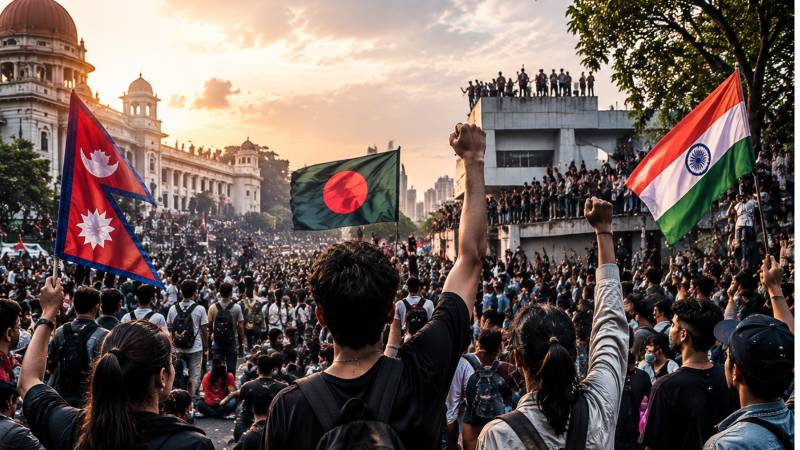
This Youth Day, August 12, I will wait to hear an awakened dreamer from Pakistan's Gen Z. I suspect I will keep waiting.
Look around the neighbourhood. In 2022, SriLanka's Aragalaya (Struggle) toppled a dynasty the Rajapaksa family, who had dominated the country's governance for nearly two decades.
In 2024, Bangladesh's students forced Sheikh Hasina from power over a discriminatory civil service job quota system that heavily favored descendants of 1971 “freedom fighters”/Mukti Bhani (closely tied to the ruling party).
In September 2025, Nepal's Gen Z burned their parliament (Singha Durbar) over a social media ban and years of corruption, and within a week a prime minister was gone.
This July, in Delhi, a satirical movement literally named after a cockroach, the insect politicians reach for when they want to describe people they despise, forced India's education minister to resign over exam paper leaks.
Four countries. One region. One restless generation. Pakistan, meanwhile, is largely watching from the sidelines of its own crises.
I do not want to interfere in Gen Z's affairs. This generation does not need another lecture from someone who "was young once. "But I will claim the right of a qualified non-specialist. Long before hashtags, I was a youth leader. Later I ran youth-focused non-profits and initiatives, including, in August 2003, Pakistan's first international youth conference, built around human development, with theatre, film and peace dialogues with South Asian delegates. I trained and mentored young people from Islamabad's elite enclaves and from slums and far-flung districts alike, on the simple, stubborn idea that they could dare to dream. My only real shortcoming was being unglamorous, non-elite, a woman with an ordinary face and a complicated personal life. Otherwise I might today be introduced as a guru, a revered mentor or atleast as a motivational speaker. I say this because it explains why I watch this generation with more attachment than distance.
Start with student unions since every debate on youth activism circles back to them. Yes, Zia banned them in 1984. Student councils replaced them. They did everything unions were feared for, minus the ideology. Politicised wings still muscle students into colleges, even medical colleges, through one quota or another. Let us stop romanticising student politics. For too many students across too many campuses, one phrase captures the experience: ghunda gardi. It may sound offensive, but sanitising the language will not sanitise the reality.
We have produced generations of public officials who are neither skilled nor civil. The good ones exist, but they are rare, unsung, or no longer in this country. My verdict: neither the union format nor the council format, on its own, produces intellectual dialogue. The structure was never really the problem. What fills it is. Then there is the elite talking to the elite, a pattern this region knows well. Faiz wrote Hum Dekhenge. In "Bol," he wrote that your lips are still free. I have lived through decades of romance with these lines, and watched revolution shrink to not even a fourth of a reform. It is worth actually understanding what those words meant, rather than turning them into reels to polish a scholarship application.
Change: the replacement of abusive power with the power of intellect requires more than symbolic acts of protest, however moving they may be. Singing, clapping, dancing, and reciting revolutionary poetry are no substitute for sustained organisation and intellectual engagement. Nor should "intellectual engagement" be reduced to carefully curated policy dialogues, press briefings, or invitation-only conversations among the already privileged. It must be inclusive, contested, and accessible to those who are usually spoken about rather than listened to.
And why has this performance become so polished? Spare some applause, too, for the selectors on the other end: the donor programmes and prestigious scholarships/fellowships, that usually reward precisely this kind of performance and let it travel all the way into the diplomatic enclave. These pipelines are not neutral talent scouts. Over the years they have quietly built their own brand of civil servant, journalist and activist, usually drawn from the same few zip codes, and Gen Z has simply learned to speak the dialect that gets you shortlisted. So how does the system actually change? Two effects need to happen at once.Non-elite youth have to unite and organise, and stop aspiring to become the elite against which they claim to be protesting.
Elite youth, meanwhile, the privileged sons and daughters who often arrive at protests in their papa's, or sometimes mama's, official cars with security details need to reckon with what that privilege costs everyone else before they march. But has any Pakistani elite kid actually rejected elitism? Are they prepared to challenge privilege where it begins, rather than only where it is convenient? Are they ready to abandon the Danish School stigma and demand that elite institutions such as Aitchison and Lawrence College become genuinely accessible to talented students from non-elite backgrounds? Ready to question the merit of "merit"? Ready to stand in a queue with a CV, or work a shift as a clerk, a sanitation worker, or a delivery rider, even for two hours, to experience what millions of Pakistanis live every day? The Elite Kids presence in protest does help, in fairness. Police batons swing more carefully when a minister's or any VIP's child is in the crowd, as India showed us again just weeks ago.
Elite youth, meanwhile, the privileged sons and daughters who often arrive at protests in their papa’s, or sometimes mama’s, official cars with security details need to reckon with what that privilege costs everyone else before they march.
And to Pakistan's youth: Are you ready to ask your legislators a question even simpler than foreign policy or finance? Why does Pakistan still have somewhere between 25 and 26 million children out of school, the second-highest number in the world even after a National Education Emergency was declared in May 2024?
And while you are asking difficult questions, perhaps it is also time to rethink whom we celebrate as public intellectuals. Many retired bureaucrats, legislators, and politicians continue to dominate newspaper opinion pages, offering prescriptions for Pakistan's future. Before applauding yet another op-ed or rushing to buy another memoir, ask a simple question: What did you do when you had the authority to act? If their years in public office produced little measurable progress on education, governance, or equal citizenship, why should their post-retirement commentary escape the scrutiny that ordinary citizens face every day?
Democracy requires not only freedom of expression but also a culture of accountability. Readers have every right to express disappointment, withhold endorsement, or simply demand evidence that public office was used to serve the public before accepting lectures on how the country should now be run.
The legendary Farooq Qaiser gave this country's children my generation's children, an immensely popular puppet show on state-owned PTV, back when there was only one television channel. Today, God only knows how many hundreds of channels we have, all supposedly "private" and "independent." Yet I know where the real puppets often sit. One of the show's most memorable songs, later reprised in successor versions of the programme under different names was sung by one of its puppet characters, who asks Allah a heartbreaking question about inequality:
Mere Pyare Allah Mian,
Dil Mera Hairan Hai,
Mere Ghar Mein Faqa Hai,
Us Ke Ghar Mein Naan Hai,
Main Bhi Pakistan Hoon.
My dear Allah,
My heart is full of questions.
There is hunger in my home,
While my neighbour has bread.
I, too, am Pakistan.
I would ask this Gen Z to find the complete poem, sit with its verses, and ask themselves whether they are still willing to sing that truth or whether it has become too inconvenient a tune for anyone hoping to be shortlisted. My apprehension, going into August 12, is that we will not hear it. That the same polished elite will dominate the digital spaces and television screens, champion the cause of "change," and walk off with the scholarships and fellowships, while the system that produced them stays, quietly, exactly as it was.