

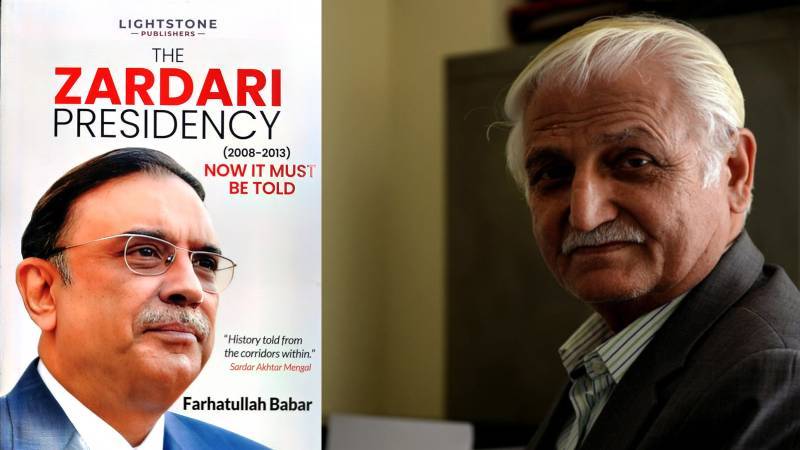
I was sitting at Piccadilly Circus trying to finish Farhatullah Babar’s book – his recollection of Asif Ali Zardari’s years as president from 2008 to 2013, The Zardari Presidency: Now It Must Be Told when I was interrupted by a young Pakistani man. His question was whether I knew the man about whom the book was written. Then, without waiting to hear my response, he said, “You know he is one of the most corrupt men in the country.” Not wanting to engage in a debate, I responded that I would rather finish the book first before making any comment.
I didn’t have the heart to tell him that the book had evaded the popular perception about Zardari by simply citing the fact that none of the corruption allegations were ever proven in court or by the country’s prime anti-corruption agency, the National Accountability Bureau (NAB). Given that the book is a memoir that reads as a cross between a diary and a bunch of opinion pieces, there was little room to debate the reasons why corruption cases against Zardari or other leaders have systematically and consistently collapsed.
Though the book is not overly critical of Zardari, it certainly can’t be read as uncritical praise of the president. Babar did not write a hagiography. It is not a book commissioned by the Pakistan People’s Party (PPP), nor is the author convinced that Zardari ever fit the big shoes left by his wife that he accidentally slipped into. He also argues that even Zardari didn’t think he could fit those shoes.
It would be unfair to expect a book like The Accidental Prime Minister, written by Indian Prime Minister Manmohan Singh’s press secretary Sanjay Baru, that describe as well as critically analyse Singh’s years in power. The author is not a journalist and is a simple-hearted man, whose main concern is the worry about the challenges that political governments face in Pakistan in bringing a politically powerful military under control. He didn’t want to be distracted by issues of corruption or to see how financial mismanagement is directly linked with the weakening of a civilian government. In fact, corruption is encouraged by the establishment so that one day it can be used to destabilise governments.
Therefore, Babar missed important details like NAB’s inability to properly investigate Zardari, mainly because the prime anti-corruption agency was dysfunctional from the start. General Musharraf, who made this infrastructure, lost faith in it within the first year of its creation and then used the Bureau to manipulate politicians. Or the fact that during Zardari’s years as president, the man appointed as NAB’s chairman, Admiral (retd) Fasih Bokhari, was placed on business tycoon Malik Riaz’s recommendation, like many others in that organisation at senior positions who were supposed to put covers on any wrongdoing rather than expose it.
Asif Ali Zardari’s story is that of a man with little sense of higher political negotiation, yet he tried in his imperfect way to strengthen democracy
However, Farhatullah Babar’s book ought not to be judged solely on its silence regarding Asif Ali Zardari’s financial misconduct. In fact, once you give the book a serious second read and negotiate through the problems one faces reading a material that definitely deserved better editing, one starts to realise that the book makes better sense if read not as Asif Ali Zardari’s biography but as Farhatullah Babar’s autobiography – we get a glance into the character of a man who served at a critical position but was certainly not part of Asif Ali Zardari’s gang, nor fully trusted by him to know all the inner secrets of the man who became in charge of the country, nor willing to ignore the president’s flaws in decision-making that resulted in not decisively reversing the civil-military balance in the country.
It is not that corruption or anti-corruption are not important for Babar, who himself is a man of integrity, but this is the narrative of a man who wants to lay out the challenges that a civilian government faces in governing with a powerful army breathing down its neck and at a time when the PPP’s competitor party, the Pakistan Muslim League-Nawaz (PMLN), and its leader Mian Nawaz Sharif didn’t lose a single opportunity to stab the PPP in its back.
This is clearly the narrative of an ‘outsider-insider’, a man who cannot intervene in decision-making and is even thrown under the bus by his own party when Babar gets pulled out of the Senate Special Committee on National Security for asking questions that the army doesn’t want answered. However, it is the decency of his character that he doesn’t complain about personal setbacks but merely sticks to writing about events as he saw them unfold during a very critical period.
If anyone fits the bill of being accidentally in a position, it is Farhatullah Babar, who was appointed as spokesperson despite not having a fondness for Zardari or the ability to ingratiate himself with the establishment or the president. One can sense that the author got the position as Zardari’s signal to the PPP that he was continuing with Benazir Bhutto’s politics and traditions.
Farhatullah Babar, as Zardari rightly judged, was politically least threatening. In any case, a spokesperson was a politically non-threatening position as compared to other important slots for which Zardari didn’t consider other senior party members like Makhdoom Amin Fahim, Shah Mehmood Qureshi or Aftab Shahban Merani, as he aimed to take full control of the PPP and transform it from Benazir Bhutto’s party to his own – which is where the party stands today, totally in control of Asif Ali Zardari and his sister Faryal Talpur.
Asif Ali Zardari’s story is that of a man with little sense of higher political negotiation, yet he tried in his imperfect way to strengthen democracy. After all, reversing Musharraf’s 17th Amendment by removing the parts that allowed the army general to serve in two positions – head of a military service and president of the country – and passing the 18th Amendment that transferred administrative and financial powers to the provinces, which were originally promised in the 1973 Constitution, are some of the important steps. These moves were possible because the army then, despite remaining a powerful institution, was fairly weak in its knees. The military was confronted by a poor image problem that, on the surface, was caused by the ugly confrontation Musharraf had with the higher judiciary, especially his police’s manhandling of the then Chief Justice, Iftikhar Chaudhry.
But Musharraf causing the army an image problem was also a myth that needs deconstruction. Let’s not forget that before the 2007 lawyers’ movement suddenly erupted, Musharraf enjoyed a fair amount of popularity, especially amongst the liberal urban middle class that saw him as a symbol of liberalism and middle-class modernity. People like Omar Asghar Khan were part of his cabinet; members of Faiz Ahmed Faiz’s family, like his son-in-law Shuaib Hashmi, would speak on Pakistan Television (PTV) eulogising the general and justifying his regime; or rebellious poets like Fahmida Riaz and many others thought highly of his enlightened moderation.
At the start of 2006, Musharraf was nowhere close to being unpopular. He was in control domestically – had comfortably negotiated with Benazir Bhutto the National Reconciliation Ordinance (NRO) – and was viewed by the United States as the man for the job of weeding out terrorism and extremism from Pakistan. And then, suddenly, the crisis with the chief justice and the legal community erupted.
Managing the military and keeping it in control by manipulating the environment in the country in the wake of Benazir Bhutto’s assassination was not possible given Zardari’s decision-making style
Perhaps, a super-confident President Musharraf forgot the basic principle of his organisation – it doesn’t tolerate long tenures of generals, especially when they begin to imagine themselves as statesmen, thus crossing certain strategic-organisational thresholds. In any case, an army chief in the seat of power for ten years makes his institution unsure of itself and shaky. Hence, it is obvious that Zardari, as is described in certain details by Babar, did not trust Iftikhar Chaudhry, a judge who endorsed Musharraf’s 1999 coup, his 2002 referendum, and his Legal Framework Order (LFO), but suddenly became an emblem of democratic rebellion and anti-corruption.
I am reminded of how Chaudhry’s son negotiated on behalf of mobile phone operators, forcing NAB to withdraw its complaint against recovering unpaid taxes from many companies. Interestingly, even Transparency International (Pakistan) was partisan in that case. Or my conversation with the late Asma Jahangir, who told me personally that, after a while, she and others didn’t know where the money to finance the ‘lawyers’ movement’ was coming from.
She certainly didn’t mean Nawaz Sharif only, who was a party with Chaudhry against Zardari. Babar cites in detail an incident in which Chaudhry had summoned Asma Jahangir, and she warned the president of how the chief justice was manipulating the system to his advantage. One is reminded of all those protests and movements that erupted from nowhere to destabilise and replace governments or individuals not desired by establishments, such as the removal of Mossadegh’s government in Iran.
Reading Babar’s account of what happened around the lawyers’ movement, General Kayani was certainly on board, encouraging Zardari to ease Musharraf out of the presidency. What Kayani, as army chief, wasn’t prepared for was for Zardari to pitch himself as president. Kayani, as Babar highlights, wanted Aftab Shahban Merani to be made president. Probably, he didn’t resist Zardari’s move to become president or later pass the 18th Amendment not because of the lawyers’ movement or the army’s poor image but due to another major development: Benazir Bhutto’s assassination. It was a development that, though temporarily, had shaken the entire country.
I remember standing in Islamabad’s F-6 market when the reality of what had just happened hit home. There was a certain sadness and silence that descended upon the capital, let alone Sindh, which welled in pain over losing someone they loved. The fact that the tragedy happened with a military general in charge of the state and another one, General Kayani, responsible for the army, made it necessary for the army to give some space to Zardari, who was also conscious of the moment being opportune to negotiate with those who actually controlled the state.
The army’s image problem was just a ploy to bring about an internal organisational change and convince Musharraf to leave both the important positions he held. Musharraf, who was initially adamant not to take off his uniform, finally agreed to abandon the top position when he realised that he was costing his institution its image. The post-Musharraf generation of army chiefs may be less sensitive. He had stayed for too long and thus blocked the possibility of promotion to the most coveted top position.
Also, he seems to have violated the institution’s ideological threshold by compromising with the US and then making peace overtures with India. Despite the popular claim made by Musharraf’s then Foreign Minister Khurshid Kasuri that the generals were on board regarding his Kashmir formula, others like the late Riaz Khokhar talked about how, ten days after Musharraf’s doffing his uniform, the new Army Chief, General Kayani, invited him to speak at the GHQ, where generals spoke openly about how they differed with Musharraf.
Obviously, the generals would not allow Zardari to change major foreign policy objectives, particularly as the new president announced a no-first-use of nuclear weapons with India or agreed to send Lt. General Pasha, the then head of the ISI, to investigate and discuss the Mumbai attacks with the Indian government. Though the consistent narrative after 2008 is that the army or the ISI had nothing to do with the Mumbai attacks, senior foreign diplomats from several significant Western states were approached by Pasha after the attacks, briefing them about how the attacks were not planned by the army but by some of its men who had gone out of control.
Babar’s lament is that Zardari tried to change the course of foreign policy and domestic politics but ended up making major compromises, especially after the 2011 Osama bin Laden operation in Abbottabad. Clearly, the establishment kicked in sooner than later and used a lobbying firm based in the US, which Babar doesn’t name, to print an article in The New York Times under Zardari’s name, arguing that the Pakistan military was on board with the US in carrying out the Abbottabad operation.
Babar suspects Hussain Haqqani, who was then the ambassador in the US, to have being part of allowing the publication that the author feels didn’t do justice to the president. Though Babar didn’t name the retired ISI chief, Lt. General (retd) Asad Durrani, he did complain about retired senior generals trying to create a myth that Pakistan Army’s senior management was on board with the US. Some sources, even in the air force, spoke privately about how they were asked to switch off the radar.
Managing the military and keeping it in control by manipulating the environment in the country in the wake of Benazir Bhutto’s assassination was not possible given Zardari’s decision-making style. The president kept his cards close to his chest and often pretended to be all-knowing when he lacked his late wife’s dexterity. He depended more on outsiders like Malik Riaz to help him in negotiating with both his political rivals and the military.
Even Zulfiqar Ali Bhutto misjudged the institution by building it after the fall of Dhaka and imagining that it would be beholden to him forever for bringing its prisoners of war home
I remember a personal chat with the late Fasih Bokhari, whom I quizzed about his reason for his private visits to Malik’s house at a time when he was being investigated by NAB. The response was that Malik was an important man who acted as a go-between for the military, the political government, and all-important institutions of the state. Not that it convinced me, but reading Babar’s book, where Malik is mentioned at least six times, it is not difficult to realise his significance in Zardari’s scheme of things.
From being involved in negotiations with rival political groups to the military, Malik Riaz was to the PPP what Jahangir Tareen was to the Pakistan Tehreek-e-Insaf – sitting through cabinet meetings and important discussions despite not being an elected member of Parliament. Zardari, the book helps us understand, could not have managed to make the elephant dance – that is, turning the army to follow his line – because he was not an institutional man. He didn’t build expertise within the party or develop a cadre. But then, can one blame him for this shortcoming, as this was never done even by his father-in-law, Zulfiqar Ali Bhutto, who created the PPP in the 1960s and 1970s. Even for Bhutto, the PPP was about the masses following him rather than building a political cadre. This is a flaw that persists across all political parties in the country.
Of course, the other major flaw was Zardari’s inability to understand the military as an institution and its instinct to protect itself and its interests. Even Zulfiqar Ali Bhutto misjudged the institution by building it after the fall of Dhaka and imagining that it would be beholden to him forever for bringing its prisoners of war home. Zardari, it seems, had failed to understand that he had limited time to convert the space created due to American support and later Benazir Bhutto’s assassination into a long-term advantage unless he created institutional structures to ensure a regime change in Pakistan.
Zardari made the mistake of thinking that Washington, which played a major role in negotiating the NRO and had passed the Kerry-Lugar-Berman Bill, would continue to invest in strengthening the civilian government, especially when the government didn’t demonstrate enough capacity to strengthen itself. I am reminded of my conversation with Congressman Berman in Washington in 2008. When I asked him why the Obama administration had backed down under pressure from the army, he responded that if the people of Pakistan, meaning the political government, were not willing to shoulder the burden themselves to strengthen themselves, then there was nothing much Washington could do.
Zardari, as Babar points out, couldn’t use the opportunity in 2011 to investigate OBL’s presence so close to an army cantonment in the country. He probably confided his suspicion to Hillary Clinton, who visited Pakistan and with whom he had an hour-long private meeting in which no one from the Foreign Office or the military was present. According to the author, it was later that he found from an American diplomat that the discussion revolved around who may have known about the Al-Qaeda chief’s presence.
Had Zardari been in the habit of listening more than talking, he might have thought about the reason that America negotiated the NRO and initially tried to help strengthen democracy in Pakistan. Washington’s objective in helping Benazir Bhutto, whom they had almost completely written off in the early 2000s, was to bolster Musharraf, whom they thought was the right man for the job of cleaning Pakistan of terrorism. I remember Benazir Bhutto struggling to meet people at the State Department during her 2005 visit to Washington. However, as the US realised her importance and developed a conversation with her, they considered her an equally viable partner in achieving the objectives of the War on Terror. It was probably her direct conversation with Washington that bothered those who decided to remove her from the scene in 2007.
Bhutto’s spouse, who became president after her death, didn’t understand the logic behind the politics of her relationship with the US. He at least miscalculated the extent to which Washington would go to pressure the Pakistan Army. Some of the details that the author has given regarding conversations between Pakistani authorities and various delegations that visited Pakistan after the 2011 Abbottabad operation, including the then Secretary of State John Kerry, indicate that the US was in no mood to give Islamabad a free pass – he refused to issue a statement ensuring American non-intervention in Pakistan or guaranteeing its security and that of its nuclear assets ‘in blood’. They refused to issue a statement stating that there was complete confidence in Pakistan.
One wonders if Zardari perceived the post-2011 dialogue with the visiting American dignitaries as a moment that Washington may be ready to put further pressure on GHQ Rawalpindi. Though the book does not suggest Memogate as Zardari’s conscious plan, one really wonders if it was just the army’s ploy to pressurise the president under the garb of accusing his ambassador in Washington, Hussain Haqqani, of orchestrating a plan to encourage a conflict between the US and Pakistani militaries.
Divided between his urge for personal survival and leaving a political mark behind, Zardari failed in weakening the army’s hold or strengthening democracy
At least Zardari believed that the real target was himself and not Haqqani. The latter certainly did not enjoy General Kayani’s confidence. Despite fawning over Kayani, who was visiting Washington around 2008, Haqqani was not trusted by the general. Sources in Washington claim that not only did the Pakistani army chief use his American interlocutors to keep Haqqani out of bilateral meetings, but instead used a former Pakistan ambassador to the US as a channel with the American State Department and White House. Interestingly, Zardari, as is apparent from details in the book, was the main person in his own party who believed in Haqqani. For example, when asked to state in favour of Ambassador Haqqani as an honourable man, a
senior party member, Raza Rabbani, refused to use the term ‘honourable’ to describe Zardari’s ambassador in the US.
Despite the author’s claim that Zardari had faith in Haqqani, the thrilling details in the book demonstrate how the president was unnerved by the Memogate scandal. Notwithstanding that the Kayani-Pasha duo didn’t pursue the Memogate case to its logical conclusion, despite involving Nawaz Sharif and the Chaudhry court in this affair – creating the impression that it was really just a ploy to destabilise Zardari – the fact is that the army managed to achieve both its objectives: removing Haqqani as ambassador and thus re-establishing an uninterrupted line of communication with Washington, and weakening the president mentally, emotionally, and physically. Babar gives details of how Memogate affected Zardari to the degree that he fainted during a cabinet meeting and engaged in long, unrelated, and strange monologues during a meeting with the visiting Sri Lankan delegation.
While Memogate didn’t achieve the objective of getting the American military to hound its Pakistani counterpart (that may have been possible if Donald Trump were president then), it exposed the varied skills of an institutionalised military versus a civilian president more adept at domestic manoeuvring and brokering deals. The details given in the book read like a Bollywood movie script, in which a rattled Zardari not only stuck to his guns on taking Haqqani along on the presidential plane that was waiting for him at the tarmac at Chaklala – because he feared that the ambassador might be thrashed by the army in his absence to give a negative statement against the president – but also took his personal pistol along in case there was a physical encounter with army men.
It took a lot of negotiation from his own party men and close aides to convince him to abandon the plan to return to the presidency, where another set of negotiations took place, even involving his son Bilawal Bhutto, to convince him not to take Haqqani along. Instead, an alternate plan was chalked out according to which Haqqani was left in charge of Prime Minister Yusuf Raza Gilani as Zardari then flew to Dubai, taking Haqqani’s wife, Farahnaz Ispahani, along.
While making for a thrilling read, the incident raises questions about why Haqqani, who knew the establishment far longer than the president, while working through various governments and political parties, went along. He would certainly have been a target if an actual shoot-out had happened. Or was he ready to stake his life to let Zardari try his gimmick, hoping that the fear of an ugly encounter might actually make the army back down and allow him to leave the country when he was clearly not permitted to do so by an unfriendly Supreme Court?
It remains a mystery how Zardari, despite the confrontation with GHQ over Memogate, managed to win the institution’s confidence to return to the presidency in 2024. The possible answer lies in his handling of Sindh and ensuring that it remained fairly calm despite a brewing nationalist movement. Eventually, the army depends on the colonial historic formula of governing peripheral territories through reliable agents. Divided between his urge for personal survival and leaving a political mark behind, Zardari failed in weakening the army’s hold or strengthening democracy. Hence, Babar’s book reads like a tragedy of Pakistan’s democracy.