

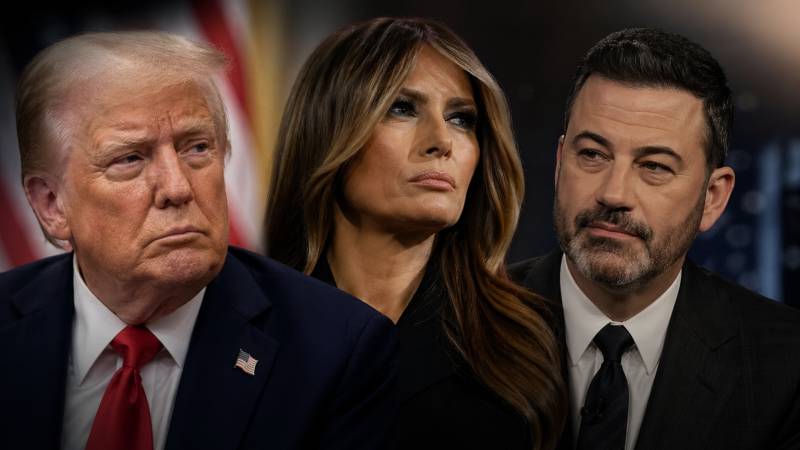
On April 23, Jimmy Kimmel aired a mock White House Correspondents' Dinner roast and joked that Melania Trump had "a glow like an expectant widow." It was a two-second line and a fairly obvious dig at an age-gap marriage and a woman who famously looks like she would rather be somewhere else. Classic late-night.
Then the dinner itself was disrupted by a shooting, suspected to be a third assassination attempt on Trump. And suddenly, a joke about a widow's glow was, depending on who you asked, incitement.
Melania posted on X that Kimmel's "hateful and violent rhetoric is intended to divide our country." Trump called for him to be immediately fired. There have been unverified reports of the Federal Communications Commission (FCC) ordering Disney's ABC stations to file for early licence renewal within 30 days, which is the government's preferred way of saying "fire this man" without technically saying it.
Kimmel pushed back that it was not, by any stretch of the definition, a call to assassination. And he's right, it wasn't. But here's where it gets interesting. Being right about that doesn't settle the larger question.
The freedom of speech argument is seductive in its simplicity. You have the right to speak, the state cannot jail you for your words, the works. That is the floor, not the ceiling of a healthy society. The moment someone reaches for "incitement" to describe a widow joke, they have either lost the plot entirely or they are cynically using the language of harm to neutralise a political critic. In this case, probably both.
However, and there is always a however...
There is a real question underneath the bad faith one. And it is the question nobody in this conversation actually wants to ask: what is speech for?
The Western liberal framework treats free speech as an almost sacred individual right, which makes sense if you think of the self as the primary unit of society. You, the individual, have something to say. The state must not silence you. Full stop. But that framework was built in a particular cultural context, by people with a particular view of what the self is and what community means. It does not travel cleanly.
We want the freedom without the accountability. The government wants censorship without accountability. Nobody wants accountability.
In high-context cultures, and Pakistan is one of the highest-context you will find, communication is never just between a speaker and a listener. It happens in a field of context, relationships, hierarchy, community standing... where what is unsaid matters as much as what is said. A joke lands differently depending on who is telling it, who is in the room, and what has just happened in that room. It is a complex model of how meaning actually works.
The Kimmel case, from a Pakistani lens, would not be primarily a legal question. It would be a social one. Did he embarrass someone? Did he cause harm? Did the timing show bad character? Forget the FCC or, in the Pakistani context, PEMRA. What does it say about a man that he would make that joke and then feel the need to defend it rather than simply saying it was badly timed?
We do not have a good word for this in liberal political vocabulary. The closest is "civility," which has been almost completely ruined as a concept because it gets weaponised to silence dissent. But civility and free speech were never actually in opposition. You can believe you have the right to say something and also believe you should not.
Here is what bothers me about the way both sides handled this.
The Trumps turned it into a power play, because, let’s be honest, they know the joke was not incitement. Using the machinery of the FCC to go after a television network over a bad widow pun is a sheer misuse of authority. Kimmel also went straight to the constitutional argument, which is correct, but stopped there. Did he stop to consider what it felt like to be in that room when a gunman ran through a checkpoint, and to come home to that joke playing on repeat? He acknowledged it briefly, said he was sorry for the trauma, and then returned to his legal rights.
This is the ceiling of the free speech framework. It is very good at protecting speech. It is not very good at asking whether the speech was worth protecting, or what the speaker owes the listener beyond the legal minimum. Those are less state questions and more human ones.
Frankly, I think we have imported the absolutism of American free speech culture and left behind the social infrastructure that was supposed to go with it. In the U.S., free speech absolutism coexists, at least theoretically, with a strong culture of public debate and accountability. You can say whatever you want, and people can also hold you accountable for it socially. That is the deal.
In Pakistan, we have absorbed the idea that saying whatever you want is a right worth defending while simultaneously having very little tolerance for actual criticism, dissent, or uncomfortable ideas. We want the freedom without the accountability. The government wants censorship without accountability. Nobody wants accountability.
The Kimmel joke is not a Pakistani story. But the question that surfaces is one we walk around with every day. What does it mean to speak freely in a society where meaning is always collective, where words land in a field of relationship and history, where a joke is never just a joke?
A widow's joke about a living person (who might be hated, and for the right reasons), made days before a near-assassination, is not illegal. It also does not help anyone reason about anything. It is, at best, a laugh, and a fairly cheap one.
Does that mean it should not have been made? Probably not. Does it mean the authorities should come after Kimmel's network? Absolutely not.
It means that freedom of speech is the beginning of a conversation about how we want to live together, not the end of it.