

Did Pakistan successfully lobby the United Nations Security Council to erase a terrorist group's role in the Pahalgam massacre? This explosive claim—circulated by Indian media outlets such as India Today and The Times of India as tensions soared following the April 22 killing of 26 civilians—demands serious scrutiny. The Resistance Front (TRF) initially claimed responsibility, only to retract its statement days later, citing an "Indian cyber intrusion." Yet beyond the militant group's contradictions lies a more troubling story: how media on both sides of the India-Pakistan divide have abandoned journalism for jingoism, turning a human tragedy into geopolitical ammunition.
TRF’s initial claim of responsibility further complicated an already tense situation. But is this report an accurate reflection of events, or an example of how media, rather than acting as a conduit for responsible journalism, has become a tool of provocation? The Pahalgam attack starkly illustrates how sensationalism and politicised narratives can distort facts, inflame public sentiment, and obstruct the path to regional stability.
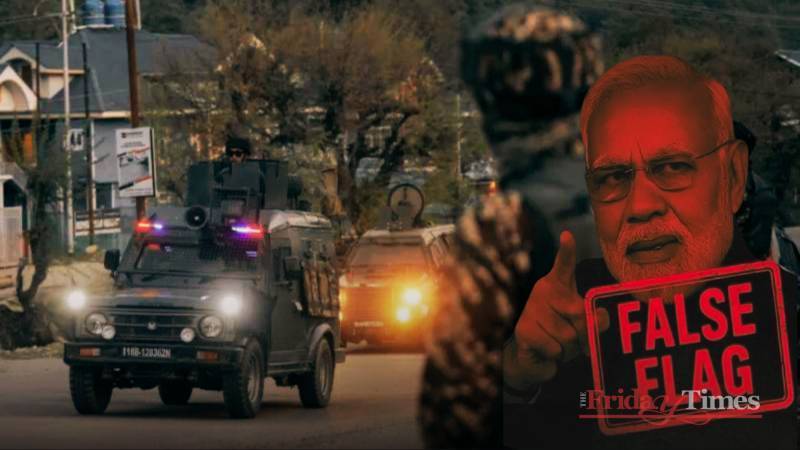
Within hours of the attack, Indian media constructed a narrative of Pakistani complicity, citing the Army Chief’s “jugular vein” rhetoric and invoking the "two-nation theory" as ideological motivation for targeting Hindu pilgrims. Pakistani outlets responded with an equally unfounded counterclaim—that the massacre was a "false flag" operation orchestrated to boost Prime Minister Modi’s election prospects. Neither side presented concrete evidence. Instead, both sides amplified hostilities. Empathy for the victims found no space in these rhetorical crossfires.
The Pahalgam attack and its aftermath expose not only the fragility of peace in South Asia but also the dangerous role media can play in shaping public perception and state policy
The hysteria reached a fever pitch when Indian outlets reported a dramatic development at the United Nations Security Council: "Pakistan Celebrates as TRF Removed From Resolution." According to these reports, Foreign Minister Ishaq Dar, during a Senate briefing, claimed credit for persuading China to block the inclusion of TRF in the resolution. India considers TRF a proxy for banned outfits involved in cross-border militancy, a claim Pakistan rejects. For many in the Indian press, Dar’s alleged remarks were interpreted as a tacit admission of shielding a violent group, further fueling the wave of hatred and suspicion ignited by the Pahalgam massacre.
But the actual video of Dar’s Senate briefing tells a different story. Far from confessing to protecting militants, Dar portrayed TRF as part of an "indigenous resistance" that emerged after India revoked Kashmir's semi-autonomous status in 2019. His focus was on diplomatic semantics, emphasising that the UNSC should refer to the region as "Indian-occupied Jammu and Kashmir."
Crucially, no Western media outlet or Pakistani source corroborated the Indian version of Dar’s remarks. Despite extensive searches, including through official platforms like PTV and the National Assembly’s website, no transcript or account confirms that Dar discussed influencing the UNSC resolution. While some international aggregators like MSN amplified the claim, no major Western outlet, such as Reuters, AP, or The Washington Post, independently reported or verified Dar's alleged remarks. Pakistani sources, including statements from Dar himself, have consistently rejected allegations linking Pakistan to the Pahalgam attack and have demanded evidence from India to support such claims. Either the Indian media misrepresented Dar’s comments, or the Pakistani government redacted sensitive details. Both scenarios point to a larger problem: the erosion of factual accountability in times of crisis.
This media war also reflects the entrenched conceptual divide between India and Pakistan. While Pakistan views many Kashmiri separatist groups as freedom fighters waging a legitimate struggle for self-determination, India sees them as violent extremists undermining national sovereignty. In its support for Kashmiri groups, Pakistan often overlooks the violent methods employed—even as a parallel separatist movement in Balochistan uses similar tactics to challenge Pakistan’s territorial integrity.
TRF is on record admitting responsibility for multiple attacks in the Kashmir Valley, including the Pahalgam massacre. Its initial claim—widely disseminated by Indian media—was withdrawn four days later, citing a suspicious claim of hacked social media accounts. Yet, TRF’s statements claiming previous attacks remain publicly available and unchallenged, including the 2023 Anantnag ambush that killed three security officers and the targeted killing of Kashmiri Pandit Sanjay Sharma.
If the claim about Pakistan’s role in having TRF’s name excluded from the UNSC resolution is accurate, it would naturally raise serious concerns, not just in India but across the global diplomatic community. However, in the absence of any corroborating report from Western or Pakistani media, and no official documentation to support the narrative, the Indian coverage appears questionable. This raises the possibility that either Dar's comments were misrepresented, or sensitive parts of his statement have been withheld from public record to avoid diplomatic fallout.
The Pahalgam attack and its aftermath expose not only the fragility of peace in South Asia but also the dangerous role media can play in shaping public perception and state policy. In a conflict-prone region, journalism must be rooted in verified facts—not in jingoism or political expediency. The temptation to score rhetorical points or boost ratings should not come at the cost of exacerbating a nuclear flashpoint.
Even when covering groups like TRF, whose track record includes deadly violence—the media must resist the urge to speculate or distort. Sensationalist headlines and half-verified reports only deepen hostility, narrow diplomatic space, and ultimately endanger civilian lives. In the volatile India-Pakistan context, restraint and responsibility are not merely journalistic virtues—they are geopolitical necessities.