

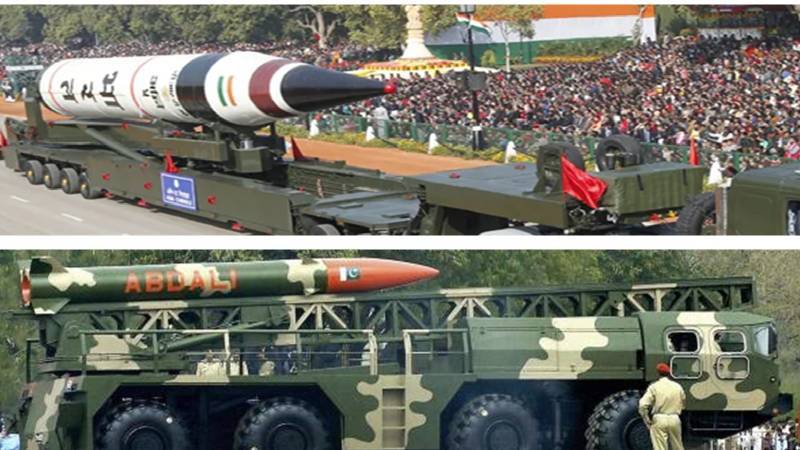
The 1971 India–Pakistan war compelled Pakistan to initiate a military nuclear programme which was further accelerated by the Indian nuclear test in 1974. Pakistan sought this capability to deter a conventionally superior India and a repeat of 1971. Nuclear deterrence was established when Pakistan responded to the second round of Indian nuclear tests in 1998. Since then, the very presence of nuclear weapons has prevented several crises from escalating into an all-out war. India, however, has continued to find space for a limited conventional war under the nuclear overhang, indicating its discomfort with the nuclear deterrence equation between India and Pakistan.
The 2019 Pulwama–Balakot conflict and the recent Operation Sindoor primarily involved the use of air power. Limited conventional exchanges between two nuclear-armed adversaries, particularly in the air domain, carry a high risk of escalation. Pakistan’s restraint, a calibrated response, and the risks of further escalation have limited Indian military adventurism.
Nuclear weapons are a central element of Pakistan’s strategic thought in terms of deterring India from conventional aggression against Pakistan. However, it does not mean resorting to the use of nuclear weapons if the adversary violates a ceasefire or strikes some targets inside Pakistan. Pakistan’s conventional forces are capable of deterring and defending against such threats.
Nuclear deterrence played a critical role in restricting Indian response options in the Kargil War (1999) and the 2001–02 military stand-off. The limitations posed by the nuclearised environment and challenges in military mobilisation imposed frustrating limits on Indian military response options. This frustration led to the introduction of the Indian Cold Start Doctrine (CSD), which can be termed the single most disturbing development in South Asia. The doctrine aimed at exploiting the nascent nuclear status of Pakistan by threatening limited conventional war under the nuclear overhang, completely overlooking the fact that “not even the aggressor can assure that a limited conventional war, skirmish, and conflict will not escalate into a full conventional war with a possibility of further escalating into a nuclear exchange situation.”
The dangerous Indian strategic thinking of viewing Pakistan’s restraint as its weakness will prove to be detrimental for South Asian deterrence and strategic stability
Ever since, India has been trying to escape the limitations of nuclear deterrence. Earlier, it attempted to do so through ‘surgical strikes’ in the aftermath of the Pathankot and Uri attacks in 2016, a limited ‘unsuccessful’ aerial strike in the 2019 Pulwama–Balakot crisis, and recently through launching missile and drone attacks inside Pakistan, ignoring the risk of escalation. Apparently, India did not learn any lessons from the 2019 crisis and continues to downplay the role of nuclear deterrence, going one step up the escalation ladder with each conflict. Pakistan, on the other hand, through its ‘Quid Pro Quo Plus’ policy is demonstrating its resolve and commitment to defend its territorial sovereignty and its ability to deal with any sort of aggression from the Indian side.
Even in the recent crisis, despite India’s violation of Pakistan’s sovereignty and territorial integrity through launching missile and drone attacks on its civilian infrastructure and air bases (7–9 May), Pakistan’s response came, only after repeated warnings to India, in the form of ‘Operation Bunyanum Marsoos’ on 10 May 2025. A delay in Pakistan’s response was viewed in India as a failure of nuclear deterrence, as nuclear deterrence should have ideally deterred India from launching the attack in the very first place. However, unlike India, Pakistan did not give a knee-jerk reaction. A well thought-out counter-attack from Pakistan, resulting in a US-brokered ceasefire, proved that its conventional capability is qualitatively superior and effective in denying India its military objectives. Pakistan has for long maintained that nuclear weapons will be used as a last resort after the conventional response options are exhausted. A nuclear response is not warranted when the conventional forces are working as desired.
Pakistan’s positive and responsible attitude vis-à-vis Indian provocations is often mistaken as its weakness. India needs to understand the cost of escalation between the two nuclear-armed adversaries and hence refrain from such adventurism in future. Calling a nuclear bluff is a dangerous and potentially destabilising move. It carries a high risk of miscalculation and escalation, potentially leading to a nuclear conflict with devastating consequences. The dangerous Indian strategic thinking of viewing Pakistan’s restraint as its weakness will prove to be detrimental for South Asian deterrence and strategic stability.
Since 1998, besides working on destabilising strategies, India has been consistently investing in an indigenous and foreign-supplied missile defence shield. Such a system is supposed to protect Indian military and civilian targets against a Pakistani missile strike. This conflict, however, demonstrated that Pakistan’s air- and land-based systems are fully capable of breaching any defences. Pakistan even destroyed one such highly prized air and missile defence system – the S-400. Pakistan’s ability to defeat such defences would likely be stronger in its strategic systems like cruise and MIRV-capable (multiple independently targetable re-entry vehicles) missiles manifestly designed to defeat BMD systems.
On the 27th anniversary of Youm-e-Takbeer, Pakistan stands firm and stronger against Indian aggression. Pakistan’s policy of Full Spectrum Deterrence (FSD) within the bounds of Credible Minimum Deterrence (CMD) ensures that Pakistan is capable of covering the entirety of the threat spectrum emanating from India at tactical, strategic, and operational levels. Pakistan has time and again reinforced that it will not remain oblivious to Indian destabilising developments, conventional and sub-conventional aggression, and will act accordingly to ensure the credibility of its deterrence in both conventional and nuclear domains.