

There was a simple, mysterious and lyrical game which many boys and girls played. A circle of boys and girls would place one fellow in the centre and they would chorus: “Hara Samandar, Gopi Chandar, Bol Meri Machhli Kitna Pani” (Green Ocean, Gopi Chandar, My Fish, Tell us how much water?). Responding to this chant, one fellow would point one’s hands towards one’s feet and slowly raise them to one’s chest, shoulders and head. One would keep performing this pantomime until one shouted by stretching them high above, “Itna Pani” or this much water. It was a playful game, but in the view of current flooding, this chorus takes on an eerie resonance and spectral prophecy. Pakistan’s northern areas are submerged in floods.
Unprecedented flash floods have left behind them a trail of devastation in Swat, Buner, Shangla, Mansehra, Peshawar and beyond. According to a report released by NDMA, these floods have claimed 469 lives in KP. Buner remains the worst-hit district. So far, 337 and 17 deaths have been reported in Buner and Swat. FC Swat established its camps in Swat and Buner to provide flood relief.
On 20 August 2025, FC Swat was the first government organisation to reach Chaghar Zai and Gokin, two remote villages in Buner. There were above 46 deaths recorded there. Two teams of FC Swat helped rescue 10 missing corpses in four operations. Besides, FC Swat steadfastly expanded its search and rescue operations in Swat. In 32 operations, its personnel rescued 10 children, 21 boys, 30 men and 40 women.
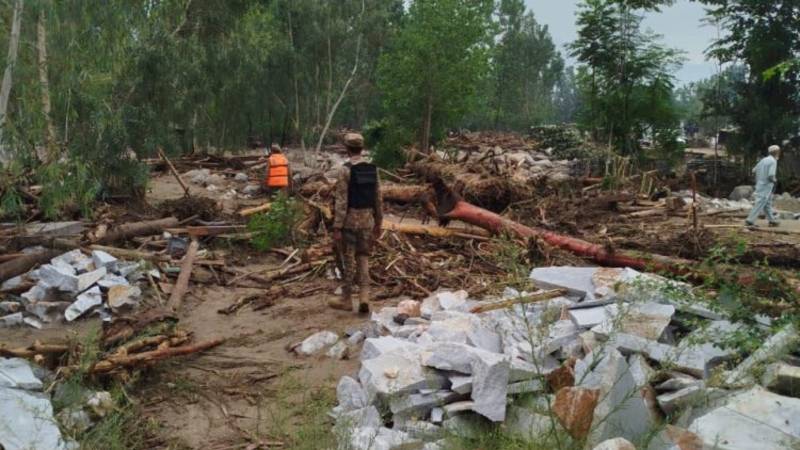
Monstrous rainwater unleashed its wrath in biblical fury and swept away everything
Scenes witnessed during logistics and relief distribution were terrifying. Monstrous rainwater unleashed its wrath in biblical fury and swept away everything. The plains of Buner, once dotted with small, adorable abodes, have been completely washed away. Wooden planks and concrete slabs could be seen from afar. There were no remnants of life. In these moments of catastrophe, FC Swat handed out 1,000 litres of pure drinking water to flood victims. Ration cartons donated by Commandant FC, weighing 4,000 kilograms were also distributed. Other key supplies included 200 pairs of clothes, 100 pairs of shoes, 100–150 pieces of crockery and gas cylinders. Flooding has meant heavy fiscal slippage for flood victims. In order to atone for their miseries, FC Swat with the collaboration of its private donors has disbursed an amount of PKR 1 million.
As a common practice in KP, announcements to evacuate homes are made from mosques on the third round of lightning. Women adopt the role of ushers to guide their children and cattle towards safer areas and men go to fields to take up all protective measures. However, these flash floods brought with them bricks, stones, sand and boulders and destroyed all crops. 120 personnel of FC Swat participated in the evacuation operations. They evacuated 111 people in Swat. They cleaned 50 houses and 20 streets. In order to preserve the sanctity and sentiments of people, copies of the Holy Quran and other religious texts were recovered and handed over to their owners.
By 18 August 2025, the Provincial Health Department of KP documented 380 cases of communicable diseases among children under the age of five. These diseases include acute respiratory infections, watery diarrhoea and scabies. Moreover, there was a considerable surge in vector-carrier maladies such as malaria, dengue and flu. FC Swat established a three-day camp in Swat with the Young Doctors Association and a one-day camp in Buner. FC disbursed PKR 120,000 in terms of medicines. In total, around 500 patients were treated. Along the hilly terrains of Swat and Buner, two teams of FC moved patients with fractured legs and transported them to nearby DHQ hospitals. WHO, being mandated by the provincial government as the technical agency for health emergencies, co-chaired the activities of all partner organisations, including FC.
Mismanagement is no longer a glitch; it is an architecture
These floods are wounds in red; simmering and bursting everywhere. The deadly impact of floods can be gauged from a report issued by the Provincial Disaster Management Authority (PDMA). According to PDMA, 320 cattle died. Additionally, 336 homes, 57 schools and 23 other buildings were damaged or partially damaged. Early estimates put the figure of affected houses at 219 in Swat. Out of these 219, 42 were fully destroyed and 177 were partially destroyed. People’s livelihoods largely rely on agriculture and livestock. 163 cattle heads perished in Swat and it affected people’s livelihoods.
Flash floods in Buner washed away two villages of around 100 houses situated on the Barandu River in Tehsil Chaghar Zai. To overcome, the Emergency Centre of PDMA was quite functional. PDMA set up a toll-free helpline where the public can contact for any untoward incident. Moreover, the provincial government established medical camps. International donors also sprang to action. The European Union has pledged 280 million euros. The federal government tasked the respective provincial minister to supervise relief activities due to severe damage.
It is comforting, almost fashionable, to put the blame on the administration. Usual suspects of blame-mongers are the age-old resistance to change, mediocrity-rewarding system and incompetent administrators. However, amidst these deficiencies, FC Swat rose to the occasion. Amidst catastrophe, FC protected all state assets by managing crowds. Not a single state building was damaged. However, there were some missing links which need to be fixed immediately. One of them is miscoordination between NDMA, PDMA and the district administration. Mismanagement is no longer a glitch; it is an architecture.
Their respective control rooms functioned in a fragmented manner. Their miscoordination was unable to dismantle the unplanned construction of hotels on rivers. It intensified flash flooding. This unplanned construction is not only threatening the fragile mountainous ecosystem but also hampering waterways. Such encroachments encroach more than 1,800 kanals of riverine land in KP. To avoid such calamities, it is essential for the administration to govern with integrity and professionalism. There should be a centralised mechanism in calamity-hit districts.