


Violence is not an aberration. It is constitutive. From the act of the tree becoming the chair, to the horrors of the ongoing genocides across the globe, not to equate the two, one being incomparably more grotesque than the other, but both trace the same impulse across vastly different scales of consequence. It is in our bones, installed at the very moment of arrival; our entrance into this world is our first act of it, having inhabited another body, grown inside it, and torn through to declare ourselves alive. Graphic images may desensitise us over time, and still we look, still we follow, still we seek its enactment in cinema and music, fiction reiterating reality for an audience that cannot look away. Violence is deep, personal, and always a struggle of power, present equally in the intimate and the geopolitical, in the way light scorches skin in unforgiving heat and in the way entire peoples are displaced, their lands stolen to make way for something more profitable. It is this understanding of violence, not as event but as condition, that brings us to Quddus Mirza’s latest solo exhibition at Canvas Gallery, Karachi.
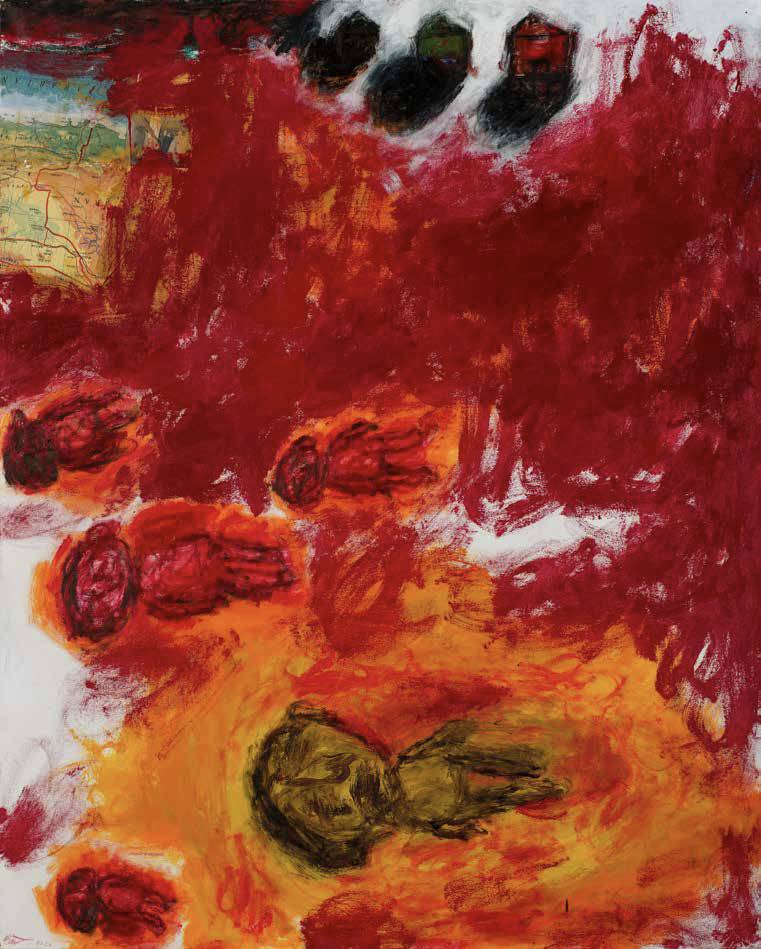
Oil on Board
48 by 36 inches
2026
“A perception in paint, in and of the world around us.” This is the only text the visitor is offered upon entering the gallery. The phrase came to Mirza during one of his morning walks around his residence, at the kind of hour in which the world reveals itself before one has had the chance to armour up against it. For a writer as prolific and esteemed as Mirza, the choice to offer just this single phrase in lieu of an artist’s statement is itself a provocation. It refuses the viewer a safety net. It asks them to step into the sea of colour and stroke he has placed before them, and to find their own footing.
The apparent casualness of each stroke conceals an entire architecture of decision; he pours himself into the gesture, impersonating the very violence he is painting about
And the sea is precisely what it feels like. The works dominate the white walls of the gallery, large and insistent, demanding the viewer to move in for a closer inspection. Deep crimsons, burnt yellows, and cooling greens are laden onto canvases with a weight that is almost physical. What reads at first as spontaneous gestures turn out, on closer observation, to be meticulously juxtaposed, with each stroke existing with acute purpose, seemingly raw, yet so intentional that one cannot help but stand in awe before them. Each painting is built up through exhaustive layering, so deep, the artist explains, that no one but himself knows what each stratum conceals; all the viewer is allowed to see is the finished product, and that for Mirza is essential. The progress of the painting is kept solely for him, a private relationship he holds with each artwork. The works are abstracted, but not evasively so; they carry an emotional specificity that is difficult to name but difficult to walk away from. Mirza’s command shows not in finish but in restraint, in the stroke withheld, the colour that stops just before it tips into noise.
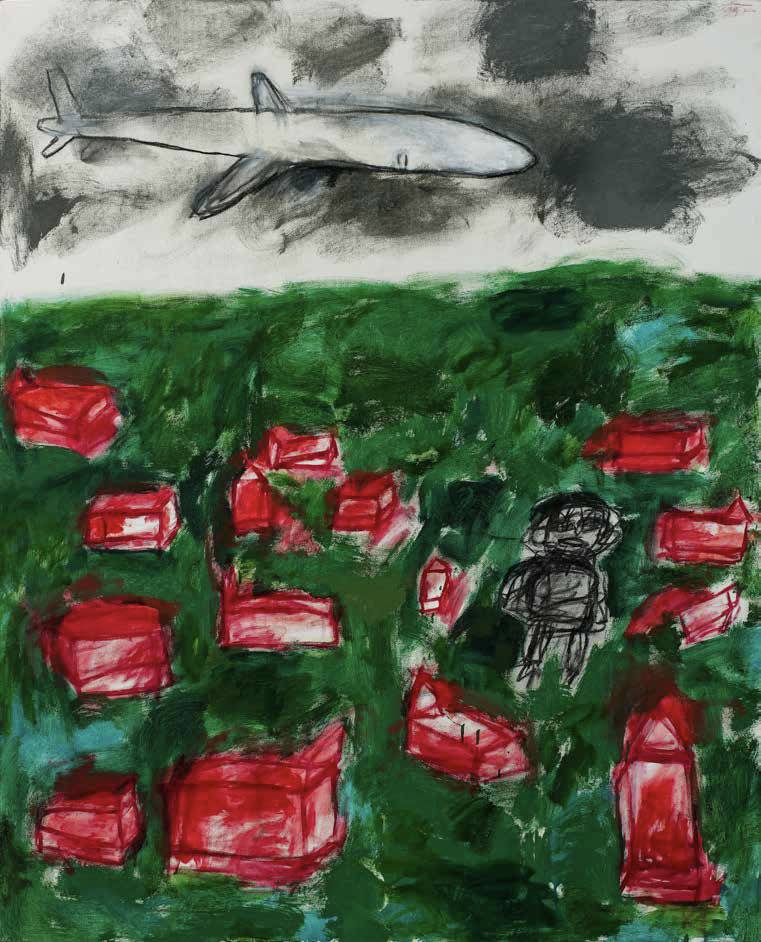
Title: A Stained Landscape
Year: 2026
Medium: Oil on canvas
Size: 60 x 48 inches
The paintings are built simultaneously, through quick gestures and deep, accumulated decisions. Each work begins with something worldly, within his immediate surroundings: the plane passing over his Lahore studio; the news channel on in the background; its images cycling through catastrophe with the indifferent rhythm of a screensaver; the interiors of his residence. With each brushstroke, thought and medium negotiate; ideas transmute, present and past days unfold within the work. For Mirza, what the painting ultimately becomes matters less than the process it moves through. Thought and action, he argues, cannot coexist in the same moment. When the hand is moving, the mind must step aside. It is only once the act is complete that one can turn back and ask what has been done.
Violence threads through the exhibition not merely as subject matter, but as method, as the very grammar of making. How does one paint violence? How does paint itself enact it, pressing into the grooves of the canvas, forcing pigment in, losing bits of itself with each stroke? Are only images violent? No, Mirza seems to insist. Processes too. The act of drawing, stretching, hanging. There is an act of destruction that leads to creation, an act of breaking that precedes mending, and somewhere in that gap, between damage and resolution, is where Mirza chooses to work.
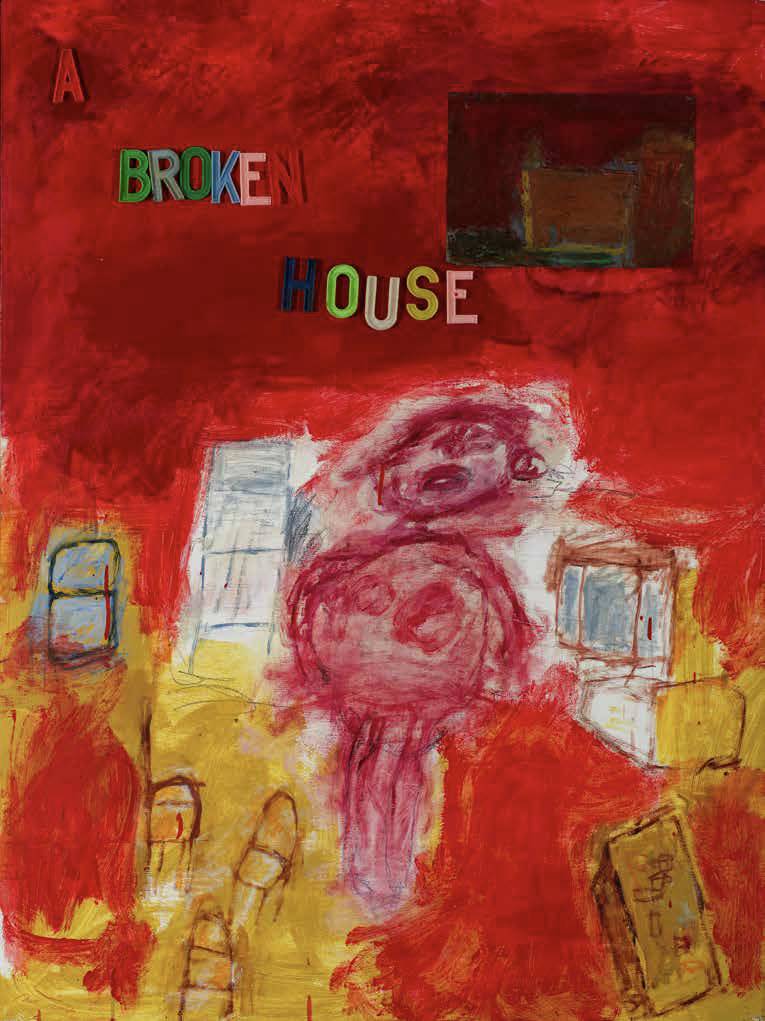
Year: 2026
Medium: Oil on canvas
Size: 60 x 48 inches
These scenes of enacted violence play out across the canvases with uncomfortable clarity. The works come together as a collection of how violence exists both outside and within: in ‘Martyred Angels’, bodies lie lifeless within a sea of maroon paint, while in ‘A Broken House’, household furniture floats in a similar shade of red, a depiction of violence indoors. The painting ‘Anatomy and Other Lessons’ is a diptych: on the left, a collection of dismembered body parts; on the right, a collection of garments. Both float in a mimicking rhythm, complementing each other visually and conceptually. The nude limbs and torso placed alongside the garments meant to cover them become, in a sense, the exhibition’s culmination, both the private body and its public covering subjected to the same act of mutilation. Clothing without bodies. Bodies suggested by their absence. What surrounds us is what we absorb, Mirza explains, and what we absorb is what we enact: an action, a reaction, a teaching, an implementation, the reiteration of violence, private and public, cycling through us without announcement.
In ‘A Stained Landscape’, an aeroplane flies over what appears to be graves or houses, a vast, almost architectural presence, its scale tilted just past reality into something more like dread. It is a vehicle that, in the past two-and-a-half decades, especially since the War on Terror, has come to represent the axis of fear and exclusion for many: the machine that determines who is permitted to travel and who is turned back at the gate. And yet Mirza notes it also compels a private wonder, especially having witnessed fellow passengers join in prayer before takeoff. How can the same monstrous object that frightens him as it passes over his Lahore studio be held aloft by the devotion of human prayer? What instills this belief that faith alone might save us from such a giant?
Mirza speaks about his relationship with paint as one might describe a consuming, one-sided love: passionate, obsessive, never fully requited. He longs to understand it more deeply, but explains that the medium does not always offer the same willingness in return, and yet he remains devoted, drawn back to it regardless. His practice is an attempt to gain admission into a dimension that does not quite exist in the tangible world, a non-space concealed between the thick oil paint and the weave of canvas fabric, to make some sense of the nonsensicality of pain, grief, and destruction. Mirza describes painting as a bus ride without a destination: the journey, not the end, is what matters.
What that journey produces, however, is anything but simple. The magic of his paintings, Mirza explains with a quiet satisfaction, is that they appear so effortless that anyone might think themselves capable of making them. And that is precisely why they cannot. The assumption of ease is what renders the completed work so stubbornly, so unexpectedly complicated. The apparent casualness of each stroke conceals an entire architecture of decision; the visible surface hides layers that will never be disclosed. He pours himself into the gesture, repeating the action over and over, denting the fabric, letting the friction between oil and canvas disintegrate with each pass, impersonating the very violence he is painting about.
Does a perpetrator of violence ever admit their misdoing? More often than not, Mirza suggests, they are not cognisant of the pain they dispense. Even when they are, there is a justification: the process is what matters, the process makes it necessary. And this is precisely what his practice amplifies. The act, not the outcome. The doing, not the done. The paint, the painter, the painting, the perpetrator; none knows what they have done until the act is complete, and, neither, perhaps, do we.
Note: Quddus Mirza’s solo exhibition was displayed at Canvas Gallery, Karachi, from 7 - 16 April, 2026.