

Sindhi society once maintained a remarkable calmness, a tranquillity seldom seen in the communal fervour of the wider South Asian Subcontinent. This peace was not a gift of luck, but a carefully woven garment, stitched from deep-seated, practical realities: kin-based villages, shared economic reliance, and communal social networks that forged powerful bonds of trust and interdependence. These structures—the enduring pillars of the Sindhi way of life—stood solid for centuries. But the very strength of their unity, rooted in interdependence, would soon become a high-stakes vulnerability as the world outside began to fray, threatening to unravel this entire peaceful fabric.
The economy of pre-colonial Sindh was primitive and interdependent. It was centred on single crops tied to the Indus flood cycles, livestock, desi ghee, and village shops. This economic necessity compelled Hindus and Muslims to share institutions and rely on one another for survival and prosperity. In rural areas, this reality was particularly evident, lasting through the Kalhora and Talpur eras into the 1900s. Hindu students learned from Muslim teachers; both communities shared the Persian language, a common murshid or guru, and grand-scale interdependence. This naturally fostered respect for religious figures on all sides. Classical Sindhi poetry further cemented this spirit. Minor disagreements existed, but they were incapable of threatening the shared social structure.
This unique atmosphere allowed Hindu writers to comfortably compose devotional works across religious lines: Amar Lal Hangorani and Lalchand Amar Dino Mal both penned biographies of the Holy Prophet (PBUH). Hindus and Muslims shared spiritual guides like Shah Abdul Latif Bhitai, Shah Inayat Shaheed, and Sachal Sarmast, and mutually revered sites like Uderolal (near Matiari) and Sateen Jo Asthan (Rohri and Sukkur). However, this shared outlook began to face immense pressure. A series of events – starting with the tragic Masjid Manzilgah event (1939-40), followed by the seismic trauma of Partition, then Zulfikar Ali Bhutto's ruling on the Ahmadiyya community (1974), and finally, General Zia-ul-Haq's Islamisation project – severely damaged the original shared public sphere. The social and economic landscape changed drastically. Political moves based on religious identity, coupled with demographic shifts and the formalisation of the rural economy, created deep societal divides that had simply not existed before.
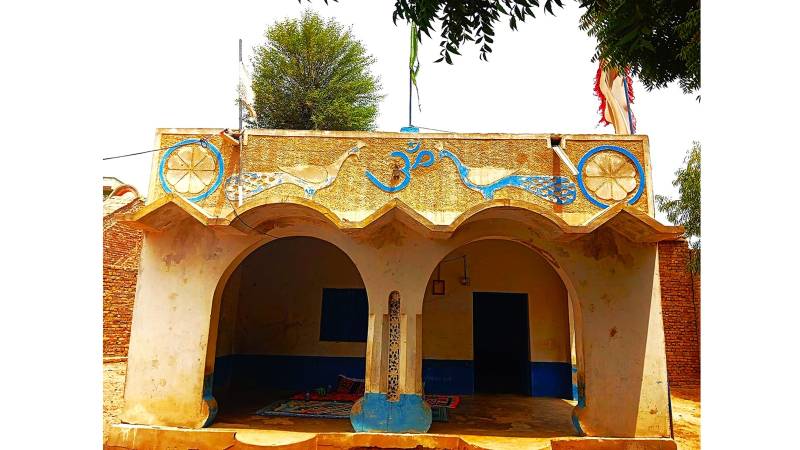
Now, these principles of mutual respect are weakened and often lost. Yet, they still endure somewhere, and case in point of Rama Pir Mandir at Bhit Shah. Last week, I had the opportunity to visit the Rama Pir Mandir in Bhit Shah, Matiari district—an old temple that locals instantly name when asked about the area’s Hindu heritage. I had requested Mr. Atta Muhammad Chopan to coordinate the visit, which he graciously did. Upon arrival. From a distance, the structure—which I had presumed would be a grand temple—was, surprisingly, a modest, one-room building. Its austere architecture instantly recalled the old Iqra schools established by the then Prime Minister Muhammad Khan Junejo. The most natural and refreshing sight, however, was a lush green neem tree standing majestically inside the compound, its leaves rustling gently. An occasional coo of a dove interrupted the mid-day cacophony of crows and sparrows.
Soon, Maharaj Sunil arrived. He welcomed us in the traditional way, offering us some sweets as a gesture of hospitality. He began by explaining the history of the place. The current temple, he noted, became particularly popular in the 1960s because it consciously welcomed all Hindu communities—the Bhel, Menghwar, Kolhi and Lohana.
“At first,” Maharaj Sunil reflected, “the Lohana community was hesitant to join. But then, we had a collective realisation. We all came under the bracket of a minority. Unity became our only option.”
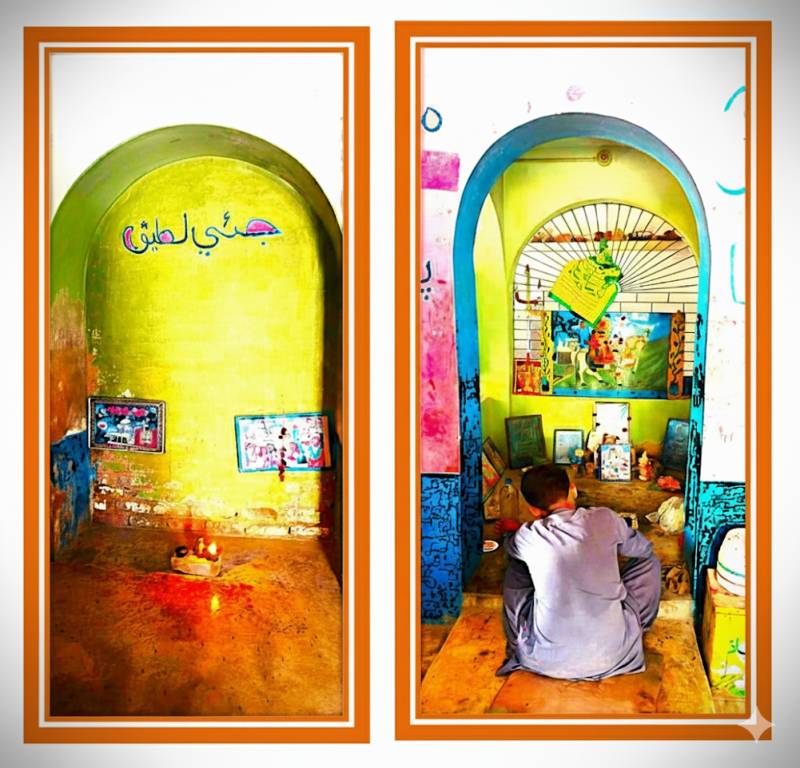
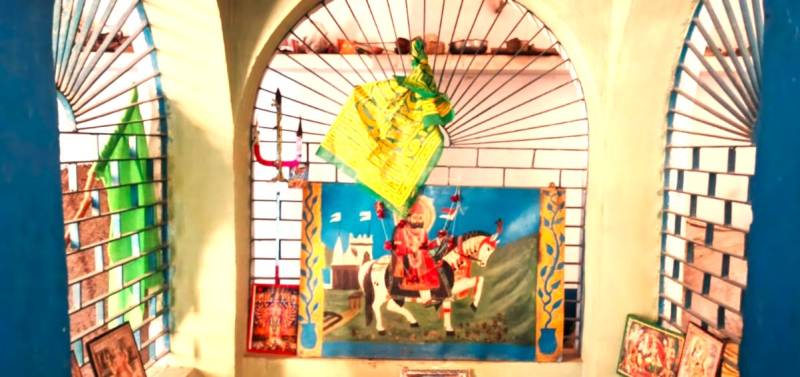
Maharaj Sunil then guided us to the temple itself, noting that its door was south facing. As we stepped inside, the immediate scene was a visual feast of typical religious items. However, the most striking element was the unexpected sight directly above the main idol of Rama Pir: a green embroidered cloth banner displaying the ‘four qul.’
“I have to admit,” I said, pointing towards the banner, “I am genuinely surprised to see the four qul here, what is the meaning behind this?”
Maharaj Sunil smiled and said: “You are not the first to ask, sahib.”
Before his reply, I offered my initial theory: “I had thought it might be strategically placed to deter thieves or intruders by suggesting an Islamic affiliation, a simple layer of security.”
“That is a very practical thought,” he conceded, “and perhaps there is some truth to that, given the times. But it is much deeper than security. This Mandir has always been a place of shared sanctity,” Maharaj Sunil explained. He emphasised that frequent visitors include Muslim women, particularly when seeking protection during the spread of illnesses like chickenpox or when praying for a sick child. They take some of the prasad and hang/decorate parr or a chadar bearing some scared words. For these women, the belief is simple: the Rama Pir Mandir, much like any respected Sufi dargah, possesses the spiritual power to alleviate their sufferings, particularly illness of their children.
Back in Hyderabad, studying my field notes and the pictures, the core question came into sharp focus: How will this inspiring Rama Pir Mandir at Bhit Shah retain its syncretism?
“We respect their belief entirely,” he added, “and we ensure that their respectful observances are retained.” He elaborated that the presence of the four qul—must be understood within this wider perspective of faith. “It is an acknowledgment that the power of protection and grace transcends the barrier between their faiths,” he concluded.
The conversation deepened with another remarkable practice: the religious ceremony performed in a dedicated place before the images of Shah Abdul Latif Bhitai. I immediately wondered aloud and couldn’t help but ask, “Why practice a ritual for Shah Abdul Latif? He is neither an avatar nor an idol, but only a poet, no doubt a great poet.”
He leaned forward. “Ah, sahib, that is where the stories of Sindh connect us.”
He then told me a story, one that resonated with similar tales I had heard in other temples connected with nani mata of Hinglaj. He recounted that, once, when a group of sadhus was on their way to receive the darshan of nani mata, and Shah Abdul Latif also accompanied them. After the caravan’s arrival nani mata refused to grant them her darshan. Recognising the difficulty, Shah Latif requested the sadhus’ permission to converse with nani. He was successful; nani mata relented and bestowed her grace upon the sadhus.
Maharaj Sunil concluded simply, “Because Shah Abdul Latif was so dear to nani mata, we have accepted and revere him as an avatar.”
This is an insightful observation regarding the interconnected tales found in the temples of the Larr area of Sindh, often serving as an oral tradition related or inspired to Sur Ramkali of Shah Abdul Latif Bhitai.
Before our departure, Maharaj Sunil clearly outlined two key challenges facing the temple, moving the conversation from the spiritual to the painfully practical.
“Our first challenge,” he began, “is that residents from nearby lanes are encroaching upon the temple’s plot. And the second is the general encroachment of the street leading to the temple.” He stressed that this narrowing of the public street severely affects accessibility, especially festivals – diyari Navaratri and satsang.
He then shared a crucial detail: Saeen Nazan Shah, belonging to the dargah of Shah Abdul Latif Bhitai, had been instrumental in the past, playing a helpful role in allocating this specific plot for the mandir’s construction. The irony was palpable: the temple owed its very physical existence to the intervention of a respected custodian of Bhitai’s dargah, yet it now battles encroaching neighbours, and most of them are devotees of Rama Pir.
Back in Hyderabad, studying my field notes and the pictures, the core question came into sharp focus: How will this inspiring Rama Pir Mandir at Bhit Shah retain its syncretism?
The sight of that Mandir makes a powerful statement that the faith we have is a plural phenomenon. But here is where the uncertainty lies: how can this local heritage of shared truth sustain itself? Can it withstand the relentless pressure of state-promoted orthodox Islam, or any project of Talibanisation and similar ideas?
I cannot fully see the future. I have only gathered the evidence and catalogued the present. Yet, I have witnessed one undeniable thing: this simple Mandir stands as a powerful symbol of hope. Perhaps, Rama Pir Mandir’s survival is the true subject that now defines the soul of Sindh.