

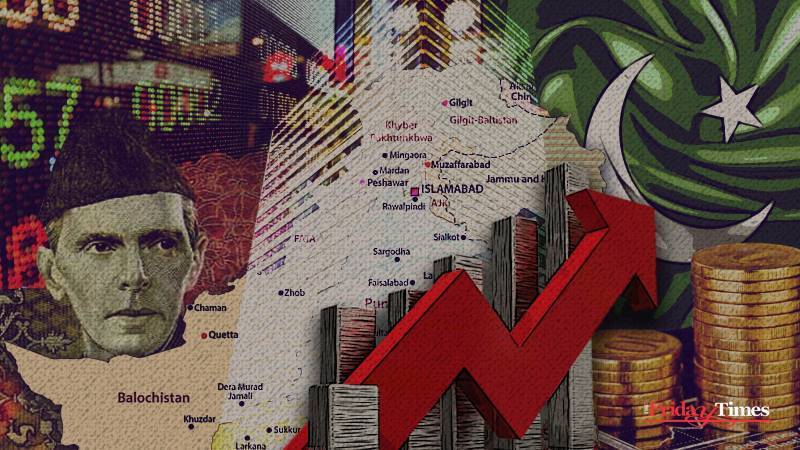
Pakistan’s economy has experienced many ups and downs. It has periods of growth, times of struggle, and phases of recovery. Agriculture, industry, trade, and services give the country a strong base to build on. However, problems within the economy, changes in world markets, and frequent shifts in government policies have often slowed progress.
In 2025, Pakistan’s economy will remain one of the largest in South Asia. Its GDP (based on purchasing power parity, PPP) is around $1.67 trillion. The nominal GDP estimate is somewhat in flux: for FY 2024-25, the provisional growth rate was 2.68 percent, up from 2.51 percent the year before. Some revised figures show growth of 3.04 percent for FY 2024-25. Because of the varying estimates, it is best to treat nominal GDP per capita numbers with caution.
The International Monetary Fund lists Pakistan’s projected real GDP growth for 2025 at around 2.7 percent. Inflation (consumer prices) is projected to be around 4.5 percent for 2025.
Agriculture remains one of Pakistan’s most important economic pillars. The country grows key crops like wheat, rice, sugarcane, and cotton, and many people, especially in rural areas, depend on farming for their livelihoods. But the sector faces problems such as old-fashioned farming methods, water shortages, and the impact of climate change. Floods, droughts, and changing rainfall patterns have affected crop yields. In FY 2024-25, the agriculture, forestry and fishing sector recorded modest growth of 0.56 percent, constrained by declines in major crops. Modernising the sector through better irrigation, improved seeds, and new technology could increase productivity. Agriculture also supports the textile industry, Pakistan’s biggest export sector, because cotton is a key raw material.
The industrial sector covers textiles, cement, pharmaceuticals, fertilisers, and a growing technology industry. The textile sector alone employs millions and earns a large share of export income. In FY 2024-25, the industrial sector rebounded with growth of 4.77 percent. However, energy shortages, old machinery, and high costs often make it hard to compete globally. The services sector, including banking, education, healthcare, retail, and tourism, has grown steadily; in FY 2024-25, services grew by 2.91 percent. Education and health are especially important for developing human capital, which drives long-term growth. The technology and IT services sector is also expanding, with rising software exports and many freelance professionals.
Inflation has been a persistent problem. Earlier double-digit rates moderated: for example, one report noted inflation projected at 4.6 percent for FY 2025. Although this is lower than the more extreme levels of recent years, it still affects family budgets, especially for low-income households. Higher utility prices make things worse. Even small increases in food, transport, or electricity costs can put real pressure on people with fixed incomes.
If Pakistan combines good economic management with public trust, it can achieve stable growth, raise living standards, and play a stronger role in the region
Foreign Direct Investment (FDI) plays an important role in creating jobs, transferring technology, and improving infrastructure. While specific up-to-date FDI figures for the full year are not all publicly sorted, the external account for July–April FY 2025 posted a current account surplus of $1.9 billion (versus a deficit previously). Major investors include China, Hong Kong, the UK, the US, and Singapore. But FDI remains inconsistent. To keep investors interested, Pakistan needs stable policies, clear regulations, and reliable infrastructure.
One of the biggest economic problems is Pakistan’s dependence on foreign borrowing. Repeated balance-of-payments crises have forced it to seek help from the International Monetary Fund and other lenders. These loans come with strict conditions, such as cutting subsidies, raising taxes, and reducing spending. These measures may strengthen the economy over time, but they often create short-term hardship for ordinary people. Pakistan’s tax-to-GDP ratio remains low, which limits public investment in roads, schools, hospitals, and other basic services. Many people and businesses remain outside the tax net, and efforts to expand it have been slow.
Energy shortages have long held back growth. While power generation has improved in recent years, problems in transmission, distribution, and bill collection remain. Circular debt, where unpaid bills build up and strain the sector, continues to be a major issue. Power cuts are less frequent than before, but they still happen during peak demand, affecting homes and businesses. Expanding renewable energy, such as solar and wind, could help meet future needs and reduce dependence on imported fuels.
Pakistan exports textiles, garments, leather goods, sports equipment, and agricultural products. It imports mainly machinery, petroleum, chemicals, and food. The gap between imports and exports puts constant pressure on foreign exchange reserves. Export growth faces obstacles like unstable trade policies, weak transport networks, and difficulties in meeting global quality standards. There is also untapped potential in regional trade, especially with neighbouring countries, but political and logistical issues have held this back.
Remittances from overseas Pakistanis provide a major source of foreign exchange. Millions of workers abroad, especially in the Gulf, Europe, and North America, send money home, supporting families with daily expenses, education, and healthcare. These remittances help reduce poverty but also highlight the shortage of good jobs within Pakistan. Creating more local employment could ease the need for so much labour migration.
The COVID-19 pandemic disrupted trade, reduced remittances, and put pressure on the healthcare system. Although Pakistan avoided the very high death rates seen elsewhere, the economic impact was severe. Daily wage earners, small businesses, and informal workers suffered the most. Recovery has been uneven: large industries bounced back more quickly, while small businesses and some services continue to struggle.
Looking to the future, Pakistan’s economic success will depend on key reforms. These include broadening the tax base so that more people and businesses contribute, improving governance to cut corruption and waste, investing in education and skills, raising productivity in agriculture and manufacturing, expanding exports to new markets, and attracting investment in technology, renewable energy, and infrastructure. Better regional trade could also bring major benefits through new trade routes, lower transport costs, and joint energy and infrastructure projects.
Pakistan has several strengths. Its young population offers a large workforce and growing consumer market (median age around mid-20s). Its strategic location makes it a natural trade hub between South Asia, Central Asia, and the Middle East. The rise of small businesses and tech start-ups shows the energy and creativity of its people. The country has also shown resilience in the face of natural disasters, security threats, and economic crises. Recovery has often been driven by public effort, private enterprise, and international support.
The key challenge is to maintain stability and consistent policy over time so that these strengths can fully develop. Quick fixes have rarely worked. What is needed is long-term planning and steady implementation. If Pakistan combines good economic management with public trust, it can achieve stable growth, raise living standards, and play a stronger role in the region. The road ahead will have challenges, but with a shared vision and serious reforms, real progress is possible.