

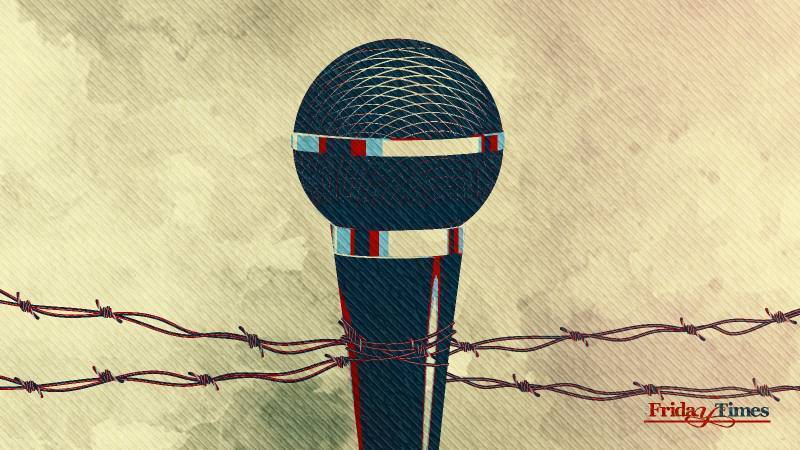
There are hundreds of channels operating in our country, but the media landscape of Pakistan is highly controlled by corporate powers and strict state rules. Even though the diverse number of media channels suggests free speech, it is misleading. The narratives are controlled by the media, which filter out public grievances and regional issues and create a false sense of harmony.
This continuous clampdown benefits the affluent at a significant “cost of consensus”, which leaves the public with a distorted sense of reality. The
Pakistani media was entirely state-controlled before 2002. When it was deregulated, it was seen as a major win for diverse perspectives to see the light and for promoting free speech. Unfortunately, it only replaced government monopoly with corporate oligopoly.
Now, only a few big media channels control the narrative; about 8 big media networks account for 69% of the viewership. This consolidation directs public perception. The statistics of big media groups’ viewership are as follows: 1- The Jang Group (27%), PTV (10.22%), ARY Group (10.06%), The Express Group (8.28%), Samaa Group (5.92%), Dunya Group (2.83%), The Dawn Group (1.79%).
The consolidation of media groups gives rise to conflicts of interest because these media groups own businesses such as banking, sugar, textiles, real estate, aviation and cement, and they try to protect their corporate goals over journalistic integrity.
These conglomerates use their media fronts to influence and pressure the government. For example, The Lakson Group owns Express News as well as Colgate-Palmolive. The Nishat Group owns MCB along with major textile and cement industries. The Jang/Geo Group, alongside media, also has a real estate business and a printing press.
The government often weaponises these corporate elites to suppress public criticism using regulatory bodies like PEMRA; it uses strict unwritten rules, such as “red lines”, to do so.
PEMRA is used as a political tool to ban former prime ministers or to control and block discussions regarding military and civil protests, and whoever fails to comply faces severe consequences such as fines, lower ratings, or even licence revocation. This approach keeps public views out of the public’s sight.
As media houses in Pakistan are reliant on government funding, they feel obligated to represent the government in a positive light, as the government is the dominant advertiser in the country.
Wealthy media owners mobilise their channels as protective shields for their businesses and to gain the favour of the government instead of reporting the truth
Successive governments have used their advertising budgets as strategic tools to control the news. They use a “reward and penalty system” to reward channels that portray a positive image of them and penalise those that are either aligned with the opposition or reflect public sentiment.
As we are witnessing a shift from traditional media to digital media, many laws are being created to control digital speech under laws such as PECA.
PECA was further amended in 2025, introducing even stricter provisions. For example, anyone spreading news that causes panic in the public or any fake news can be imprisoned for up to three years.
Moreover, departments such as SMPRA and NCCIA were created to monitor and delete online content that the government is uncomfortable with. The government also holds the power to block entire platforms such as X, YouTube, etc., as people in Pakistan have already experienced many times in recent years.
Journalism is considered a very unsafe profession in Pakistan. There were more than 230 incidents reported between early 2025 and 2026, where journalists were threatened, attacked, abducted or arrested.
Over the years, many activists have been arrested while advocating for different causes; no matter which party is ruling the country, the tactics of the government remain the same. A prominent example is the arrest of Imaan Mazari.
As a patriarchal society, the danger mostly falls upon women in the media industry. They are often attacked and harassed online. In 2025, many “deepfake” videos were created using artificial intelligence of journalists to ruin their reputations and as an attack on their credibility, and not just journalists, but women overall face problems while expressing themselves.
Moreover, a lot of women activists were arrested while advocating for women’s rights in a march with no clear context provided.
In many remote areas of Pakistan, especially Balochistan, journalists and local reporters have to hide or stay silent on matters and sensitive topics in order to survive.
In the past 20 years, over 40 journalists have lost their lives for speaking up or simply reporting. Moreover, many journalists, such as Matiullah Jan and Ahmed Farhad, were abducted by unknown persons in 2024 to scare them into silence.
In February 2024, it was revealed how the media truly works because on the day of the election, mobile internet was shut down in order to prevent people from sharing what was going on, and the flow of information was blocked by the government.
People turned towards digital media platforms such as TikTok and Instagram for independent news after they realised that mainstream media and television channels were being extremely biased and following the government’s lead.
It broke the illusion of “consensus” that the government was trying to portray. As a result, the government passed laws such as PECA in 2025 to control and monitor digital spaces as well.
Even though there are many news channels in Pakistan, free speech, in truth, is just an illusion because there is a mutual alliance of big powerful businesses, the military and politicians who control and filter what people need to hear and see.
Wealthy media owners mobilise their channels as protective shields for their businesses and to gain the favour of the government instead of reporting the truth.
The state promptly shuts down and silences the media or any broadcasting channel that steps out of line by implementing strict censorship laws, i.e. the 2025 PECA amendments, by discontinuing advertising budgets or by completely shutting down the internet.
This involuntary agreement creates an intense “cost of consensus”, meaning that when everyone is forced to repeat and display the same filtered pattern of truth, democracy bears the severe cost that comes with it.
This high cost comes with a constructed, false sense of rapport that has nothing to do with the real struggles that people face every day, completely erasing regional disparities and grievances and filtering out constructive and justified feedback regarding powerful establishments.
Due to these reasons, people are turning towards social media platforms such as TikTok and Instagram for unfiltered and unedited news, which has caused unrest in the government and led them to introduce even stricter digital rules and regulations to gain control of the narrative.
True media freedom will remain a fairytale until news channels are lawfully separated from business giants, an independent monitoring system is created, and opposing criticism and narratives are not suppressed or made punishable by law.
Until then, the diversity of choices shown on the media is just a wonderfully wrapped, calculated lie.