

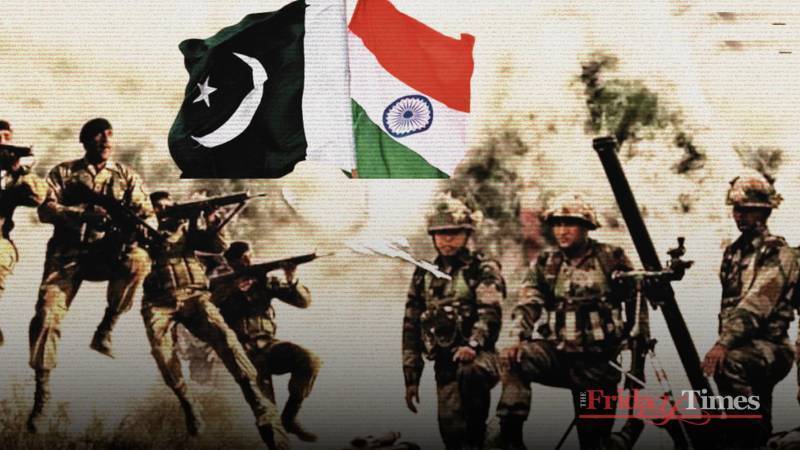
As we move ahead from the recent short war with India that plunged the region into crisis as two nuclear-armed states used their most recent conventional arms against the other, one needs to take a critical look at the situation ahead.
The failure of Indian strategy to establish (military) hegemony over Pakistan owes much to its hubris and the media’s hyper-nationalist hysteria asking for blood, as victory could be nothing short of cowing down Pakistan. In contrast, Pakistan came across as a more responsible player owing to the government’s defensive posture, the media’s relatively more professional, and people’s composed response. Further, Pakistan’s better performance in the air and tit-for-tat ground missile and drone response thwarting India’s hegemonic designs seemed to have provided a new lease of life and credibility to the current political dispensation dominated by the army with civilians as subservient partners.
However, the seriousness initially shown by the current rulers during this affair, has instead led to business as usual rather than using this opportunity to try to build a national consensus on critical issues facing the country. The extent of advertisements across the city congratulating the military and political leadership for “winningthe war”, and promoting the army chief to “field marshal” while providing an extension to the air chief, suggests that the latest Pak-India skirmish is being used for self-congratulation and self-promotion. This disregards the ground realities of the recent terror attack on the school bus in Balochistan and a drone attack in Waziristan, Khyber Pakhtunkhwa in which four children each were killed.
Strengthening the Security State does not augur well as our current insecurity and underdevelopment are actually an outcome of its continued unaccountability
Thus, let me chart here a few points of self-reflection, to allow for a more serious discussion. First, the hostilities and lack of normalisation between India and Pakistan hurt common people the most, as attested by the greatest damage of the current skirmish being borne by the people of Kashmir, who have long been pawns between the two nuclear-armed states. Further, it hurts the people of Pakistan much more than India because it entrenches the Security State led by unelected army generals. Thus, as even the so-called peaceniks argue for a greater share of the defense budget, it should be quite clear that this negates our progress, which is possible only if greater investments are made in industry and human development, and people’s elected representatives are able to chart the strategic direction of the country.
My position here is that the Modi government’s current muscular hegemonic regional designs are an outcome of the failure of multiple Pak-India peace initiatives since the late 1980s, many of which have been thwarted by Pakistan’s Security State. The outcome has been that India owing to its size continues on a growth trajectory, and the (international and economic) power differential between the two countries continues to grow leaving Pakistan with only bad or worse options. Pakistan’s time-tested way to counter India has been as a hard Security State leading to domestic underdevelopment and subservience to a world power that can provide military aid, suggesting a transition from being a frontline state for the American Empire to that of China in the near future. This paradigm has been disastrous for the people of Pakistan, as according to the Human Development Index, Pakistan now consistently ranks (168 out of 193) among sub-Saharan African or war-ravaged countries of the world, in contrast to South Asia where Bangladesh and India are far ahead at 130, and Sri Lanka at 89.
Two, Pak-India relations since the late 1980s have been characterised by proxy wars. Initially, it was Pakistan that used asymmetric warfare in Kashmir through jihadi proxies. Later, it was taken up by India, especially after the Mumbai bombings, targeting Balochistan and more recently even major cities in Pakistan. Thus, even if normalisation is a distant dream, it is in Pakistan’s interest to formulate an agreement on ending the proxy war as it is a losing battle for Pakistan. A much greater area of Pakistan is impacted by it as attested by the failure of CPEC owing to Baloch insurgency & Taliban-related violence as compared to India where Kashmir is but a peripheral area with no impact on a larger national economic trajectory.
Further, Pakistan’s Afghan policy since the 1990s and particularly after 2001 was also an outcome of a proxy war with India, where the Taliban were preferred to the Afghan National Government, leading to continued insecurity in Khyber Pakhtunkhwa. Security State’s misadventures of using non-state religious actors (jihadis) for these policy objectives have not just destroyed the cultural and religious fabric of the country but have also become an effective tool for domestic political control, as some Pakhtun scholars cynically term the current TTP resurgence as ‘controlled chaos’. It’s unfortunate, then that the choice of using a Quranic phrase for naming the operation inadvertently amounts to the militarisation of religion while terming the conflict with India in religious and thus existential terms.
In conclusion, strengthening the Security State does not augur well as our current insecurity and underdevelopment are actually an outcome of its continued unaccountability, leading to policy misadventures and treatment of people as subjects. Should one then rejoice at the opening up of X (Twitter), owing to the Security State’s interest in using its Pakistani subjects to counter Indian propaganda rather than accepting citizens’ constitutional rights and the court’s judgments?