

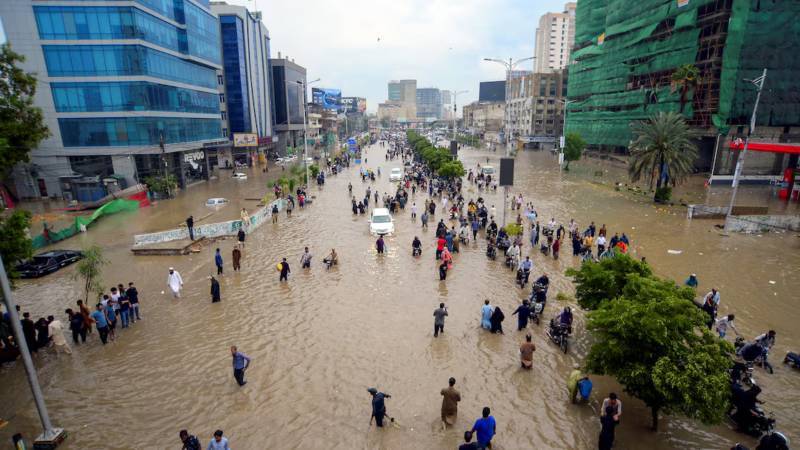
Same old story since childhood. On 19 August 2025, Karachi was pounded with 135 mm of rain, heavy but not a record like 2020’s downpour. A calm morning drizzle turned into a fierce 2 p.m. shower, and, like clockwork, the city plunged into chaos. From DHA to Machar Colony, Gulistan-e-Johar to Nazimabad, every neighbourhood drowned in its own flood. Shahrah-e-Faisal, the city’s main artery, was choked like a river, leaving students and workers stranded. Some sheltered with relatives, others in eateries and factories that opened their doors. Social media lit up with kindness, but the bitter truth remained: a few hours of rain can still shut Karachi down. Decades later, nothing has changed, and the rattled government’s only response was the usual public holiday and school closures.
Karachi’s Rain Crisis: A Coordination Catastrophe
Why does three hours of rain paralyse a megacity? Because Karachi’s drains can only handle 40 mm of rainfall, as Mayor Murtaza Wahab admits. Anything more, and the city drowns. Yesterday’s gridlock, flooded roads, and stranded citizens aren’t new; they’re symptoms of a man-made coordination catastrophe. Unlike Khyber Pakhtunkhwa’s cloudburst, glacier-melt floods or Punjab’s river-driven disasters, Karachi collapses after just a few hours of rain. The reason: fragmented control. The mayor governs barely 27% of the city; even Shahrah-e-Faisal splits into cantonment and federal land beyond his reach. How can one mayor take the blame for a city he doesn’t even control?
Politicians Point Fingers, Not Solutions
Instead of fixing this, politicians play the blame game. MQM-P demands Mayor Wahab’s resignation, ignoring their own alliance with PPP in Islamabad. The truth is, urban planning isn’t the mayor’s job—it lies with the Sindh Building Control Authority, under the PPP-led Sindh government. Here’s the irony: in Khyber Pakhtunkhwa, floods killed over 600 in Buner, yet no one asked the CM to resign. Why? Because in KP there’s no local government system, the CM owns the responsibility. At least Karachi has a mayor, who, despite limited powers, was out cleaning nullahs and directing KMC staff through the night before the next rain spell. Blaming him misses the point—it’s political rivalry, not problem-solving. What Karachi needs is all parties—PPP, MQM-P, PTI, and JI—to stop bickering and unite behind real solutions.
Rain should bring joy, not dread, but until Article 140-A is amended, S-III is completed, and elected local governments are truly empowered, we’ll remain stuck at a 40 mm limit
A City at Its Limit
Meanwhile, Karachiites are exhausted. They buy water from tankers, gas cylinders for stoves, and drive on broken roads without mass transit. K-Electric’s outages add to the misery. Rain only makes it worse, forcing shutdowns of businesses and schools. The Nursery furniture market drowned again, as its low-lying location collects runoff from higher areas. Kashmir Road faces the same gravity problem every monsoon. Whenever rainfall crosses 40 mm, nullahs backflow into neighbourhoods. This could have been fixed gradually. If drainage capacity had been boosted by even 10 mm a year for the last 17 years of PPP rule, Karachi would now withstand 210 mm of rain without flooding. Instead, every monsoon feels like a fresh punch to the gut.
The S-III Mess: Why Drains Don’t Work
At the root lies Karachi’s sewage disaster. The Greater Karachi Sewerage Plan (S-III), launched in 2013 with World Bank support, was supposed to fix it. The plan: treat wastewater from Lyari and Malir rivers so storm drains like Gujjar and Mehmoodabad could carry only rainwater to the sea. By law, untreated sewage cannot be dumped into the Arabian Sea, yet 460 MGD still flows there daily. Encroachments have forced sewage and rainwater into the same channels, so during downpours drains backflow, spewing filthy water onto streets. If S-III had been finished, drainage would be faster and cleaner. Instead, 13 years later, only 20% is done, costs have ballooned from PKR 8 billion to 48 billion, and political disputes have stalled it further. The new “completion date” of 2027 feels more like a mockery than a commitment.
Empower Local Fixes Now
This crisis isn’t unsolvable. The Orangi Pilot Project already proved local drainage fixes can work, so why not scale them up with stormwater dams, canals, or constructed wetlands? Instead, the NDMA, created after the 2005 earthquake, mostly issues warnings. PDMAs, under provincial CMs post-18th Amendment, operate loosely. And DDMAs, under unelected Deputy Commissioners, are dysfunctional. It’s absurd: the mayor battling floods has no authority over city planning, land control, or cantonment boards. Even the CM showing up on flooded roads for photo ops is just political theatre, not governance. Karachi’s drains need empowered local leaders, not bureaucrats.
Before the Next Rain Drowns Karachi
The fix starts with power. Amend Article 140-A to expand the mayor’s jurisdiction, give him authority over planning and landholding bodies, and establish a clear chain of command. So when he faces the cameras, he doesn’t need to say “not my area”, an excuse that’s unacceptable for a city of 30 million people. Global megacities like London and New York give mayors full control over infrastructure; Karachi should too. Rain should bring joy, not dread, but until Article 140-A is amended, S-III is completed, and elected local governments are truly empowered, we’ll remain stuck at a 40 mm limit.
Karachi fuels Pakistan’s economy, yet drowns in neglect. The real question is, how much longer will we accept a city that sinks every time it rains?