

A week ago, I playfully tapped the keyboard of my laptop and typed the word “Himalaya” in the Google search bar. In a similar whimsical mood, I added the word “books.” Immediately, a list of books related to the Himalayas came up. I glanced at the suggested titles. All of them fall into themes of adventure, mountaineering expeditions, spiritual journeys, and human ambition.
As I was reading, I held the cursor on one title: Himalaya: Adventures, Meditations, Life, edited by Ruskin Bond and Namita Gokhale. Instantly, I failed to understand why I was drawn to that specific title. But soon, I realized that Ruskin Bond’s name served as a powerful hook to connect memory to details of a 33-year-old story – perhaps it was of the year 1992. I was surprised that it was still so fresh, like an event from yesterday. Simply, Bond’s name pulled old memories of that event. I will be back soon to describe it.
I left my writing table and checked my piled notebooks for confirmation. I guessed correctly: it was the year 1992. In those days, I was associated with the National Rural Support Programme, but during the holidays, I, along with Rafiq Mangi, used to visit Professor Syed Zafar Hasan Shah. In those evening gatherings, say kacheries, our common topics were Sindhi language, nationalist politics and Sindhi and English literature.
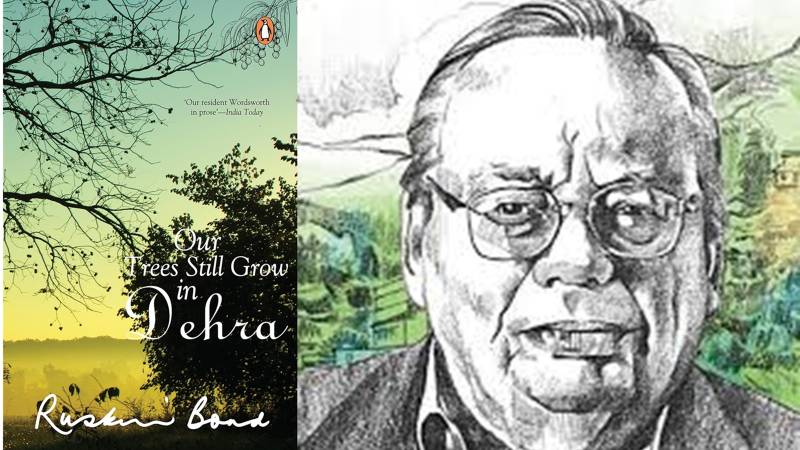
I recall correctly that one day, in the cool evening of February 1992, Syed Zafar Hasan told us that Mr Bond had won the Sahitya Akademi Award for his book, Our Trees Still Grow in Dehra. He elaborated that it was a collection of fourteen of his short stories. He asked, with the assumption that I must have read it: “Have you read it?” I didn’t reply, but I took a pause to figure out if Ruskin Bond and James Bond were two different people, or if they were one and the same.
Then, I rescued myself by finding a middle path and said: “I know Bond.” At that time, even today, while I write this write-up, I am not sure how Syed Zafar Hasan Shah took my response. However, he then told us that all the reviews of Mr Bond’s award-winning book so far were positive.
He shared some lines from a review aired on by the All India Radio: “All stories are based on Bond’s childhood memories and experiences growing up in the beautiful town of Dehradun,” he said. He added: “These stories revolved around his early childhood and his connection with nature. Bond’s descriptions are a nostalgic picture of the town. The book presents some anecdotes from Bond’s childhood, but Nature remains a dominant theme.” He called the book “an important document of Dehradun’s landscape." Sadly, Professor Zafar Hasan added, “this year, none of the Sindhi authors have won a Sahitya Akademi Award." At roughly 7:30 pm, we took our leave.
After the evening with Professor Shah, the very next day, I went to the Allama II Qazi Library, the central library of Sindh University, Jamshoro. Although I had left university, the junior staff members were my friends. They usually favoured me by issuing books to me under their names. I met with them, and as usual, succeeded in getting two books: The Room on the Roof (1956) and Vagrants in the Valley (1987). I was in the mood to get as many books as possible, but at the time, these two were the only titles available.
Around midday, I went to Badin, where I was posted. I read both books within three days. My notebook still bears witness to some of my thoughts about them. My entries mention that in The Room on the Roof, the author has created a fictional child character named Rusty, who learns how to cope with the challenges of life. He earns money by teaching English and eats unhealthy market food. The book, as I noted, is about values and friendship. “Agreed, it is a young person’s book," I wrote. "But it offers a certain freshness, or perhaps it is just different from the lot. Maybe Ruskin Bond (at that time) was also young and knows how to approach adults.”
Then came another entry about Vagrants in the Valley. The book, as I observed, connects with Rusty, who adventures through life and enjoys the company of his friend, Kishen. The book reveals the lead character’s restlessness in Bond’s typical style. Rusty moves on with new friendships, lives in new homes, and embarks on a journey of self-discovery in the beautiful hills. Somehow, it is a nostalgic, heart-warming sequel to The Room on the Roof.
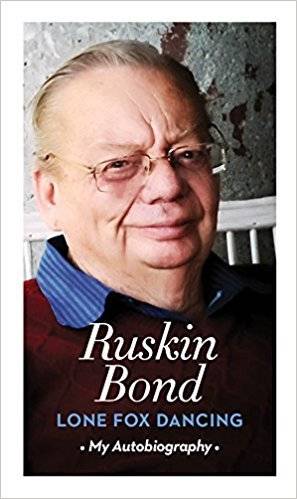
Soon, I forgot Himalaya: Adventures, Meditations, Life (edited by Ruskin Bond and Namita Gokhale.), and went on to search “Ruskin Bond memoirs or “autobiography,” and in a fraction of a second, Lone Fox Dancing: An Autobiography popped up. Immediately, I downloaded the free PDF version and read it. Like other autobiographies, Lone Fox Dancing offers a sense of the time and place of the author’s birth, his immediate environment, the influences that shaped him, and his relationships with family and school administrators. The entire book, in a sense, roams around his childhood experiences, imbued with a palpable sense of nostalgia and melancholy.
Ruskin Bond makes his life sound very easy-going. He mentions that his father taught English to the children of the Prince of Jamnagar. It is the southwestern city in the Indian state of Gujarat. As an infant, he was fond of JB Mangharam’s biscuit tins, which were decorated with scenes from Indian mythology. Thes biscuits were prepared and packed in Sukkur, Sindh, and distributed in the neighbouring states of India. Another early experience for him at Jamnagar was to roam the magnificent places and gardens of the Jam sahib, the Prince of the state.
Another persistent theme traced throughout the book is his bittersweet experience at his boarding school in Shimla. Before that, however, he fondly narrates his close association with his father, who was with the Royal Air Force. His father’s death made him feel lonely, and he found solace in reading books—a habit that ultimately destined his calling as a writer. He also mentions his time in London and his encounters with his mother and stepfather.
Authors like Bond, who write about the gentle rhythm of life in the hills, were not widely published in Pakistan. This created a profound gap in the literary experience of Pakistani readers
The most important section of the book, in my view, is the story of The Room on the Roof. One day, he received a letter from CR Mandy, an editor, who said his novel would be serialized in The Illustrated Weekly of India. While he was already a regular contributor of that newspaper and earned fifty rupees per story. Interestingly, the manuscript of the book was submitted to the London based publisher, but the publisher did not told Bond that his book had been published, and it is available in India as well. He commemorated the event in his journal, and it is now a part of the autobiography.
I have taken some sentences from his autobiography and paraphrased them in a report form; it reads: “Bond found himself standing before the National News Agency, Mussoorie. He asked Mr Gupta, the owner of the newspaper stand, for the latest Illustrated Weekly of India. The vendor, bewildered, asked what had brought him there so early. Bond responded that his novel was being serialized in the newspaper. Mr Gupta, still surprised, and then and there Bond purchased three copies. Bond immediately saw the first instalment of The Room on the Roof, in newspaper, it was a work that he had toiled on for a couple of years, and publisher of London kept it for couple of years.
Undoubtedly, both his fictional and real life revolve around Mussoorie. All his life events are anchored in hills, valleys, and streams. In his book, he mentions more than once the Sindhi Sweet Shop on the Mall, where he and his friends used to loiter and have a cheap lunch of puri-chhole. He also briefly mentions his father’s posting in Karachi. The book talks about the family he has since made his own. He has shown all phases of his life, both as a writer and as a person.
I found Lone Fox Dancing to be full of anecdotes, laughter, and wisdom. One can take away whatever one likes most. Bond writes: “A ‘real’ writer should be able to write anywhere—on board a ship, in a moving train, in a prison cell, in a hospital bed, in a five-star hotel room, or in a dingy attic.” These lines from Ruskin Bond are a powerful piece of advice. He also tells young writers, “I suppose if you keep at something for fifty or sixty years, you will have produced so much material—pictures or cuckoo clocks or monkey-caps or books—that people will begin to take notice. Perseverance does pay.”
I have an interest in history and Partition Studies, thus, I found the 1930s and 1940s sections of Lone Fox Dancing particularly interesting. These portions offer a different view, especially concerning English people who were interested in living in India after independence. The book also shades light on the socio-cultural issues faced by Anglo-Indian people. The book is an important read for students of history, Partition Studies. Surely, it has also appeal for scholars, who are interested in the pre- Partition and post- Partition socio-cultural lives of the English people and Anglo-Indians. Another part of the book that deserves to be highlighted is its cultural and environmental history of Shimla and Dehradun.
The Partition of 1947 created a cultural schism. Readers on this side of the world have borne the loss of access to the works of Ruskin Bond and other Indian English writers. Authors like Bond, who write about the gentle rhythm of life in the hills, were not widely published in Pakistan. This created a profound gap in the literary experience of Pakistani readers, who were cut off from a body of work that celebrated a shared subcontinent’s natural beauty. As a result, generations of readers in Pakistan have missed the opportunity to connect with a literary voice that speaks to a shared heritage, seeing it instead as the literature of “Other” rather than a continuation of a shared past.
But thanks to IT, Internet, technology-based social platforms, and the English language, the gaps have are being bridged, and we can access the writings of authors on both sides of Radcliffe’s drawn line.