

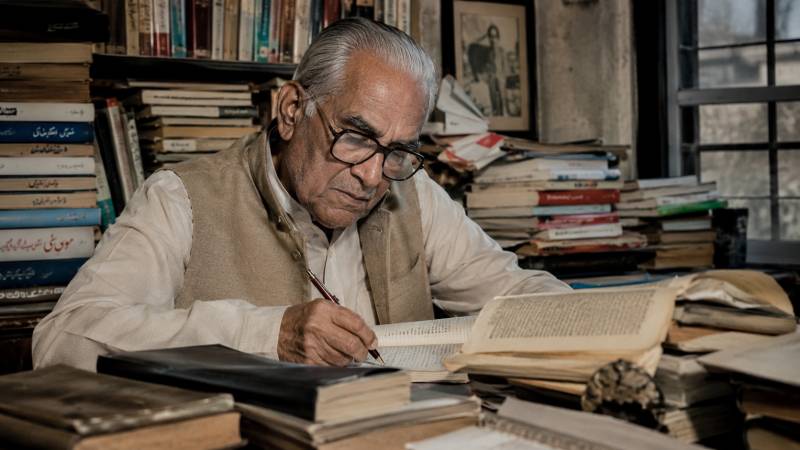
What a man of wonderful calibre and bearing, knowledge and wisdom, Rahimdad was. He was an authentic historian, a distinguished author, and an indefatigable wanderer in the pursuit of scholarly excellence and literary acumen. — Mir Ghous Bukhsh Bizenjo
Rahimdad Brohi, famous by his nom de plume, Moulai Sheedai, in Sindh (1894–1978), was a widely recognised historian, researcher, and prolific writer from Sukkur. He belonged to the Mengal tribe of Brohis. He served his land for over half a century, leaving behind a rich literary legacy comprising a large number of books and essays covering the historical, cultural and economic evolution of Sindh, illustrating it as the proud seat of the Indus civilisation.
His books on Sindh include: The History of Sindh (Janat-ul-Sindh), The History of the Civilisation of Sindh (Tarikh-e-Tamadun-e-Sindh), The History of the Musavis (Musavian ji Tarikh), The History of Sukkur (Tarikh-e-Sukkur), The History of the Khaskhelis (Tarikh-e-Khaskheli), The History of the Economy and Trade of Sindh (Sindh ji Iqtasadi, Tijarati Tarikh), The History of the Talpurs (Tarikh-e-Talpur), and The Old Cities of Sindh (Sindh ja Qadeem Shahar).
He also wrote The History of Balochistan, The History of the Mengals, and The History of Islam, apart from leaving behind a treasure trove of unpublished articles and essays, some of which his grandson, Amir Ali Mengal, has traced and published as part of his grandfather's legacy. He still possesses unpublished manuscripts. Many of his books have gone out of print and need to be reprinted to meet the academic and research requirements of the new generation. We should compile a list of the books that have already gone out of print or are close to disappearing from the bookshelves for reprinting.
Many years ago, I accidentally found one of his books on the history of the Mengals, their tribal notables, their role in establishing and consolidating the Khanate of Kalat, and their resistance to the incursions of British imperialists into Balochistan. He described their battles in minute detail, based on proper references. I was simply awestruck by his years of hard work in separating fact from myth before committing it to paper. This kind of writing is not a luxury. It is hard and exacting labour, made easier only by a deep attachment to the pen and paper.
A friend from the literary and intellectual circles of Balochistan confided in me that Mir Gul Khan Nasir, a renowned scholar of history, had extensively benefited from the research of Moulai Sheedai while completing his two-volume history of Balochistan. This is a great tribute to the scholarly pursuits of Moulai Sheedai.
Some Sindhi literary giants, intellectuals and writers, who are familiar with the delicacy of the Sindhi language as well as the history of Sindh, the literary and intellectual works of Moulai Sheedai, and those of his contemporaries and successors, have all praised the unparalleled dedication of Moulai Sheedai in producing such monumental treatises on the historical and cultural trajectory of Sindh.
The Government of Sindh, as a tribute to these great men, should issue directives to the Sindh Book Foundation and the Sindhi Adabi Board to preserve the intellectual heritage of these iconic sons of Sindh for posterity
While going through his books, one feels the power of his written words and unfailingly travels with his episodic descriptions of the political and economic evolutionary phases through which this land has passed over the centuries. His words, drenched in the scent of patriotism and commitment, settle deep within our souls, reflecting the abiding bond Moulai Sheedai had with his chosen subject, Sindh, and the people who have inhabited it for millennia.
Sindh was his ancestral land, stretching from Kashmore to Karachi—indivisible and a monolithic symbol of motherhood, affection, and spiritual and physical sustenance, with his soul whispering in harmony with the soft and lyrical waves of the River Indus.
I have read somewhere that he used to become completely absorbed while writing the history of Sindh. His monumental treatises on the history of the Talpurs, the Khaskhelis and the Mengals were the product of this ecstasy, his romance with and love for the soil of Sindh, which flowed through his veins throughout his life and kept him restless to sketch the kind, generous and expressive face of Sindh by removing the obscuring dust from the mirror of history.
Sindh has absorbed Saracens from the Arabian Peninsula, Mughals, Begs, Akhunds and Mirzas from the Caucasian regions, Pathans, Brohis and Baloch from Balochistan and Afghanistan. This migration to Sindh has been a constant feature of its history and culture, and has gone a long way towards strengthening its cultural and social architecture rather than weakening it.
Unfortunately, the intellectual labour of this iconic son of Sindh has received scant attention from Sindh's new literary and intellectual generation. What I have painfully observed is that this generation of intellectuals and literary figures has become more introverted and more absorbed in self-projection instead of feeling privileged to connect with the rich intellectual heritage of their land. The invaluable books written by the stalwarts of an earlier generation, after painstaking research, are rarely available on bookshelves. The Government of Sindh (GoS) has never paid attention to the most vital task of preserving the intellectual legacy of the earlier generation of Sindhi authors.
The Sindh Book Foundation or the Sindhi Adabi Board could compile a list of books on the vitally important subjects related to the political, cultural and economic history of Sindh that need to be reprinted. The sense of responsibility for this important national task is even more lacking at the federal level, which is unfortunate.
A former President of the United States is traditionally expected to write memoirs for posterity and establish a Presidential Library in his name at a place of his choice. All recent Presidents of the United States have done so. President Barack Obama inaugurated his library a few days ago in Chicago, with his predecessors and successors in attendance. Our politicians and rulers prefer to go to their graves with their memoirs.
The civil awards of Pakistan have been doled out to every Tom, Dick and Harry. The literary and cultural annals of Sindh have been emblazoned with the names of iconic intellectuals, writers, poets and artists. Among these stalwarts, we have humble and unassuming heroes from the Brohi community, including Moulai Sheedai, Abdul Haleem, Ahmed Ali and Allama Jauhar. Our local media should not only recognise their services to Sindh in literature and authorship but also highlight the significance of their work from the historical, cultural and literary perspectives of Sindh.
The Government of Sindh, as a tribute to these great men, should issue directives to the Sindh Book Foundation and the Sindhi Adabi Board to preserve the intellectual heritage of these iconic sons of Sindh for posterity. We have a growing youth population. We could build their intellectual capacity by establishing libraries in our towns and cities. I may remind the Pakistan Peoples Party (PPP) of the National Book Centres established by the senior Bhutto in every town and city.
We are planning to hold a seminar on 9 July 2026 on Moulai Sheedai to sensitise those who matter in society to their responsibility towards the literary heritage of our dear land. Let us be different from others as far as our intellectual and cultural landscape is concerned.